A Conservation Success Story for the Pheasant-tailed Jacana, Adding Another Conservation Example to Sustainable Agriculture
Pheasant-tailed jacana conservation in Tainan City once made headlines when a mass die-off was reported after farmers changed their sowing methods. Over the past few years, through the efforts of the Tainan City Government and the Conservation Division of the Forestry Bureau under the Council of Agriculture, the most recent report from the Wildlife Conservation Advisory Committee showed that in surveys conducted from late last year to early this year, not only did the number of pheasant-tailed jacanas rise to 485, but deaths fell from 51 the previous year to 5, a remarkable conservation result that won unanimous recognition from the Wildlife Conservation Advisory Committee, adding yet another success story to Taiwan's conservation governance model.
Since the mass die-off of pheasant-tailed jacanas in 2010 shocked Taiwanese society, the Chinese Wild Bird Federation, the Tainan City Government and the Council of Agriculture immediately stepped in to investigate, finding that the deaths were caused by the birds accidentally eating poisoned seedlings. It turned out that farmers, in order to cut costs and reduce bird and rodent damage, had switched from transplanting rice seedlings to direct seeding with pesticide-treated seedlings, causing indirect harm to the jacanas.
Weng Rong-xuan, director of the Tainan Pheasant-tailed Jacana Ecological Education Park, said that the period from late December to late January each year is the rice sowing season after the water caltrop harvest, and also the peak period for jacana poisoning deaths in recent years. Surveys of the areas with concentrated deaths found they were located on the east and west sides of the park. The first survey (late 2009 to early 2010) found a total of 85 birds dead from accidentally eating poisoned seedlings; last year (late 2010 to early 2011), a full census counted 399 birds, with 51 deaths; this year (late 2011 to early 2012), a full census counted 485 birds, with 5 deaths.
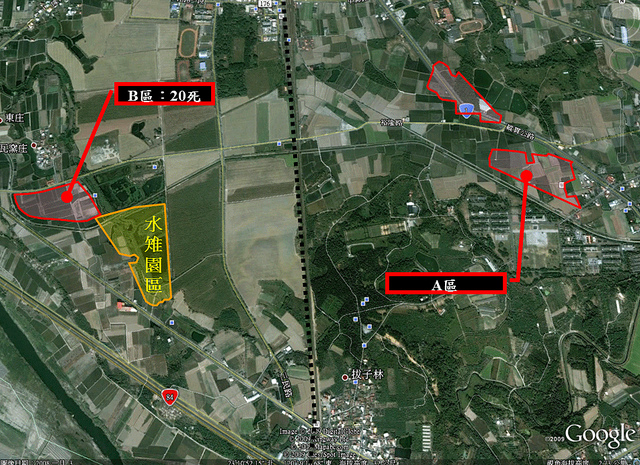

Although the subsidized farmers still practice conventional farming, the Tse-Xin Organic Agriculture Foundation has carried on last year's spirit of the Green Conservation Label, continuing to encourage and invite farmers to adopt organic production. Su Mu-rong said that currently 8 or 9 rice farmers have joined, the first rice crop is being harvested, and it is expected to hit the market in July or August; consumers can now pre-order the first batch of Green Conservation Label rice through the foundation.
"It would be best if farmers could profit from their production without relying on subsidies." Su Mu-rong pointed to the role consumers play in conservation, saying that supporting and buying agricultural products with the Green Conservation Label is the best recognition.
Of the Green Conservation Label water caltrop launched last year, more than 1000 jin sold online (about 25% of total output) and the entire stock at the Leezen retail channel sold out. Su Mu-rong said many consumers came specifically for the conservation label, and many also returned to ask about it, but the sold-out water caltrop will not be available again until September this year.
The Council of Agriculture's subsidy to the Tainan City Government for rewards during the jacana breeding season has in recent years reduced risks during that period; farmers avoid nest sites when spraying pesticides, and chicks hatch in every nest. The Tainan City Government will continue to promote this. Li Wan-ying, section chief of the Conservation Section of the Agriculture Bureau, also said the city government believes that maintaining adequate water sources and preserving aquatic plant habitats, so that jacanas stay in the park as much as possible and avoid foraging in surrounding farmland, is the way to solve the problem of jacanas dying from accidental poisoning. Last year, under the active promotion of Mayor Lai Ching-te, 1.6 million in funding was allocated, and Well No. 15 of Taiwan Sugar Corporation near the park was repaired, solving the water source problem.
This conservation success brought together NGO groups including the Tainan Wild Bird Society and the Tse-Xin Organic Agriculture Foundation, farmers, and local and central authorities, while the public can also take part in jacana conservation through their purchases, making it yet another example of collaborative governance. Guan Li-hao, head of the Conservation Division of the Forestry Bureau, expressed thanks for the public's support and efforts, saying conservation cannot rely on the government alone. He also noted that conservation work must constantly embrace new ideas, absorb overseas knowledge and integrate it with local experience, turning it into feasible action plans, which is also the reason this conservation effort succeeded.
[Guantian Pheasant-tailed Jacana Conservation Record]
- Tainan spends big on jacana conservation, farming methods are key
- Water caltrop can also be conservation-friendly, jacanas no longer die for food
※ Also published on Environmental Information Center