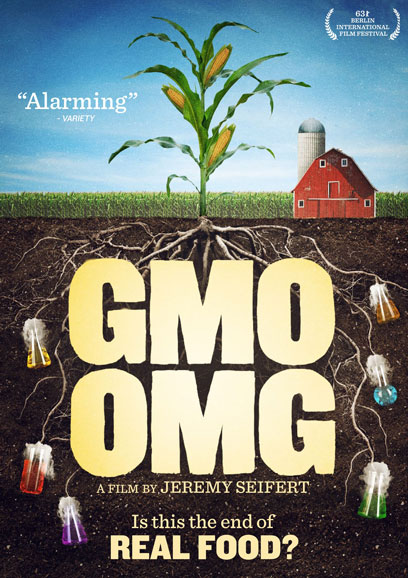
A Journey to Solve the Mystery of Genetically Modified Food: Parents and Children Read GMOOMG Together
Text | Chen Ju-wei
Author's note: In July 2014, the Taiwan GMO-free Promotion Alliance exclusively obtained the screening rights for the film "GMO OMG" (Chinese title: GMO? Good Heavens!) and launched a two-year touring screening program in Taiwan, China. I was fortunate enough to serve as an executive staff member and sharer during the first half year of this program. I have probably watched this film more than fifty times (absolutely no exaggeration~~) (laughs). Honestly, it is a very interesting and relaxing documentary, and every time I watch it I discover something new and have new thoughts. If you are interested in this film, you are welcome to email [email protected] to inquire about application matters. We and the Taiwan GMO-free Promotion Alliance will both enthusiastically support you!
"Have you ever heard of GMO (Genetic Modified Organism)?" "I don't know what that is? Don't ask me!" "Can you eat it?" "What?" "Does it taste good?" "Is it like beef or chicken?" "Do chickens eat GMOs?" "I heard there are strawberries with fish genes, is that it?"... This string of questions and astonishment from the people interviewed in the film officially opens the prologue of "GMO OMG."
It is just too absurd. Every time I watch it I find it unbelievable, and the audience below often bursts into waves of laughter. Of course, director Jeremy Seifert exclaims even more: My God, how can we be so completely ignorant!
What are GMOs? What impact do they have on human health? Will the US government check things for the public? What do scientists or farmers think about GM crops? Holding this string of questions, Jeremy Seifert takes his family around to investigate and interview. In the process of seeking answers, however, he generates even more questions.
Finn, the director's eldest son, learned the letters on seed exchange catalogs starting at age 3. He is now 6 years old, and has spent half his life collecting seeds. He finds it utterly magical that planting a seed can produce even more seeds.
GM crops mainly fall into two categories: herbicide-resistant and insect-resistant. For example, through genetic engineering technology, corn can be made to produce insecticide to repel pests, or soybeans can be made tolerant to herbicides so that even more pesticide can be sprayed. The vast majority of these GM technologies and seeds are controlled by six major multinational agricultural corporations: Monsanto, Syngenta, Dow, Bayer, DuPont and BASF.
On the other side of the world, farmers in Haiti burned Monsanto seeds donated by the United States, because these seeds not only can be planted only once, but will ultimately cost them their food sovereignty, the sacredness of their land, and their culture and way of life. Not only Haiti, but people in many countries around the world, including Europe, India and Mexico, have stood up to oppose GM seeds. The global seed vault in Svalbard, Norway, stores about 700,000 seed varieties from around the world in a storage chamber 135 m beneath the mountain at minus fifteen to twenty degrees, in order to prevent species extinction, because the most important factor sustaining human life comes from these diverse seeds.
But who gets to decide whether GM crops are safe? The three-month experiment report claiming safety submitted by Monsanto, the company that developed GM seeds, or the two-year paper published by French scholar Gilles-Eric Seralini and his research team, pointing out that the toxicity of GM corn and Roundup residues has a significant impact on the health and lifespan of rats?
Before the controversy has subsided, GM soybean and corn products have already flooded our modern lives, and finding food without GM ingredients seems to have become a difficult task. If it is not organic milk, then it is very likely produced by dairy cows fed GM soybeans or corn feed. Of course, that ice cream in your hand would then be classified as containing GM ingredients. If the sugar in a food is labeled high-fructose syrup, congratulations, that too is refined from GM corn. Even the trout feed in Redwood National Park, where director Jeremy Seifert takes his children for vacation and leisure, contains GM soybeans!
Should GM foods be labeled or not? The film uses animation to clearly show how Michael R. Taylor successfully used the US revolving door provision to move between the US Food and Drug Administration (FDA) and Monsanto, becoming a greedy corporate agent who influences the direction of US GMO policy. Under clever manipulation by politics and business, the FDA treats GM foods as substantially equivalent to ordinary foods and therefore does not require labeling. Does this conclusion come from detailed scientific evidence, or from Monsanto pulling the strings behind food safety policy?
If foods are not labeled for GMOs, how can the public's right to know about their food be protected? Many states in the United States are now rising up in opposition, striving to propose legislation requiring labeling of GM foods. In Taiwan, China, a new GM food labeling system officially took effect on July 1 this year. In addition to the original packaged foods, it also includes bulk foods, food additives and highly processed products such as soy sauce. Starting January 1 next year, labeling will be fully implemented, and from then on Taiwan, China's GM food labeling and management will have taken another big step forward.
Through the unraveling of clues in "GMO OMG," we follow this father who loves his children and embark on a globalized food roots journey that lifts the veil on GMOs in everyday diet. To borrow what one visual artist said after watching this film:
This is basically a parent-child road trip movie!