The economy is not just GDP. Indian scholar Kumar asked President Ma: Do you even understand what the economy is?
Satish Kumar, founder of Schumacher College in the UK, came to the NTU College of Law on Wednesday to give a talk titled "Sustainable Small Is Beautiful." He once walked across Pakistan, Moscow, Paris, and Tokyo to promote the idea of peace and nonviolence, and this time he also made a special trip to the Legislative Yuan to show support for the people opposing the cross-strait service trade agreement. In his view, the economy is not just GDP; the soil, rivers, forests, and homes on Earth are all part of the economy. Taiwan has its own characteristics, and it should not just make more computers and cars to sell to China. "President Ma, do you understand what the economy is?"
Forests, rivers, and land are all part of economics
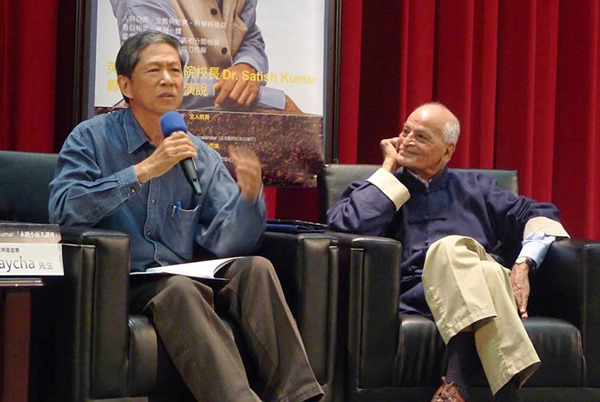
Schumacher College in the UK is world-renowned for its holistic education in academics, art, and the environment. Its founder, Satish Kumar, was invited by the Wutong Environmental Integration Foundation and the Green Front Alliance, and on Wednesday joined Daycha, executive director of Thailand's Khao Kwan Foundation (KKF), Taiwanese scholar Peng Ming-hui, and Ye Jun-rong, chair professor at the NTU College of Law, at the "Sustainable Small Is Beautiful" forum, which attracted over a hundred people.
Satish Kumar has long focused on environmental and economic issues. Once, when he went to speak at the London School of Economics in the UK, as soon as he arrived on campus he asked, "Do you have a college of ecology here?" The reception staff, bewildered, answered no. "Then the economics you teach has only one dimension!" Kumar said that the English word Economics comes from Greek, meaning household, house; the whole Earth is home, and the essence of economics is how to let all species live in harmony.
Kumar believes that many people look at the economy and focus only on GDP, factories, and production, but the economy includes all homes on Earth: forests, rivers, land, animals, and mountains. Yet many people have only a partial understanding of what they are supposed to manage, which is worse than not knowing at all, like eating rice but not knowing how to cook it. "No wonder there is a global economic crisis."
Peng Ming-hui also believes that Taiwan's way of looking at things is too narrow. Poor economic development is not because GDP is too low, but because distribution is unequal. "Today's GDP is 10 times what it was when I was a child, but the suffering is also 10 times greater." Economic development is only a means; we should ask what our social development goal is.
As for the Taiwanese government's repeated emphasis that only by signing the cross-strait service trade agreement can the economy be boosted, Kumar directly asked Ma Ying-jeou in return: "Do you understand what the economy is? (Do you understand?)" Developing the economy is not about making more computers and cars for China; these items account for only 10% of the economy or less. Although it was his first visit to Taiwan, he deeply felt its small-but-beautiful character here, and Taiwan should find its own economic model. His brilliant analysis drew cheers and constant applause from the audience.

Walking 8,000 miles, a vow of nonviolence against nuclear weapons
Seeing people stand up against the cross-strait service trade agreement, Kumar also shared his own idea of nonviolence. At age 20, without carrying a single cent, he walked 8,000 miles from India to Moscow, Paris, London, and Washington, the four major nuclear weapons centers, to convey his anti-nuclear views to the leaders of the four countries.
When friends saw him off in India, they specially gave him food and money, but he not only took not a single cent, he even refused the food, because he believed that carrying food was a sign of distrust toward local people. On this peace journey, he moved forward with optimism the whole way. If no one shared food, he treated it as a one-day fast; if there was nowhere to sleep, he simply lay down in nature's starry-sky hotel. "Violence cannot bring true peace; peace begins with trust, and war begins with fear."
On this visit to Taiwan, Kumar specially took time to enter the Legislative Yuan chamber and give a speech on nonviolent resistance in support of the students. In his Wednesday talk, he again reminded people that resistance is not against individuals such as Ma Ying-jeou or Jiang Yi-huah, but against the entire system. "If you do not accept it, you must stand up and resist to fight for your own rights." Laws are revised by people and reflect the social culture of the time; if they are unfair and unjust, of course they can be changed. "Nonviolent resistance is not something cowards can do." He encouraged everyone to think positively. If someone disagrees, practice explaining your beliefs clearly and use the power of public opinion to influence the system.