Red Dragon Fruit Production Surged Without Collapsing Thanks to Typhoons: Is Export the Next Stop?
Erlin in Changhua was once Taiwan's largest wine grape producing area, but now what climbs on the trellises is no longer grape vines, but the thick leaves of red dragon fruit. Over five years, Taiwan's red dragon fruit production increased by a full 1,000 hectares. The Agriculture and Food Agency estimated last July that 2015 production would rise another 18%, and urged farmers to switch to other crops. For the past three or four years, voices questioning whether red dragon fruit would collapse have never stopped, yet last year the average price still reached NT$50 per kilogram, about the same as the year before. Ironically, the driving force behind saving the red dragon fruit industry turned out to be two typhoons.
Typhoons Damaged Other Fruits, Red Dragon Fruit Filled the Market Gap
Every year from July to September is the peak season for red dragon fruit. According to data from the Agricultural Products Trading Market Information Station, last year red dragon fruit (red-fleshed) surged in volume, with July trading volume reaching 2,088 metric tons, nearly double that of 2014, and the average price per kilogram falling 40% to NT$30.4, while the cost of cultivation alone was at least NT$21.
Just when many people thought the predicted collapse was about to come true, the price of dragon fruit rebounded sharply to NT$47.5 in August, and prices at Taipei First and Second Markets both broke NT$50, slapping the naysayers in the face. The key was Typhoon Soudelor, which arrived on August 8. The same scenario played out in September: Typhoon Dujuan struck on September 28. Late-season red dragon fruit was already not cheap, and the typhoon pushed prices even higher. In October, the average price per kilogram was nearly NT$60, and the market even saw a sky-high price of NT$100 for a single fruit.
The good price of red dragon fruit was not entirely due to typhoon damage reducing production. In fact, compared with the same period, even with disaster losses, red dragon fruit trading volume was still nearly double that of the previous year. The key factor in preventing a collapse was that other fruits were almost completely wiped out by typhoons. Chen Meng-sung, assistant researcher at the Taichung District Agricultural Research and Extension Station, explained that compared with other fruits, red dragon fruit recovers very quickly from disaster damage, needing only about one month to flower and fruit again, filling the fruit shortage after the typhoon.
Weng Chen-hsin, head of the Crop Production Section of the Agriculture and Food Agency, said that every September there is already very little fruit, roughly only pomelo, persimmon and pear, but last year Typhoon Soudelor severely damaged many pomelos, and red dragon fruit happened to fill the gap.
Farmers: The Planted Area Really Is Large, Over 3,000 Hectares Across Taiwan
These accounts were also confirmed by farmers. Hsu Hui-ping, chairperson of the Changhua Yuandou Fruit and Vegetable Production Cooperative in Erlin, said that last year typhoons knocked off about three batches of red dragon fruit, but the fourth and fifth batches were fine. By contrast, mango, grape, longan and lychee all saw reduced production at the time, and it happened to coincide with the grand worship of the Ghost Festival in the seventh lunar month; red dragon fruit's pleasing color made it suitable for offering tables, so "the price was good, so everyone just kept planting."
He admitted that in previous years he also worried about a collapse and tried to persuade farmers not to plant more, but because prices in recent years had been fairly good, there was nothing he could say. However, because the planted area really was very large, he still did not encourage farmers to get into it.
According to Council of Agriculture statistics, last year Taiwan's red dragon fruit area was about 1,812 hectares, with an average price of NT$53.5 per kilogram; the year before it was about 1,675 hectares, with an average price of NT$54.3. After observing for a while, many farmers found that red dragon fruit still had not collapsed, and they rushed to plant it. The Council of Agriculture estimates that this year the area will exceed 2,000 hectares.
Hung Ching-yuan, head of the first red dragon fruit production and marketing group in Waipu District, Taichung, said even more bluntly that the actual figure far exceeds that. Because red dragon fruit is easy to grow and easy to sell, many farmers who got into it in recent years did not join production and marketing groups and are outside the Council of Agriculture's survey scope. The actual planted volume should be increased by about 1,000 hectares. In other words, Taiwan's total red dragon fruit area may now already exceed 3,000 hectares.
Bad Weather in 2016, Red Dragon Fruit Continues to Dominate
Last year red dragon fruit escaped the fate of collapse, and this year the heavens were still kind to it. Weng Chen-hsin said that March is the season when fruit trees such as mango, longan, lychee and pomelo bloom and pollinate, but it encountered continuous heavy rain, so the harvest may be affected, and red dragon fruit may again fill the gap. In addition, many farmers use lighting at night to advance or delay the red dragon fruit season, which should keep prices fairly good.
One agricultural official even admitted privately, "Thank goodness for dragon fruit!" Otherwise, this summer's fruit shortage and high prices would have drawn public complaints again.
But exactly how much demand there is for Taiwan's red dragon fruit, the Council of Agriculture has no precise figure. When this dangerous balance of relying on the weather will break down, no one can say for sure. Developing exports is the agricultural authorities' next strategy, but there are still many problems that urgently need to be overcome.
The Next Step for Taiwan's Red Dragon Fruit: Export?
Red dragon fruit area increased by 1,000 hectares in five years. In the past two years, due to extreme climate, prices rose instead of falling, but many farmers who prepared ahead had already opened up new paths separately through exports and domestic demand.
According to customs data, Taiwan's red dragon fruit first had export records in 2010, at about 176 kilograms, and last year it was already close to 15,000 kilograms. China accounted for 90%, with an average unit price of NT$81 per kilogram, mostly red-fleshed. The highest unit price was in Japan, at NT$227 per kilogram, all white-fleshed, but export volume was not large, only about 1,000 kilograms in the most recent two years, and even zero in 2013.
Taiwan's biggest competitor is Vietnam. Chen Meng-sung, assistant researcher at the Taichung District Agricultural Research and Extension Station, once went to Vietnam and Japan to study red dragon fruit, and found that Vietnamese red dragon fruit has dense branches and leaves, and the hot and humid climate makes it prone to stem canker disease, so it relies heavily on chemicals. Taiwanese farmers know how to prune branches, and can even achieve completely pesticide-free cultivation, which is the biggest advantage for exports.
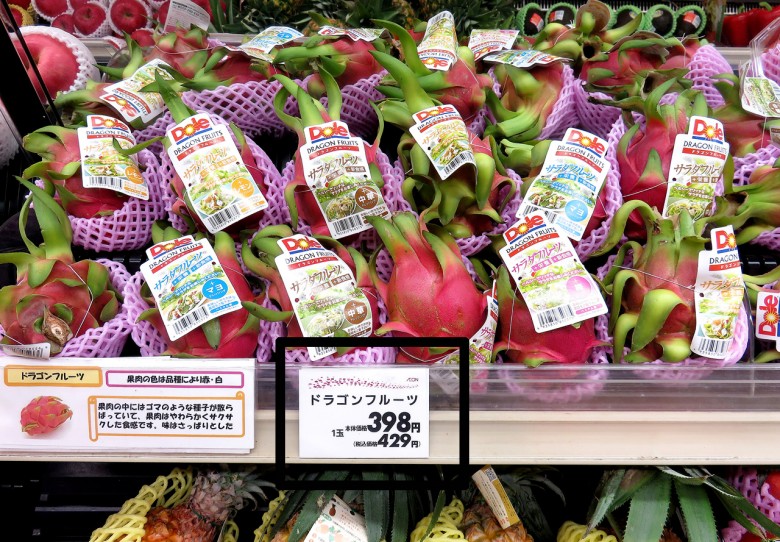
But this advantage is not obvious for white-fleshed red dragon fruit. Japanese merchants once told Chen Meng-sung that after quarantine steaming, Taiwanese red dragon fruit's scales shrink and yellow, giving it a poor appearance, and its price is higher than Vietnam's, so it has no competitive advantage. Comparing Vietnamese white-fleshed red dragon fruit on Japanese shelves, Chen Meng-sung found that if not stored too long, the quality and taste were quite close to Taiwan's, "but the retail price of Vietnamese red dragon fruit in Japan is NT$120 each, about the same as Taiwanese traders' cost."


Good Domestic Prices, Farmers Unwilling to Ship
In the past two years, the Agriculture and Food Agency has begun encouraging nearby red dragon fruit farmers to establish "group production areas." Currently in Erlin, Changhua and Yuli, Hualien, there are already 40 households and 29.1 hectares.
Weng Chen-hsin, head of the Crop Production Section of the Agriculture and Food Agency, said that group production areas introduce the spirit of Global GAP. Farmers must unify pesticide use, management and traceability. The Council of Agriculture subsidizes the construction of collection and packing houses, checks pesticide residues, and assists with applying for Global GAP, so that traders or domestic channels can give priority to fruit from group production areas.
However, various export links that urgently need strengthening seem to have been forgotten because of the good prices in recent years. One production and marketing group regularly exports to Singapore, but unlike large traders, it does not first sign contracts for volume and price; the traders they work with only agree on volume, and buy at market reference prices one week before shipment.
Insiders said that last year the export price was about NT$90 per kilogram, actually about the same as domestic sales. Sometimes when auction prices were high, farmers were even less willing to ship to traders. He admitted that traders complain about insufficient shipment volume, but it is really hard to force farmers to comply.
An operator who declined to be named revealed that in the past two years some red dragon fruit farmers earned NT$1 million per hectare; after deducting costs, netting more than NT$500,000 was not a problem. But this prosperity built on climate change only delays the point when the problem will erupt.
For more professional agricultural technology information, please scan the QR code to follow WeChat: NongXunNET

Please indicate the source when reprinting.