The 2013 South Korean Farmers' Collective Action Against the WTO and Its Foundations
Text/Fu Weizhe (member of Taiwan Rural Front)
Editor's note: The ninth Ministerial Conference of the World Trade Organization (WTO) opened on 12/3 in Bali, Indonesia. At this Bali conference, 12 farmer representatives from Taiwan Rural Front and the Alliance for Defending Rural Villages also traveled to the site to take part in the La Via Campesina protest activities (for the demands, see the press release). This article is a record by a Taiwan Rural Front member on site of the Korean farmers' actions (Rural Front member Lin Lexin has another on-site observation; please click here to read it).
──────────────────────────────────────────
From what we remember, we always think that Korean farmers' protests are very fierce and that Korean farmers are very united. During this week-long WTO action in Bali, although we did not witness the fierceness of the Korean farmers, we did feel a deeper side behind their fierceness and unity.
This anti-WTO action, as previously expected, saw the Bali local government deploy a massive police force, completely surrounding an area of fifteen kilometers around the Ministerial Conference. Whenever there was any protesting group, police would be seen watching nearby, reporting back at any time, and sending in more police. According to local Indonesian groups that told us, the earlier bombings that occurred in Bali, Indonesia, made local groups in Bali very cautious and conservative about this kind of international protest action. Therefore, under many restrictions, the intensity of the protest planned this time by La Via Campesina was not as great as when they faced other WTO conferences in the past.
A Visually Striking Korean Funeral
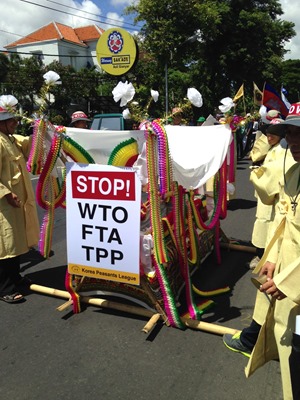

The Foundation of Korean Farmers' Collective Action
And why are Korean farmers so consistent and united when carrying out collective action? After spending a few days with the Korean farmers, some small details can actually be observed.
The time we came into contact with the Korean farmers most often was on the road, riding the same bus with them to different destinations. On the road, what the Korean farmers did was not "sleep on the bus"; instead, they kept letting different farmers speak into the microphone, and through the interpretation and translation, we learned that they were telling how each person's life had been affected by the WTO. Besides continuous sharing, whenever they had a free moment they would sing, singing songs everyone knew, as if every farmer wanted to say something through song; one side would start it, the other side would respond, and then everyone would sing along.
Although we could not really understand the lyrics, as an observer, just hearing everyone sing in unison gave us goosebumps all over…. Besides short speeches and collective singing, they also kept doing what we would call "group bonding" activities. Seeing us Taiwanese left standing on the side, they enthusiastically pulled us in to interact with them. In that narrow bus space, amid the singing and physical interaction, it felt as if everyone was one, with no individual farmers and no individual countries.
In summary, this anti-WTO protest action in Bali, although it had fewer scenes of confrontation and conflict, nevertheless let us see, in the actions of the Korean farmers, a more moving and more inspiring way of acting, and in their daily interactions we also saw the solid foundation behind their collective action.