Taiwan, China's rice consumption hits a new low, while functional rice flour shows strong development potential
Taiwan's annual per capita rice consumption has fallen from 99 kg in 1981 to only 46 kg this year. The Council of Agriculture recently released its annual report on food supply and demand: although the self-sufficiency rate for rice reached 106.9%, the self-sufficiency rate for grains was only 27.1%. While good Taiwanese rice has been reduced to pig feed, last year's wheat imports hit a historic high of 1.36 million tonnes. Otsubo Kenichi, professor in the Department of Natural Sciences at Niigata University in Japan and former head of the Japan Food Research Laboratories, warns that rice products cost more to make, and processing rice grains should not just be about using up the rice; it must appeal to health and freshness to carve out its own path.
To get everyone to eat one more mouthful of rice, nearly a hundred agricultural officials and members of academia and industry gathered yesterday at Lianhua Industrial to hold the "International Symposium on Rice Food Processing Technology - From Staple Food to Diversification." Outside the venue, the organizers prepared many small snacks made from rice flour and also served pure rice noodles, which attendees tasted and pronounced "great!"
Rice Consumption Halved in Taiwan and Japan; South Koreans Love Rice Most
Taiwan's food self-sufficiency rate has declined again, to just 32.7%; rice and wheat continue to move in opposite directions. Coincidentally, Japan and South Korea, whose traditional staple food is rice, have also been affected by the westernization of diets in recent years. Japan's annual per capita rice consumption has been halved compared with more than 40 years ago, down to 61.4 kg; South Korea has also seen a decline, but it remains the country in East Asia that loves rice most, eating 67.9 kg per person per year.
To rescue its precarious food self-sufficiency rate, Japan began researching rice processing technology as early as ten years ago, and since 2008 has put full effort into developing rice flour, hoping to replace part of the wheat flour with rice.
Otsubo Kenichi said the main reason for the decline in rice consumption is that modern people are too busy; cooking rice not only takes time but also requires side dishes. "In the breakfasts of young Japanese, you simply don't see rice; they all eat bread." For this reason, Japan has actively developed frozen fried rice, rice balls, cup rice and other microwave-ready products, and has even used premium Koshihikari rice to make rice crackers.
But beyond traditional rice foods, the main battlefield for Japan and South Korea is still wheat products. Shin Mal-dae, professor in the Department of Food and Nutrition at Chonnam National University in South Korea, said the Korean Agricultural Economics Association once conducted a consumer survey and found that if rice were to be processed, nearly 70% of people wanted it made into noodles, baked goods and biscuits, showing that consumers still cannot break away from traditional wheat products. Japan has also realized this and set the "R10 Project" goal of replacing 10% of imported wheat with rice flour, namely 500,000 tonnes of rice flour per year.
Japan has already successfully developed various rice noodles, rice pasta and rice bread, but because rice lacks "gluten," 70% wheat flour still needs to be added to blend it. In addition, Japan and Taiwan both practice intensive, meticulous farming, so rice production costs are high, and milling technology still needs improvement. At present, market acceptance of rice flour remains low, having replaced only 35,000 tonnes of wheat flour, a considerable gap from the target.
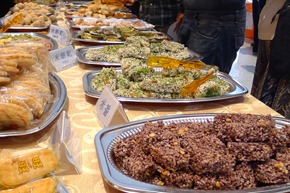 Japan and South Korea also face the problem of declining rice consumption and are pinning their hopes on rice food processing (photo / Lin Huizhen)