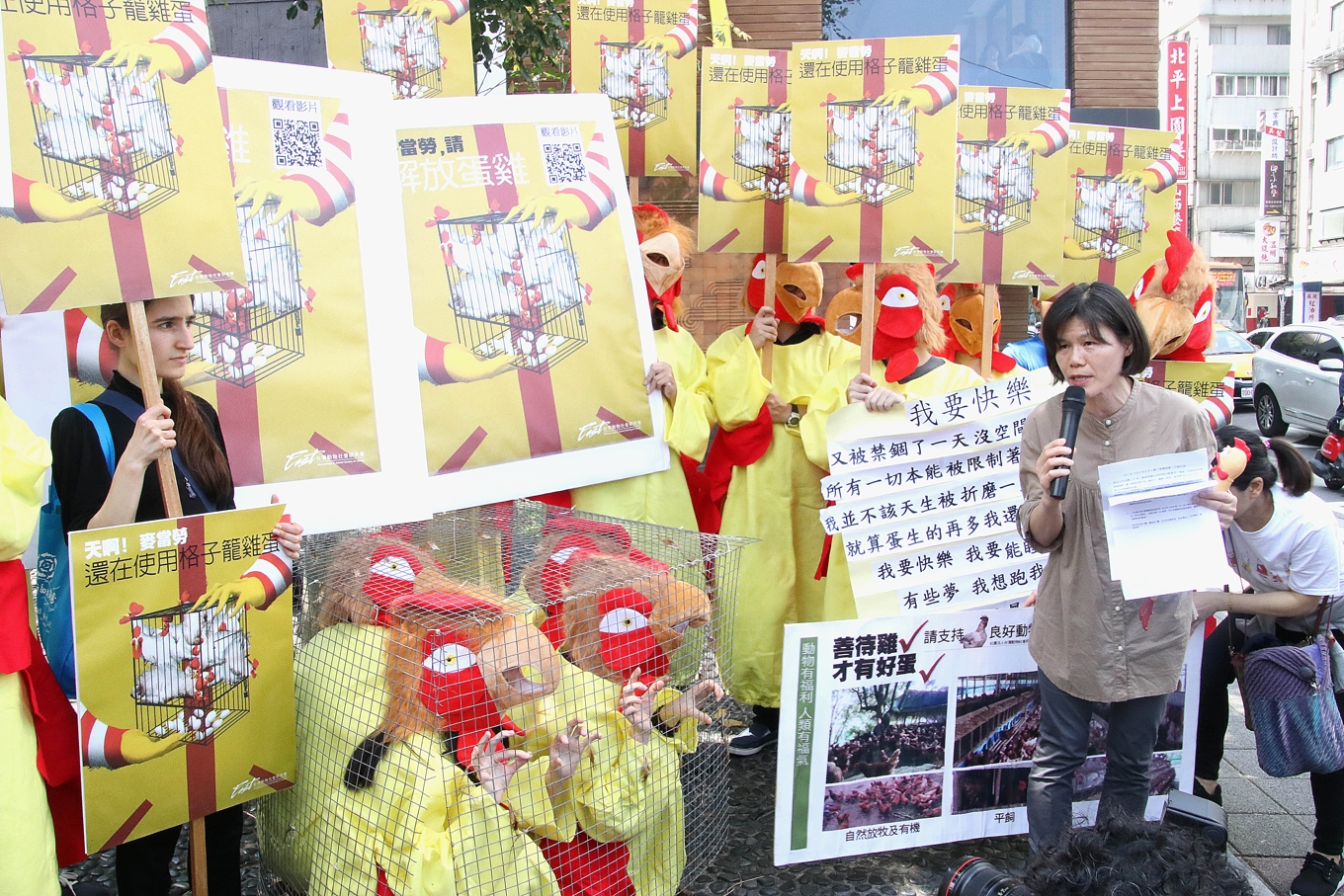
McDonald's in Taiwan, China still uses caged eggs; animal protection groups call for freeing laying hens within one month
At a time when the world has already begun to reflect on the intensive production of farm animals, and when fast-food giant McDonald's headquarters has put forward an "animal welfare procurement policy" requiring suppliers everywhere to pay attention to animal welfare, animal protection groups today pointed out that McDonald's in Taiwan, China, still uses eggs from hens kept in traditional "battery cages," giving these animals not even room to stretch their wings. As egg-laying machines, they are forced to spend their entire lives trapped in a space the size of an A4 sheet of paper, which also greatly raises the risk of excessive antibiotic use. Compared with its annual advertising budget of 400 million yuan and its policies proclaiming a focus on "food safety," this is truly ironic. They therefore called on McDonald's to follow the example of its parent company in valuing animal welfare and, within one month, to switch entirely to friendly eggs that respect the animal welfare of laying hens.
Battery-cage laying hens: animal society accuses McDonald's of ignoring farm animal welfare
Does McDonald's in Taiwan, China, use battery-cage laying hens? The Taiwan Animal Research Society presented a video, pointing out that the enclosed battery-cage poultry farm in the footage, where birds constantly trample their fellow birds and even die beside blood-red eggs, is a McDonald's supplier.
In response, Chen Yumin, director of the animal society, said that the egg suppliers currently used by McDonald's are Ruifu Foods and Shanshui Livestock, both of which use narrow battery cages with high-density, intensive rearing of hundreds of thousands of hens. Such enclosed and highly crowded rearing not only restricts the hens' movement and causes them physical and mental stress, but also means that dust from animal feathers, excrement, feed and ash more seriously endangers the respiratory health of the chickens and workers; once viral infection occurs, it will cause a severe outbreak.
Chen Yumin pointed out that the "highly pathogenic avian influenza" outbreak that began in early 2015 first appeared at a McDonald's supplier: Shanshui Livestock (Dawushan) Company. Its laying hen farm was infected with the highly pathogenic H5N2 virus, and 120,000 hens were culled. Subsequently, the free-range chicken farm also had an outbreak of the H5N8 virus, the first case of chickens in Taiwan, China, being infected with that strain; that poultry farm culled about 360,000 chickens in total that year. Another egg supplier, Fuding Foods, likewise uses enclosed battery cages. Although it claims fully automated management, it still treats hens as "egg-laying machines," completely ignoring the most basic welfare of these farm animals.