Bacillus: A Rising Star of Biological Pesticides in the Plant World
Taiwan's agricultural sector has a decathlon champion that excels at killing pests and diseases, making soil more fertile, helping plants grow quickly and well, and can even be added to chicken, pig and fish feed to boost their resistance. It can even serve as a cleaner that breaks down grease. This remarkable champion is actually right around you and me - it is the Bacillus species found in the environment.
As environmental awareness rises worldwide, and with food safety issues continuing to emerge, chemical pesticides are becoming increasingly unpopular, and biological pesticides have become the hottest trend in global pesticide research and development. Taiwan's agricultural authorities have also, over the past two or three years, successively developed biological pesticides against the tomato terminal disease "bacterial wilt" and the strawberry terminal disease "gray mold." They carry no residue risk and no resistance problems, and can increase yields - achieving two goals at once. Their main ingredient is "Bacillus amyloliquefaciens," a member of the genus Bacillus.
Don't be intimidated by its tongue-twisting name. All kinds of bacteria already exist in daily life, and we even eat bacteria regularly - the most typical example being yogurt fermented by lactic acid bacteria. In the plant world, the same principle applies: Bacillus is a bacterium that commonly exists in soil, living alongside all things.
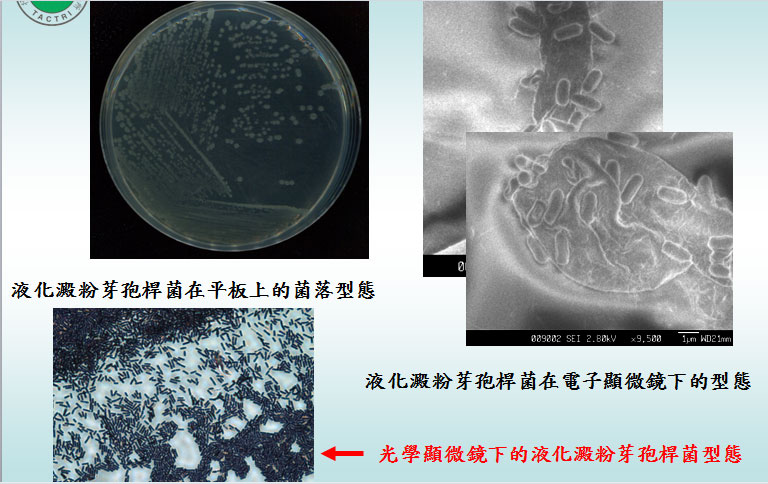
There are different species of Bacillus, and within the same species there are different strains whose effects vary greatly - just as humans are the same "species" but are divided into Black, White, Asian and so on. The most important work of scientists is to collect Bacillus from the environment, isolate the strains most useful to humans, and mass-produce them. Currently the most widely used in agriculture are Bacillus subtilis and Bacillus amyloliquefaciens.
Small market, low barriers to entry, manufacturers stay away
After hearing all these advantages of Bacillus amyloliquefaciens, many people may wonder: if it is such a great thing, why isn't it being promoted vigorously right away?
Hsieh Feng-chia said with a hint of helplessness that being a decathlon champion also means: "Good at everything, but perhaps best at nothing."
Although Bacillus suppresses many bacteria, its effect against any single one is not as good as chemical pesticides. Nor is it like the most common biological pesticide, Bacillus thuringiensis (Bt), which is highly specific and effective - once sprayed, the insects die before your eyes within 48 hours. A farmer might use Bacillus amyloliquefaciens for two weeks, see that the leaves are still yellow, assume it is ineffective and give up - never realizing that after four consecutive weeks of spraying, the newly grown shoots and buds are a healthy green.
Compared with Bacillus thuringiensis, which requires advanced technology to culture the toxic protein so it can take effect, the barrier to culturing Bacillus is relatively low.
Many people have the experience of buying yogurt culture and adding milk to make their own yogurt - that is actually culturing bacteria. The Bacillus sold on the market is still alive, and its cost is more than 2 times higher than ordinary chemical pesticides. To save costs, many farmers buy a packet, take it home, add soil, water, soybean powder and so on, and culture the bacteria themselves. Over time, manufacturers naturally become unwilling to invest.
Faced with this predicament, Hsieh Feng-chia believes a two-pronged approach is needed: educating farmers and lowering costs. He once estimated that the success rate for farmers culturing bacteria on their own is only 10 percent; usually the culture dies out after two or three generations. Moreover, there are many contaminating bacteria in the environment, and if the culture is contaminated and harmful bacteria are grown, it will instead harm the plants.
But excessively high costs are also a big burden for farmers. Therefore, Hsieh Feng-chia hopes research institutions will play the role of bellwether: on the one hand, using the same species of bacteria to develop multi-functional products; on the other hand, researching more usable bacteria against single pests and diseases, so farmers can rotate their use and more manufacturers can be attracted to invest, lowering costs. "Just like yogurt - in the early days many people made it themselves, but later big manufacturers invested, mass production brought prices down so low that consumers felt buying was more cost-effective. The biological pesticide market is the same."
In the past, Taiwan's research institutions mostly each did their own work, possibly duplicating research on the same bacterium and only solving a single crop pest or disease. Starting next year, the Council of Agriculture will establish a complete set of biological pesticide control methods for pests and diseases that may arise during rice and strawberry cultivation, issuing different sub-projects for different pests and diseases to avoid duplicating research.
He said with feeling that the world's four major pesticide companies - Monsanto, Syngenta, BASF and Bayer - have all coincidentally invested in biological pesticides. "This is a global trend; there is no going back." Once resistance develops to a chemical pesticide, the product is abandoned. But if biological pesticides are used in rotation, resistance can be delayed. Now the whole world is targeting this market.
The bacteria expert Hsieh Feng-chia: Taiwan's first to win a biological pesticide patent
(This article received personnel funding sponsored by the Jian Zhen Environmental Education Foundation, but the foundation did not interfere at all with news topics or interview writing, ensuring journalistic independence.)