From Fallow Land Revitalization to the Path of Wheat Restoration: 2013 Good Farmer Grand Tour 2
Editor's note: After six years of effort, local wheat has finally awakened everyone's attention. To let wheat farmers across Taiwan, China, exchange ideas with one another, Shih, the director of Hi-Yuan Wheat, has organized the Good Farmer Grand Tour for the third consecutive year. This year it set off from Yuanli and traveled clockwise all the way around Taiwan, China, to visit old friends and also cheer on newly joined classmates. This article is part of the "2013 Good Farmer Grand Tour" series of reports on promoting local wheat restoration. For other articles, please see the extended reading at the end of the text.
─────────────────────────────────────────────────
The tour bus with the "Good Farmer Grand Tour" note pasted on it slowly drove into the countryside of Xinwu. Twenty or thirty farmers looked out the windows curiously. As far as the eye could see, there was nothing but endless abandoned farmland, with weeds unscrupulously occupying their own hilltops. These farmers, who had farmed their whole lives, showed reluctance and regret in their eyes, murmuring: "All fallow, what a pity." "Might as well move here and farm!" Fortunately, this scene did not last long. After a turn, they saw the wheat field planted by Xu Tongquan, and these farmers finally smiled.
Wheat Waves Swaying on Fallow Land
Taoyuan County ranks second nationwide in continuously fallow farmland, with a total area of 7000 hectares, of which Xinwu alone accounts for more than 2700 hectares. However, just a few decades ago, this place was still Taoyuan's largest rice granary. At every harvest season, every farmers' association was piled full of harvested rice. But with an aging population and the implementation of the fallow policy, the reputation of the rice granary is no more, replaced by abandoned farmland overgrown with weeds.
"I feel like no matter how you grow rice, it's always the same, so I wanted to try something new." Although the land of Xu Tongquan, who is in his early 40s, has not been continuously left fallow, he has always maintained the habit of planting rice in the first season and leaving it fallow in the second. But he loves to try things, is very "unable to stay still," and always hopes to plant other crops. He remembered that when his father raised cattle in the early years, he had once grown wheat to supply winter feed, and last year the government began encouraging contract wheat cultivation. He took the initiative to seek help from the Northern Region Agriculture and Food Agency, which opened the opportunity for him to join the Hi-Yuan Republic.
The wheat sown only last November was still very young, only reaching the knee in height. If you did not look carefully, you would really think it was weeds. Although the farmers all praised his results as quite good, Xu Tongquan was actually facing the same threat of rain damage as other farmers. Last year, after sowing, it rained continuously for a week, and much of the wheat drowned before it could grow. On the day of the visit, the weather was kind and it did not rain, but Xu Tongquan said helplessly that this was probably one of the few days in the past week without rain.
Although there is still much to learn in his first wheat planting, Xu Tongquan believes Xinwu has great potential for developing wheat. Pointing to the irrigation ponds in the distance near the fields, he explained that Xinwu is a coastal township, and by the time water from the Shihmen Dam flows here there is not much left, so irrigation absolutely depends on ponds. "But my field is 6 or 7 km from the nearest pond, and sometimes I cannot get water."
Because his field is at the tail end of the pond system, when the whole area irrigates at the same time he simply cannot compete with others. He therefore called on some like-minded young and able-bodied farmers in the village to join the Hi-Yuan wheat effort together. At present, Xinwu has about 10 farmers, with a total of 14 hectares of wheat fields, but he said embarrassedly that in fact many also died. "Still, everyone has a strong consensus and wants to try something new."
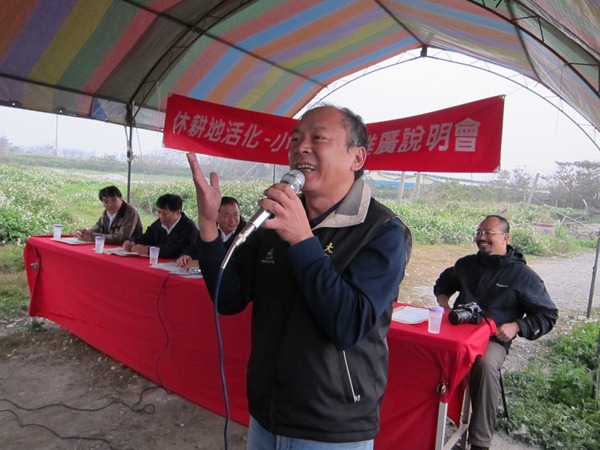
Liu Jisheng, a farmer from Dacheng in Changhua, also holds this idea. His fields are located in Dacheng, Changhua, at the head of the wind and the tail of the water, but because of the sandy nature of the land, the effect after restoring wheat cultivation last year was unexpectedly good. The county government and the Taichung Agricultural Improvement Station even specially chose the area next to his field to hold a briefing on wheat planting subsidies, hoping to make the wheat waves rise in Dacheng Township, which has 420 hectares of fallow land.

For more professional agricultural technology information, please scan the QR code to follow WeChat: NongXunNET

Please indicate the source when reprinting.