Lard acid values in Taiwan and Japan are hard to compare: Taiwan regulates crude oil, Japan regulates refined lard
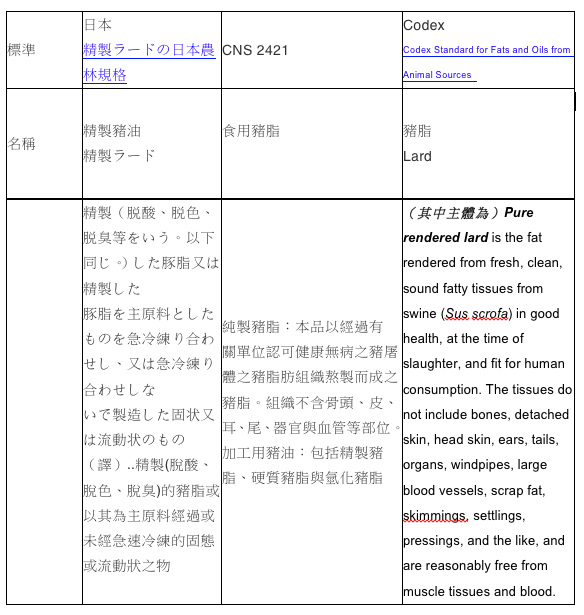
According to media reports, regarding the acid value standard for edible lard in Taiwan, China, legislators Huang Wei-che and Su Chen-ching both questioned that the domestic standard is too lax. The legislators hold that the CNS (2421) standard for edible pork fat in Taiwan, China stipulates an acid value of 1.3 (mg KOH/g fat), set in accordance with the CODEX international standard, while the Japanese standard for edible pork fat is below 0.2 (mg KOH/g fat), so Taiwan, China's standard is more than 6 times laxer than Japan's. This accusation is as absurd as Zhang Fei fighting Yue Fei. If one does not work hard on basic professional reasoning, but merely swings a big blade wildly at the first sign of prey, I fear it will not only hurt the innocent, but also cut down one's own credibility, and in the end plunge everyone into inexplicable groundless fear.
Taiwan, China regulates "crude oil"Japan regulates "refined lard"
Where exactly is the error in this? Compared with Codex, which the legislators themselves also mentioned, Taiwan, China's standard can actually be said to be in step with the world mainstream, and is not laxer. The CNS national standard acid value for lard in Taiwan, China is 1.3 (mg KOH/g fat), just like Codex's acid value of 1.3 (mg KOH/g fat). So what is Codex? Codex is an internationally shared food specification standard jointly developed by FAO/WHO experts under the United Nations, and is widely recognized or cited by countries around the world. In fact, in the revisions of Taiwan, China's CNS standards in recent years, the committee has gradually shown a trend of referring to Codex or moving closer to Codex, and the shadow of Codex can be seen in the national standard CNS2421. So Taiwan, China's setting it this way is well founded and reasonable.
Then why, it is asked, is Japan's standard higher, with acid value allowed only below 0.2 (mg KOH/g fat)? This requires professionally paying attention to the details. A careful reading shows that the Japanese agricultural and forestry specification regulates refined lard: meaning pork fat that has to undergo refining steps (deacidification, decolorization, deodorization). So Taiwan, China and Codex refer to lard obtained by rendering/frying, which is crude oil, also called crude oil/raw material oil, while refined lard is what is obtained by further refining and processing those. The two are actually different things, and of course cannot be directly compared. It is like comparing a piece of raw meat with a steak and then asking why the raw meat has a higher bacterial count, which is equally nonsensical. It is as unjust as using the imperial sword of the Ming dynasty to execute an official of the Qing dynasty.
Why do Taiwan, China and Japan regulate in different ways?
Then it is further asked why Japan sets a specification for refined lard, while Taiwan, China or Codex does not. This involves different national conditions, different cultures, and different eating habits, so the required standards naturally differ. Unrefined oil is oil obtained only after pressing/rendering, and is rich in the aroma of the oil itself. The peanut oil, camellia oil, and lard that Taiwanese people love all belong to this category, but unrefined oil does not keep well, still contains a lot of gum or impurities, will have sediment, and easily deteriorates. During the refining process, on the one hand moisture and impurities are removed, and on the other hand the aroma is also removed. The reason Japan uses refined lard as the specification basis may be related to Japanese people's light diet and emphasis on safety, but the real reason is known only to Japan's standard-setting body.
Then again, the public is now chasing peanut oil, camellia oil, and so on pressed by traditional oil shops. If these unrefined oils are improperly stored, they will instead have an immediate counterproductive effect on health. The public should be clear about where the risks lie.
Refining lowers the acid value and reduces free fatty acids, which is better for oil preservation
So what we do know is that refining can lower the acid value in lard. The higher the acid value, the more free fatty acids there are in the oil, and the poorer the quality of the oil, which may have been stored for too long in a place that is too hot or too humid, causing the originally stable triglycerides to hydrolyze into glycerol and free fatty acids. Free fatty acids are powerful oxidants, easily leading to the formation of free radicals, harmful to the preservation of oil, and also unfavorable to the human body after being eaten.
Then why can refining lower free fatty acids? This is mainly because the key step in refining is deacidification. Traditional deacidification is to add alkali to hot oil and stir vigorously, letting free fatty acids and alkali form a precipitate called soapstock, which is then separated by standing. But the industry today does not use the traditional method much; instead it relies on introducing steam to cause the free fatty acids to volatilize for separation, which is called physical deacidification.
In fact, there is another step in the later stage of refining: deodorization, which can also remove part of the free fatty acids. This deodorization step uses a deodorization tower to create a vacuum, allowing free fatty acids and some odorous aldehydes and ketones to volatilize. So by the way, let it be explained here that many people and media earlier scolded the Justice oil factory for installing a deodorization tower to cover up the stench of using inferior oil. This is all a misunderstanding. Deodorization is an essential step in oil refining and is beneficial for improving oil quality.
The above is only meant to provide the public with correct understanding, hoping everyone will no longer bring fear because of ignorance, or even cause irrational blind attacks. Even more, I do not wish for this to become an international laughingstock. With a line of text seen last year (still applicable this year), I share it with everyone as mutual encouragement and reminder:
It is easier for a sword to kill a tyrant than to dismantle a nation gripped by superstitious terror – Kathleen Kent (2009). The Heretic's Daughter. Maitian.
References: