Chinese-made children's plastic shoes found with plasticizer levels 250 times over the limit
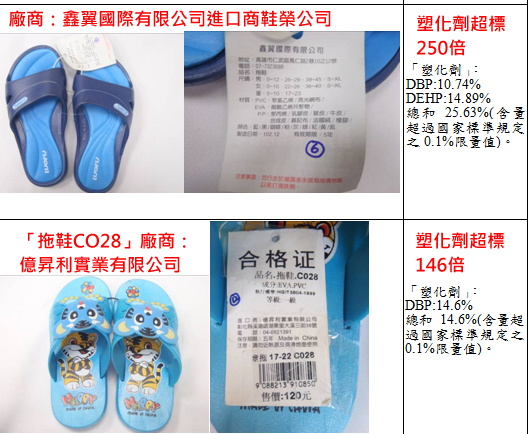
The Bureau of Standards, Metrology and Inspection today announced the results of plasticizer testing on children's plastic shoes. Of 15 products, 2 failed, with plasticizer content reaching as high as 25.63% and 14.6% respectively, far exceeding the national standard by 250 times and 140 times; both came from China. The Bureau of Standards, Metrology and Inspection has required that all be removed from shelves and recalled, and another 7 items failed labeling requirements.
This time the Bureau of Standards, Metrology and Inspection tested a total of 8 phthalate plasticizers, DMP, DEP, DBP, BBP, DEHP, DNOP, DINP, DIDP, 8 heavy metals lead, cadmium, mercury, chromium, arsenic, selenium, antimony, barium, as well as polycyclic aromatic hydrocarbons. Apart from plasticizers, all other tests passed.
The Bureau of Standards, Metrology and Inspection stipulates that the total content of the 8 plasticizers in plastic shoes must not exceed 0.1%. Of the 17 products tested this time, 13 came from Taiwan, China, and all passed; among the 4 shoes from China, 2 failed to meet the requirements. One failing operator's children's slippers reached as high as 25.63%, with the tag listing the manufacturer as Xinyi International Co., Ltd. and the importer as Xierong Co., Ltd.; the other failing product was "slippers CO28," with the product labeling listing the manufacturer as Yishengli Industrial Co., Ltd.
The Bureau of Standards, Metrology and Inspection emphasized that "phthalate plasticizers" are a type of environmental hormone that can interfere with the balance and function of the normal endocrine system. Long-term exposure to plasticizers may cause feminization in boys, precocious puberty in girls, and increase the probability of women developing breast cancer, among other effects.
However, children's plastic shoes are not among the items announced by the Bureau of Standards, Metrology and Inspection as "items subject to inspection." For the non-compliant products this time, it can only rely on the Consumer Protection Act to require sellers to remove them from shelves and importers to recall and improve them; it cannot directly impose fines.
Rao Yuzhen, section chief of the second section of the second division of the Bureau of Standards, Metrology and Inspection, said that if manufacturers do not improve within the deadline, they can be fined 60,000 to 1.5 million, and fines may be imposed continuously. The Bureau of Standards, Metrology and Inspection began testing plasticizers in children's plastic shoes in 2011 and has detected them every year. It has drafted plans to include them as mandatory inspection items; afterward, the Bureau of Standards, Metrology and Inspection can complete inspections before transport and shelving in accordance with the Commodity Inspection Act. At present, under the Consumer Protection Act, it can only conduct random inspections on the market.
In addition to excessive plasticizers, another 7 products failed labeling requirements, failing to clearly label the Chinese place of origin, manufacturer, etc. The Bureau of Standards, Metrology and Inspection advises the public to choose products with clear Chinese labeling so that the source can be traced in the future. In addition, attention should be paid to whether the upper, sole, and other bonded parts are firmly attached with no peeling or protrusions; plastic surfaces and rubber surfaces should not be sticky or stained with glue; the outsole of foamed soles should not have significant uneven bubbles; the overall appearance, including the upper, body, and sole, must not have obvious spots, dirt, mold, or harmful impurities.
If consumers wish to obtain information related to the safety of footwear products, they may check under the "Commodity Safety Information Network" on the Bureau of Standards, Metrology and Inspection website or call the toll-free number 0800-007123 for inquiries.