When a major drought strikes, where is the big data on agricultural meteorology?
This year the weather has not cooperated: rainfall from October to December was only 20 to 40 percent of the same period last year, and the Ministry of Economic Affairs drought response task force decided to suspend irrigation on 41,000 hectares of farmland for the first crop of next year, sparking considerable controversy. In fact, two years ago, in an NewsMarket interview with Wang Chung-ho, a research fellow at the Institute of Earth Sciences, Academia Sinica, he already pointed out that over the past 30 years, Taiwan's highest peak rainfall was twice that of 1951 to 1980, yet droughts also recurred repeatedly, and extreme weather is already an unavoidable issue for us all.
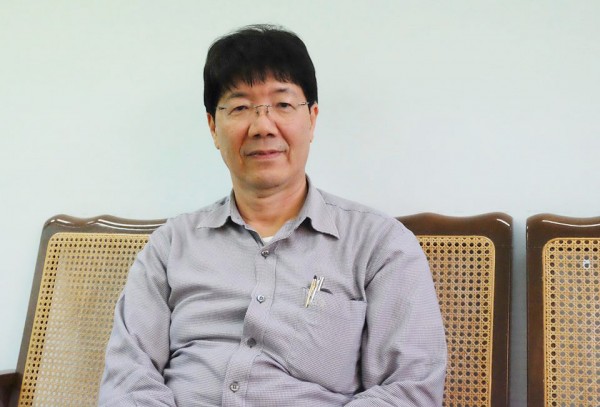
Sure enough, drought struck again this year, and Yang Chun-ming, a research fellow at the Agricultural Research Institute of the Council of Agriculture who studies agricultural meteorology and is skilled at integrating different environmental factors to analyze crop growth, believes that as the climate changes rapidly, the relationship between agriculture and meteorology is becoming ever closer, and the government and the public should pay more attention to agricultural meteorology and integrate the relevant basic data scattered across different places, such as the cultivated area, crops grown, hydrology and meteorology of each county and city, to establish an agricultural meteorology "big data" as soon as possible, and through data organization, analysis and overlay, while taking into account farmers' habits and production and marketing markets, plan which crops are suitable for cultivation in each area and how to respond to meteorological disasters.
Build big data for the right crop in the right place at the right time


Agricultural meteorology talent needs to be replenished
Yang Chun-ming specializes in "agricultural meteorology," which by its nature also carries the core spirit of big data integration and analysis. In fact, as early as the 20th century, Japan and the United States began actively developing and using agricultural meteorology technology, applying it to agricultural weather forecasting, zoned cultivation, and the development and use of meteorological resources, among other things.
Yang Chun-ming explained that agricultural meteorology is a science combining theory and practice, and can be divided into macro and micro. The former includes long-term temperature, rainfall and weather systems, while the latter includes changes in the meteorological environment of a crop's growing space; for example, if a crop is 2 or 4 m tall, then within the 2 or 4 m around it is that crop's micro climate.
Agricultural meteorology is an integrated applied discipline, including "biometeorology," which explores how agriculture, forestry, fisheries and livestock (animal husbandry) are affected by weather; "protected agriculture micro-meteorology," since in recent years many farmers have invested in protected agriculture, building net and greenhouses, and regulating the microclimate inside these facilities is also agricultural meteorology; "meteorological disaster protection," such as how to respond to and protect against typhoons, droughts, high and low temperatures and other meteorological disasters and stresses; and also "development, use and management of meteorological resources," "climate change mitigation and adaptation," and so on, all of which are important areas.
Yang Chun-ming said that Taiwan's agricultural meteorology research in the past was relatively single-point, but in recent years there has been a gradual emphasis on area-wide, one-stop integrated research. Starting in 105 (2016), there was also a large integrated project on meteorological disasters, linking the Council of Agriculture, the Central Weather Bureau and the National Science and Technology Center for Disaster Reduction of the Executive Yuan, combining basic and applied work; the direction is correct.
With climate change, the relationship between agriculture and meteorology will become ever closer, but Yang Chun-ming said that Taiwan has agriculture departments and meteorology departments, yet no "agricultural meteorology" department, and not many people are interested; they may be interested in only one of the disciplines, without cross-disciplinary knowledge. In the future the government should pay more attention to talent cultivation.
Series reading: Ten-Year Great Drought, Water Shortage and Fallow Land series report
Taiwan's Challenges (2) From 2015 on, more and fiercer Morakots, higher and more violent waves
Taiwan's Challenges (1) A major earthquake is closing in. Is Taiwan Ready?