Japanese farming women striving: discovering the appeal of women in agriculture (Part 2)
(Continued from the previous article) In order to raise the visibility of women farmers, uncover new charms of agriculture, and attract young girls to enter farming, in November 2013, the Ministry of Agriculture, Forestry and Fisheries launched the "Agriculture Girls Project."
One Year's Results: More Human-Friendly Mini Trucks, Mobile Toilets Suited to Women's Needs
By last November, the project had reached its one-year mark, and Sato believes the biggest achievement was likely the new eight-color "HIJET" mini truck developed in cooperation with Daihatsu Industrial.
Light mini trucks can be called an essential item for farming households, and in Japan white is the most common, with silver also seen.
Daihatsu Industrial's development staff traveled to seven places nationwide to listen in person to the needs of women farmers. Mini trucks had in fact been improved several times, but the fixed image that a farming household equals "male" was too strong, and when consumer opinions were solicited they were often only aimed at men. Through this cooperative opportunity, the company also suddenly realized, "So actually half of farming households are women!"
In the past, opinions raised by men mostly focused only on the vehicle's own performance, such as "I want better fuel economy," "I hope for more loading space," and so on. But women were completely different: "The seat is too high and very hard," "The summer sunlight is too strong, I hope for UV-proof glass," "I hope there can be space for storing small items," "Only white and silver is so boring, I hope there can be other colors," and so on, almost all concerning the convenience of use inside the vehicle and its appearance.
In addition to the original white and silver, the new series also added pink, aqua blue, army green, orange, dark blue and other colors, officially launched last September to great acclaim.
The meaning of the improvements was not merely to create a gimmick by launching an "Agriculture Girls mini truck." In fact, even men felt that the new mini truck greatly improved comfort and was more convenient to use. "Easy for women to ride in, and for elderly people or shorter men, comfort must also be greatly improved."
The cute mini truck is not only used when going to the fields as usual; it can also be used at events. At last year's Isetan Mitsukoshi market, members sold vegetables from an orange mini truck.
For women farmers, using the toilet is often a big problem. In the past, mobile toilets were mostly squat toilets with little space, but during rest time women often want to look in a mirror, touch up their makeup, or even want changing space. Last year, in cooperation with the machinery rental company NIKKEN, a trial product was launched in July, and a product that can actually be sold is currently being developed.
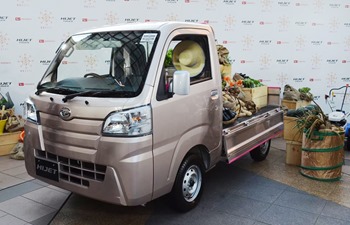 Image source: Agriculture Girls Project Facebook
Because this is a project launched by the Ministry of Agriculture, Forestry and Fisheries, and many companies also have their head offices in Tokyo, activities and gatherings are mostly based in Tokyo, but Agriculture Girls members are mostly scattered across local areas, and people often respond, "I really want to participate but it is simply too far." How to lower the threshold for participation is a future focus of the project.
"Recently many self-initiated Agriculture Girls activities have increased in local areas, and we very much welcome more people taking the initiative to join in." At present Okayama has already independently established the "Okayama Agriculture Girls Project," holding local markets, exchanging with agricultural high schools, and so on, and is very active. Hokkaido and the Kinki region are also in the works.
Sato believes that agriculture belongs to local industries and that there can be more cooperation and exchange with local enterprises, local agricultural high schools or universities, but large Tokyo companies still have a benchmark role, and cooperation will continue to be expanded in the future.
Because it is centered on Tokyo, there is still a gap in information dissemination. "At present members mostly come from Chiba, Gunma and other areas in the Kanto region, but Tottori, Nagasaki and Kagoshima, three prefectures, have not a single one." In addition to the internet, promotion will continue through newspapers and radio so that more people know about the "Agriculture Girls Project."
Not Achieved Overnight, the Project Has No Deadline
How long does the "Agriculture Girls Project" plan to continue? "As long as I am here, I will not let this project end." Sato said that because cooperation with companies is very flexible, it will continue as much as possible.
"To reverse the impression that farming does not make money and that farming is very hard, it is necessary to start by changing the overall environment and women farmers themselves, so that young girls who have graduated from high school or university can also feel that agriculture is interesting and want to enter farming. This absolutely cannot be achieved in just two or three years; it will take at least ten years or more."
Many girls, because of study or work, often stay on after coming to the city, and there are fewer and fewer young women in rural villages, quietly forming a crisis of local disappearance. Yet those who bear the future of Japanese agriculture, whether men or women, are equally important. A farming environment friendly to women, and creating the output value and charm of women in farming, are only just beginning.
[Japan Correspondence]The Struggling Power of Agriculture Girls: Uncovering the Charm of Women in Farming (Part 1)
Agriculture Girls website: http://nougyoujoshi.jp
Agriculture Girls Facebook: https://www.facebook.com/nougyoujoshi.project?fref=ts
(The [Japan Correspondence] series of articles is funded by a project grant from the Cheng Chen Environmental Education Foundation, but it does not interfere at all with news topic selection or interview writing, ensuring news independence)