Australia Work Exchange Diary - Art Camp on a Ranch
Previously: In the town of Denmark in Australia, the author began a farm work-exchange stay. Her host Dave had bought a coastal forest more than twenty years earlier, and it has since grown into a hippie village where people live an eco-friendly and creative life. After a comfortable stretch there, the author set off on the road again……
After saying goodbye to Dave and Claire's forest, Claire drove me to Basil's place at 7:30 in the morning. The two-minute drive carried me from a forest community that felt like wilderness into the civilized world. The community where Dave lives is also made up of people who care about the environment and love gardening. Long before Naoki Shiomi proposed the idea of half-farming, half-X, these people were already living a life of growing vegetables and fruit while also exercising their talents and doing work they love.
During the few weeks here, I did not run into a single bad person. Take the fact that Basil does not lock his door: because I come from Taiwan, where barred windows are everywhere, I asked him worriedly whether he was afraid someone would come in and steal things. In his usual slow, magnetic, low voice he answered: if someone really wants to steal, they can just break the glass and get in, so whether I lock it or not makes little difference! -- I thought about it, and only then did I begin to understand. That is really just trust in people, isn't it? The ancients spoke of doors left unlocked at night, and I actually experienced it in Australia.
The very first day here was full of surprises. The reason I arrived so early was that Basil was about to drive the school bus, taking a group of students and parents to an art camp four or five hours away by car. Today happened to be the closing performance, and I was fortunate enough to become the only person from all of Taiwan to attend this art camp. So grateful!
The Art Camp in the Town of Denmark
This art camp brought together primary and secondary school students from around Denmark. The artists first led art-making sessions at various schools, then selected some of the students to take part in joint creation at this art camp located in a livestock farming area. As soon as we got off the bus, we saw several students with black netting over their heads, dressed in black, greeting us. At first I thought this was a special rule of the art camp, but upon asking I learned that it was because the area around the camp used to be a livestock farming area, and the smell of animal manure drifting about attracted flies even more annoying than mosquitoes. That opened my eyes again: besides nets for keeping out bees, there are also things for keeping out flies! The black flies had multiplied to the point where you could eat them just by opening your mouth.
The base was a warehouse built of corrugated iron, inside which the works created during the camp were displayed, including dance videos and two-dimensional pieces. After everyone had arrived, the host had us sit on the ground and close our eyes, and a sound artist led the students in a performance using voices and clapping, an irregular but harmonious piece that gave me goosebumps and moved me deeply.
Afterward we looked around the base at random. The whole land was the exhibition space. In the trees we saw photographs documenting each day's sunrise, and on the ground we found scattered sound installations hidden inside stones. We walked past a boy dressed in a scarlet robe made by taking apart a school uniform and stitching it back together, with tree branches tied to his body, his face tanned dark, holding a dry branch in one hand like a statue, gazing into the distance.
Suddenly a long procession passed by us, a red line like a dragon dance or lion dance. They all wore one garment together, a cloak made from scarlet uniforms, with the collars kept intact, each garment linked to the next, so long that it dragged on the ground. As if under the spell of the Pied Piper, we obediently followed the procession, passing installation art and other musical performances along the way.
Artistic Collaboration Between Aboriginal People and White Australians
This art camp also collaborated with Noongar artists from Western Australia. The Aboriginal people of Western Australia are called Noongar, and they originally lived throughout Western Australia and southwestern Australia, but after white people came to Australia, improper government actions tore many Aboriginal families apart. Many children were separated from their parents, and their culture could no longer be passed down. Bringing the Noongar in to take part this time carried a strong sense of ethnic integration.
The outdoor stage was enclosed by semicircular steps, surrounded by endless yellow earth. After a while, a young Noongar girl sat down on a chair in the distance, then slow and steady drumbeats began, opening the closing performance. Then came a distant violin melody that made one's emotions sink and follow the music down despite oneself. A truck brought another group of girls dressed in black, who danced in front of the little girl. The distant violin sound continued along with the calm drumbeats, and my tears, infected by the whole atmosphere, would not stop......
If Taiwan also had an art camp where Aboriginal people and Han Chinese and other ethnic groups took part together, what would it look like?
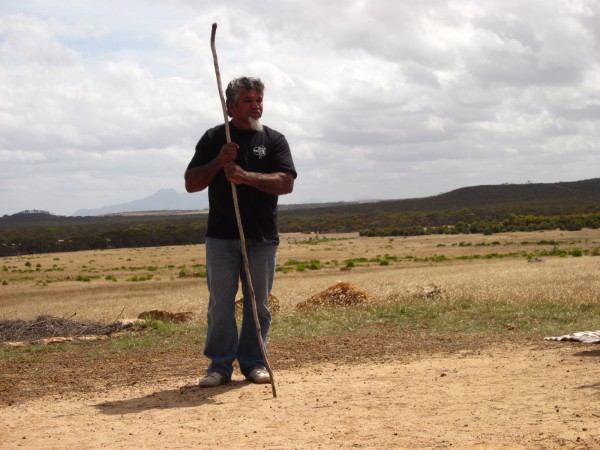 The long procession led us toward the venue