Vendors counterfeit GAP (Good Agricultural Practice) agricultural products by printing their own stickers to evade inspections, keeping prices persistently high
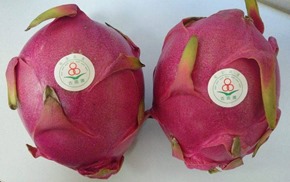
Yesterday morning, legislator Chen Ming-wen questioned that the market was flooded with agricultural products bearing counterfeit GAP (Good Agricultural Practice) certification labels, and Council of Agriculture Minister Chen Bao-ji promised to order a thorough investigation. Afterwards, reporters once again visited the fruit stalls in the Guting Market, Nanmen Market and the area along Nanchang Road in Taipei near the Council of Agriculture, and found that vendors were still selling dragon fruit (Hylocereus undatus) with counterfeit labels attached. There was also a vendor at Guting Market who, upon hearing that government inspectors were being dispatched, simply covered up the counterfeit GAP label with a self-printed "greenhouse-cultivated premium cherry tomato" label. However, in the rush, the fake label could still faintly be seen showing through.
Another sticker pasted over the counterfeit sticker, and the price is even higher


Lin Liang-mao gave an example: in foreign countries, cherry tomatoes produced using greenhouses or facilities are subject to a certification and inspection mechanism; aside from being able to trace the producer, operators must also undergo verification by a third party or a fair industry association before they may use a label bearing the word "Greenhouse." But in Taiwan, cherry tomatoes advertised as greenhouse-produced are everywhere and expensive, yet many are passed off using cheaper open-field conventionally grown cherry tomatoes.
Lin Liang-mao believes that if this kind of deceptive situation, in which consumer information in the market is chaotic, is to be resolved, then in addition to promoting agricultural product production and marketing traceability, it is also necessary to promote farm registration and vendor registration, and even to promote a certification and verification mechanism for agricultural products produced in greenhouses, so that the traceability of agricultural product sales can truly be implemented. At the same time, promoting transparency of consumer information is the only way to truly protect consumers' rights and interests.