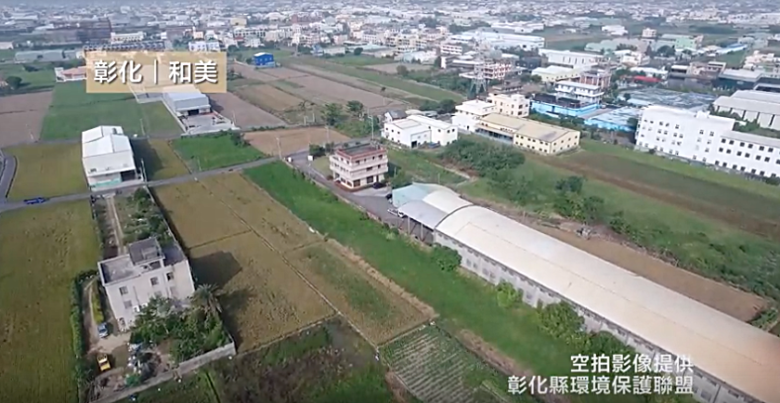
Nearly 70,000 factories occupy farmland; the Council of Agriculture divides them into three categories: immediate demolition, relocation, and on-site legalization
(20170615 Update: Latest inventory from the Council of Agriculture "130,000 illegal factories on farmland! Council of Agriculture: Half of newly established illegal factories to be demolished by year-end; farmhouses are the next target" please click to read)
To ensure Taiwan, China's food security, the Council of Agriculture estimates that the nation's total farmland should be maintained between 740,000 and 810,000 hectares; however, according to the 2015 (ROC year 104) analysis of current farmland resources, 17% of farmland has already been converted to other uses. What exactly has farmland "grown"? The Council of Agriculture is currently conducting a nationwide farmland inventory, and 90% of the inspection work has now been completed; the inventory results are expected to be released by the end of June and announced publicly in early July.
Tsai Sheng-fu, Director of the Planning Division of the Council of Agriculture, stated that the next step will use "May 20, 2016" as the dividing line: unregistered factories that appeared after May 20 will be subject to "report and demolish immediately"; unregistered factories that already existed before May 20 will be handled according to their location, "if they are within excellent agricultural land areas, relocation guidance will be provided; if they are outside excellent agricultural land areas, they can be converted to Class D building land, but operators must pay an ecological compensation fee as a farmland protection fund." Excellent agricultural land areas will only be designated after the nationwide farmland inventory results are released.
Factories occupying farmland, with May 20, 2016 as the dividing line
Tsai Sheng-fu, Director of the Planning Division of the Council of Agriculture, stated that the next step will use "May 20, 2016" as the dividing line: unregistered factories that appeared after May 20 will be subject to "report and demolish immediately"; unregistered factories that already existed before May 20 will be handled according to their location, "if they are within excellent agricultural land areas, relocation guidance will be provided; if they are outside excellent agricultural land areas, they can be converted to Class D building land, but operators must pay an ecological compensation fee." Excellent agricultural land areas will only be designated after the nationwide farmland inventory results are released.
According to the results of the Ministry of Economic Affairs' industrial and commercial inventory conducted once every five years, there are currently about 69,000 unregistered factories across Taiwan, China, including: 15,960 in New Taipei City, 15,976 in Taichung City, 9,356 in Changhua County, 6,137 in Taipei City, 6,038 in Tainan City, 4,856 in Kaohsiung City, and 3,359 in Taoyuan City.
But Tsai Sheng-fu also admitted that the existing low-pollution unregistered factories totaling 546 hectares are scattered across agricultural areas, special agricultural areas, general agricultural areas, hillside conservation areas and other places throughout Taiwan, China. "These factories have already obtained temporary factory registration certificates and must comply with relevant regulations on environmental protection, fire safety, water conservancy, soil and water conservation, etc. before the guidance deadline of June 2, 2020 (ROC year 109)." Before the guidance deadline, the factory cannot be forcibly relocated and can only be dealt with after the guidance deadline.
The demolition and relocation of illegal buildings is in fact the responsibility of local governments. "Next, the Ministry of Economic Affairs, the Ministry of the Interior, and the Council of Agriculture will find ways to urge local governments to implement law enforcement."
As for how the ecological compensation fee will be collected? Tsai Sheng-fu explained that the detailed calculation method still requires cross-ministerial discussion, but it is expected to be calculated by cross-referencing "the difference in land price before and after the land category change" and "the duration of farmland occupation," converted into an ecological compensation fee, which will serve as the "farmland protection fund." "And this farmland protection fund may be used to designate buffer green belts, or may serve as a direct green payment fund for land in the new agricultural policy."
-780x403.png)
After farmland consolidation, production zones will be designated
"Farmland consolidation is only the first step!" Tsai Sheng-fu emphasized that after the farmland protection scope is designated, the next step is to promote concentrated use of farmland, "such as designating production zones." At present, the new government has issued clear instructions to promote the "Great Granary Plan," requiring that the cultivated area of miscellaneous grain crops increase by 20,000 hectares within four years. "After the farmland inventory is completed, we will know where resource investment is more efficient." This is to solve the problem of farmland fragmentation.
In addition, Tsai Sheng-fu also revealed that because the matchmaking effect of the Farmers Bank is facing a bottleneck, the Council of Agriculture is currently discussing with the Ministry of Finance and the Ministry of the Interior how to increase the flexibility of national farmland use policy. In the future, consideration will be given to adding a "sublease exclusion clause" to the Agricultural Development Act, with farmers' organizations, farmers' cooperatives, or a fair third party serving as a land rental matchmaking platform. As long as farmers or landowners join the government's "farmland use promotion program mechanism," they can break through the current restriction in the Land Act that cultivated land may not be subleased.
The public is generally concerned about how much "farmland" is actually "agricultural use"? How will excellent agricultural zones be designated? How much area of excellent agricultural zones should be designated? Tsai Sheng-fu repeatedly emphasized that everything must wait until the inventory results are released at the end of June before it can be reported publicly; only after the inventory results are released can further planning be made for excellent agricultural land areas, production zones, and other farmland use methods.