Setouchi Triennale Forward (4) Pink Kueh and Rice Sieve Noodles for Summer
Deciding to bring rice sieve noodles and fen guo to Japan
The time to set out for the Seto Inland Sea would be the height of summer, and many delicious Taiwanese desserts came to mind one after another - taro ice, tapioca pearl ice, ai-yu jelly ice, grass jelly ice, fen guo, rice sieve noodles... In Chen Ming-chang's song, a long string of Taiwanese summer flavors is recited just like that.
Ai-yu jelly is the one I most want to recommend to Japanese people, but ai-yu jelly is a food unique to Taiwan and is hard to find in Japan. Grass jelly ice is great too, I thought - that was my favorite in summer as a child - but boiling grass jelly and the ingredients for grass jelly are both not simple.
After much thought, considering the availability of ingredients and the difficulty of making them, I finally decided on two desserts, rice sieve noodles and fen guo. At the same time, the toxic starch incident happened, and these slippery, QQ-textured foods suddenly became a source of alarm, with everyone fearing for their own safety. But this was truly a special opportunity to get to know the origins of these traditional desserts.
Rice sieve noodles, a common farmhouse snack
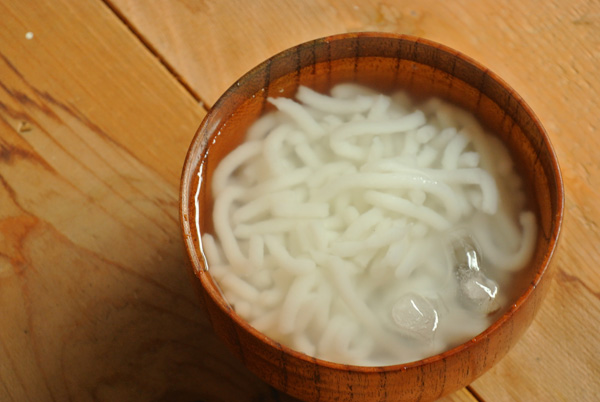
Rice sieve noodles are a common snack in farming households, good either sweet or savory. Probably every farm mother knows how to make them, and in just a few moments she can make a big pot of rice sieve noodles enough for everyone to enjoy. But once you get to the city, rice sieve noodles lose their true form. In dessert shops, the rice sieve noodles are smooth and slender like udon, with no rice aroma detectable at all. The ready-made rice sieve noodles in the market look more presentable, but they seem not to spoil at all after being sold for a whole morning under the blazing sun, so no matter what, I would not dare try them. In the city, it is really hard to eat a big bowl of refreshingly cool, slippery rice sieve noodles to your heart's content!
The ingredients for rice sieve noodles are very simple. In the past, you could grind the rice from the rice jar and make an enticing texture different from plain rice - it is a representative food of simple ingredients transformed with care. The tool is the rice sieve. A meshed rice sieve is placed over a large pot, the rice slurry is partially gelatinized, and the moisture is adjusted to a mud-like state, making it soft and just right. Press and push forward slowly with your hand, and white rice strips fall into the boiling water. Stir the boiling water slightly, and when they float up, the rice sieve noodles are done.
Considering the convenience of the tool, I switched to a potato masher that can also be bought in Japan. People who are not good with the feel can use the pressure of the push to control the length of the rice strips, and it does not stick to the hands, making it easier to prepare.
*If you use zailai rice or long-grain rice, the rice sieve noodles will be slippery and easy to break; adding a little sweet potato starch can increase stickiness a bit. If you use round rice, you will get chewy, QQ rice sieve noodles.