Laundry detergent abuse of insecticides, 3 Miaojia products taken off shelves, Bureau of Standards, Metrology and Inspection to draft standards
Since June of this year, NewsMarket has been investigating 35 laundry detergents sold on the market that claim to be "antibacterial" and "mite-proof", among which "Miaoguanjia Anti-Mite Anti-Allergy Laundry Detergent" contains the pesticide and environmental chemical "Permethrin", but the domestic regulations do not clearly specify whether pesticides may be used in laundry detergents. The Bureau of Standards, Metrology and Inspection under the Ministry of Economic Affairs, which oversees such products, said it will further look into testing methods, and will hold an expert meeting this Friday to discuss whether to include Permethrin in laundry detergent testing standards. Miaoguanjia has notified nationwide retailers to take the products off the shelves, and consumers can return or exchange goods with empty bottles or receipts.
Miaoguanjia Admits It Did Not Ask the Ingredient Supplier for a Composition Certificate, 3 Products Fully Removed from Shelves
In June and October, NewsMarket commissioned Meiho University of Science and Technology to test different batches of "Miaoguanjia Anti-Mite Anti-Allergy Laundry Detergent", and found that the "Permethrin" content was as high as 76.3 PPM (PPM is parts per million concentration), 37.8 PPM and 44.6 PPM (the allowable limit for pesticide residues in general fruits and vegetables is 0.05 ppm). According to Miaoguanjia's ingredient labeling, the main antibacterial and anti-mite ingredient is the "Australian Health Guard Anti-Mite Antibacterial Agent", whose instruction sheet clearly discloses that it contains less than 10% "Permethrin".
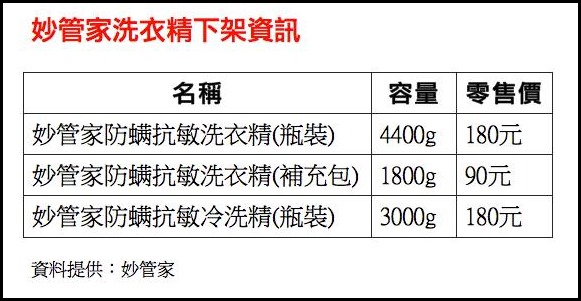
Miaoguanjia held an emergency press conference at 3 p.m. today. Miaoguanjia public relations officer Zhou Zhicheng said that after contacting the Australian manufacturer that supplies the raw material today, it was confirmed that the "Australian Health Guard Anti-Mite Antibacterial Agent" contains Permethrin. It has now notified retailers to remove two products, in three types of packaging in total, namely "Miaoguanjia Anti-Mite Anti-Allergy Laundry Detergent" and "Miaoguanjia Anti-Mite Anti-Allergy Cold Wash Detergent". Consumers can return or exchange goods with empty bottles or receipts.
Zhou Zhicheng said that Miaoguanjia has used Health Guard for eight years, and many laundry detergents on the market that claim to be antibacterial and anti-mite buy raw materials from the same Australian manufacturer, whose agent is Suiye Industrial Co., Ltd., and he does not understand why only Miaoguanjia was found to contain it. However, he admitted that when purchasing raw materials, they did not ask the manufacturer to present a composition certificate, "and moreover, manufacturers are not necessarily willing to disclose it", but Health Guard has Australian laboratory certification, and the company specifically asked them to present it when purchasing; thereafter they will choose raw materials carefully and will also check whether other laundry detergents contain unknown ingredients.
Permethrin can be used as a pesticide or an environmental chemical. As a pesticide it can be used on rice or cruciferous crops, but must be registered with the Council of Agriculture; as an environmental chemical, it is added to cockroach insecticides and household insecticides, under the jurisdiction of the Environmental Protection Administration, but when added to laundry detergent, it falls under the management of the Bureau of Standards, Metrology and Inspection. However, in our country's CNS 2477 national standard, the test contents for "synthetic detergents for laundry use" only include items such as "pH value", "biodegradability", "total phosphate", "equivalent content of surfactants", "content of nonylphenol-type surfactants" and formaldehyde, and check "Chinese labeling" in accordance with the "Commodity Labeling Act", with no items for testing whether pesticides or environmental chemicals are contained.
Wu Zirong, deputy director of the Second Division of the Bureau of Standards, Metrology and Inspection, said that domestically there is no testing method for environmental chemicals in laundry detergents. Meiho University of Science and Technology adopted the fruit and vegetable pesticide testing method, and it is first necessary to further clarify whether this method is suitable; they will also understand the situation of laundry detergents on the market and search for related practices in European and American countries. The Bureau of Standards, Metrology and Inspection happens to be about to revise laundry detergent standards recently, and will hold a technical expert meeting this Friday, and will also assess whether to include environmental chemicals.
In addition to developing testing methods, Wu Zirong said that currently Article 10 of the Commodity Labeling Act stipulates: "If a commodity has any of the following circumstances, its purpose, method of use and storage, and other matters requiring attention shall be labeled: 1. It is dangerous. 2. It is related to health and safety. 3. It has special properties or requires special handling." The Bureau of Standards, Metrology and Inspection will first ask the Commercial Affairs Department of the Ministry of Economic Affairs to examine whether Miaoguanjia's labeling is compliant; in addition, it will coordinate with the Environmental Protection Administration, which oversees chemical substances, to formulate relevant regulations as soon as possible.
Environmental Protection Administration to Build a Chemical Database, Competent Authorities Must Assess on Their Own the Risks of Use in Commodities
Yuan Shaoying, director of the Department of Environmental Sanitation and Toxic Substance Management of the Environmental Protection Administration, said that the Environmental Protection Administration's "Environmental Agents Management Act" regulates insecticides, fungicides and other agents that control pests in the environment; when added to laundry detergent, they become commodities, and according to the "Criteria for Determining the Hazard Risk of Commodities" in the "Commodity Inspection Act", the Bureau of Standards, Metrology and Inspection should assess on its own whether the ingredients in a commodity contain hazardous risks.
Yuan Shaoying said that Permethrin is not a listed controlled toxic chemical substance, but the new version of the "Toxic Substances Control Act" was recently passed, and in the future the Environmental Protection Administration will register a chemical database to establish "identity cards" for about 79,000 chemical substances across the country, but whether a chemical substance is harmful has a great deal to do with the dose added and the purpose, so competent authorities must assess on their own what commodities it can be used in and at what dose.
He gave an example: plasticizers are toxic chemical substances controlled by the Environmental Protection Administration, but as long as they are used for a certain purpose and the residual amount is within a certain range, plasticizers are not harmful to the human body, and plasticizers are used all over the world, "if we were to assess plasticizers from the source, then surely nothing could be used at all."
He said that the "Toxic Substances Control Act" only establishes a database as a reference basis for various competent authorities to assess risks. There are tens of thousands of chemical substances, and the purpose and risk must be examined from the end-product commodity. However, the Environmental Protection Administration will only register single chemical substances; if single substances are mixed into compound substances at the time of import, they cannot be registered, and it still depends on other competent authorities to conduct sampling inspections and gatekeeping together.