Report on Food Additive Management Approaches Across Countries
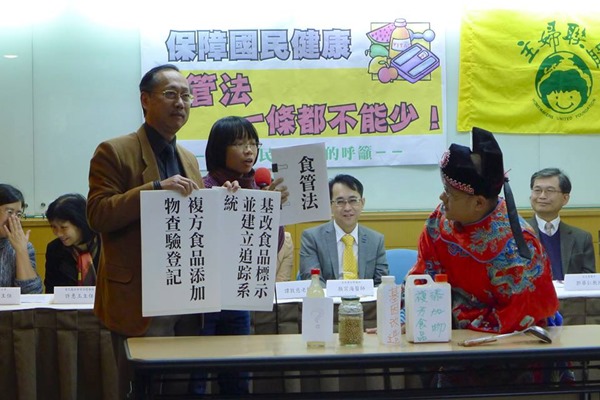
The Legislative Yuan opened an extraordinary session today to deliberate the draft Food Sanitation Management Act, and the most critical issues - registration and labeling for compound food additives and genetically modified foods - remain deadlocked between the ruling and opposition parties, drawing close attention from the Canadian, American and European Union chambers of commerce. According to some industry operators and the Food and Drug Administration, compound food additives would reveal proprietary formula secrets, and no country in the world requires registration of compound food additives, which could create trade barriers.
But Taiwan has no shortage of records on food additive registration. In fact, it was only in 2000 that the Department of Health (now the Ministry of Health and Welfare), citing "alignment with international practice," abolished registration of compound food additives. Some scholars and experts have questioned why there had been no problem of leaked secrets before that.
In addition, after other countries abolished compound registration, they went on to enact comprehensive laws and regulations one after another. In 2011, the Food and Drug Administration commissioned WK International Inspection Technology Co., Ltd. to conduct an "Analysis of Border Management Mechanisms for Food Additives." The resulting report noted that although Japan and China do not require compound registration, the outer packaging of additives must clearly indicate ingredients and content; the United States, China and Canada had long since assigned separate tariff codes to food-grade and industrial chemical raw materials, while Taiwan was still at the discussion stage; and China's food additive import and export records must even be kept for two years for traceability.
The NewsMarket has compiled this report to examine how six countries - the European Union, Japan, the United States, Australia, Canada and China - manage food additives.
1. Food additive management:
At present, all countries use a positive list system for single food additives, and any substance not on the list may not be used. Although compound food additives do not require registration, their ingredients must be labeled on the packaging.
The United States requires that labels on bulk products fully list all ingredients within a compound, and for meat and poultry products, operators must submit the composition of blended additives in confidential documents for government inspection.
The United States passed The Public Health Security and Bioterrorism Preparedness and Response Act of 2002, under which all food businesses must register with the FDA, and imports must be declared to the FDA 30 days in advance, and anyone who produces, processes, packs, stores, transports and distributes, or receives imported food into the United States must establish, maintain and keep records and files.
Canada additionally requires that importers prepare purchasing specifications to ensure products meet grade specifications, and retain written copies of the product grade specifications of purchased products. When importers bring in damaged or deteriorated goods, they must re-grade the products and provide relevant proof, such as a reissued valid food inspection certificate; if the products have been processed, they must also provide evidence of product handling, such as invoices or confirmation letters.

Registration abolished without supporting measures, leaving food safety full of holes
Although other countries do not require registration of compound food additives, they have related supporting measures, and some even require listing ingredient content; by contrast, Taiwan has no separation at the source of imports, and operators routinely import industrial-grade raw materials to evade tariff codes. At present, only 5 food additives have dedicated tariff codes. In the report, an operator responded: "The common color-retention agent sodium nitrate is still mainly used for industrial purposes on the market, so at the import and export border it is impossible to control which grade of raw material operators use." Only after the toxic starch incident did the Food and Drug Administration coordinate with the Ministry of Economic Affairs to require that imported food additives be annotated "for food use" next to the original tariff heading F02.
In addition, food additive plants in Taiwan are subject to general factory management rules and are often blended by chemical trading companies on their own, some without even factory registration. Dr. Lin Chung-ying, a researcher in the Clinical Toxicology Division of Chang Gung Memorial Hospital, and a senior inspector said that food additive plants in Taiwan are "as numerous as roadside stalls," with no dedicated technicians at all, leaving all quality control to the operators themselves.
In an interview in May last year, the Ministry of Health and Welfare said that about 500-plus food additive plants are currently registered; from 1998 to the present, more than 200 have been inspected; the Industrial Development Bureau further stated that the factory establishment registration of food additive manufacturers was originally registered under chemical plants; only after the plasticizer scandal, starting in January 2012, did the Industrial Development Bureau add a food additive factory category under the food factory heading.
Due to the lack of supporting measures, the report pointed out "the management approach of not requiring registration of compound food additives will cause importers to circumvent the rule that single-item additives must reach 95% purity, importing lower-purity additives in compound form to reduce costs, but relatively raising the food risk for the people."
At a seminar on April 28, 2011, a manufacturer also pointed out: "Domestic operators, in order to circumvent food additive purity standards, import lower-purity additives under compound additive specifications." At a meeting on November 28, another operator supported restoring compound registration, with the TFDA conducting mobile sampling and sending samples to a third impartial body for testing.
The Ministry of Health and Welfare claims that mandatory registration of single ingredients within compound foods is more efficient than registration. But an unnamed local health bureau pointed out, "'Registration' is like taking a test at home; 'registration and inspection' is like taking a test at school, where at least the opportunity and nerve to cheat are smaller." Registration takes time, and the central competent authority must bear greater management responsibility, but it relatively eases the pressure on frontline inspectors.
Another senior inspector said that registration and inspection are all handled by the CAS Association; when eight manufacturers submit the same compound additive, only one is sampled for substantive inspection, while the rest undergo documentary review, taking only 10 to 30 days. FDA Director-General Yeh Ming-kung's claim that it would take 30 years to inspect all 200,000 additive entries in the country is simply "bullshit." He further said that because Taiwan does not conduct registration and inspection, operators do not even need to label when buying and selling, and downstream manufacturers do not know what they have added - "this kind of management system is rare in the world."
Professor Chiu Chih-wei of the Department of Food Science at Fu Jen Catholic University, who has accompanied the New Taipei City Health Bureau on inspections, also said he had caught operators using a compound additive for baking that contained dehydroacetic acid, which is not permitted in baking, yet the operators said they did not know of this rule. Besides insufficient operator knowledge, this also highlights the problems with compound additives. He believes that if operators worry about formula leaks, they can provide it confidentially to the government; how much must be disclosed during sales or labeling can be discussed separately, but trade cannot be placed ahead of people's health.