How do shallow-rooted grass species add value to orchard plantings? Research from the Kaohsiung Station provides the answer
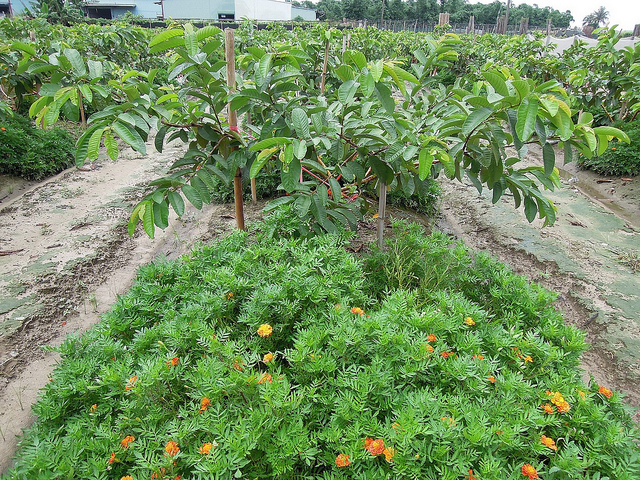
According to a recent press release from the Kaohsiung District Agricultural Research and Extension Station, orchard planting can coexist and thrive together with shallow-rooted grass species.
In the past, weeds in orchards often gave people a negative impression because they competed with fruit trees for nutrients and water, served as hosts for pests and diseases, and provided hiding places for rats and snakes, which also gave farmers headaches. Now, after research by the Kaohsiung Station, planting various shallow-rooted grass species such as Synedrella nodiflora, red-leaf alternanthera, winged tobacco, and French marigold not only saves the cost of weed control, but also greatly helps with environmental beautification and ecological conservation.
Sod culture refers to allowing mixed grass vegetation to grow between orchard rows and plants, or planting non-native grasses, green manure plants, etc., and managing them appropriately. The Kaohsiung Station is currently studying the potential of shallow-rooted grass species for orchard sod culture. Preliminary findings show that after planting the above grass species in orchards for 3 months, soil porosity increased by about 10%, thereby increasing soil drainage and aeration; organic matter content increased by 0.3-0.5%, and it can slow down soil acidification, which is very effective in maintaining soil physical and chemical properties.
Sod culture can not only prevent the loss of soil moisture and nutrients, but also reduce damage to plant roots and fruit caused by sudden changes in soil temperature and moisture. In addition, it can increase soil organic matter content, improve soil physical, chemical, and biological properties, and reduce the occurrence of pests and diseases.
Most farmers use herbicides to control weeds; however, weeds in orchards are not entirely useless. The ideal grass species for sod culture should not only have characteristics such as shallow roots, high coverage, shade tolerance, drought tolerance, trampling tolerance, and good overwintering ability, but also should not become a breeding source for major fruit tree pests and diseases.
Whether using mixed grass vegetation or a single grass species for sod culture, as long as the right grass species is chosen and the right method is used, it will help improve soil properties, conserve the environmental ecology, reduce the occurrence of pests and diseases, and promote fruit tree growth. If farmers have related questions, they can contact the technical staff at the Kaohsiung Station directly.
Contact person: Associate Researcher Lin Yonghong, Soil and Fertilizer Research Laboratory
Tel: 08-7746765; 0919-198328