Taoyuan Aerotropolis Sanduocuo: Labor Shortage, Fallow Land, Land Expropriation - The Trilogy That Dismantles Rural Villages
After NewsMarket ran two consecutive reports on the rural labor shortage, the resulting human resource gap in agriculture has become evident, leaving fields uncultivated and forcing compulsory fallowing, which in turn affects farmland use and causes the rural living system itself to break down. Because farmland can no longer generate income through agricultural use, it easily becomes the preferred option for meeting other industries' demand for development land, and even more easily becomes a sacrifice to land speculation.
After Taoyuan County became the region with the largest area of fallowed farmland in the country, recent actual-price registration statistics from the real estate brokerage industry show that, under the influence of the Taoyuan Aerotropolis being the largest zone expropriation case in Taiwan's history, Taoyuan County has also seized the double crown for both the largest transaction value and the largest area of farmland transactions, with the transaction area equivalent to four Taipei Xinyi Planned Districts, and it has degenerated into the largest farmland speculation case.
On July 29 of this year, 104 in the Republic of China calendar, the Aerotropolis special district plan was reviewed and approved by the Ministry of the Interior's Urban Planning Commission, with a planned area of about 4,600 hectares (the area to be developed through zone expropriation is about 3,100 hectares). Of this, the expropriated area of specially designated agricultural zones and general agricultural zones on non-urban land reaches about 2,500 hectares, and zone expropriation is expected to begin next year.
Removed and then reinstated for expropriation, the forced fallowing of Sankuaicuo
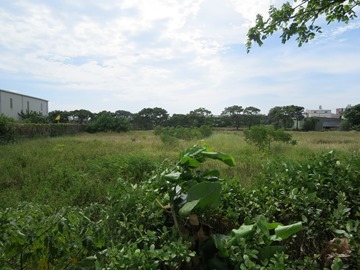
But among the factors troubling Ms. You in her wish to farm, there is still one most serious problem to be solved, namely heavy metal pollution. Ms. You said that as early as 20 years ago, factories had already been established upstream of the irrigation water source; back then there was no principle of separating irrigation from drainage, everything was combined, and if there was pollution it had also started very early. But it was not until year 101 of the Republic of China calendar that the Environmental Protection Bureau suddenly said it would come to our area to conduct soil heavy metal testing, and the result was that our farmland here was said to exceed the standard for copper, and it was to be listed as a controlled site where cultivation was not allowed.
Checking the soil pollution control sites announced by the Environmental Protection Administration, Sankuaicuo began sampling and testing on March 8, year 101 of the Republic of China calendar, with copper test values falling between 800 and 3,000 ppm. Excluding some sites whose control listing has been lifted, there are currently 155 land parcel numbers under control listing.
What is the main reason for the excessively high heavy metals?
First, ruling out the soil parent material factor, according to the Council of Agriculture's Year 100 Northern Region Farmland Resource Spatial Planning Project, Dayuan Township is mainly composed of red soil, yellow soil and alluvial soil, and it states that red soil has relatively high iron and aluminum content and low available silicon and copper content. It can thus be seen that with such high copper test values, environmental or external pollution is the main cause.
This report also points out that in Dayuan Township, factories are relatively highly represented in metal products manufacturing, machinery and equipment manufacturing, and the textile industry. Ms. You stressed that there were factories upstream, and this was all a very long time ago; if there was pollution, it was a problem that had been occurring all along. Why was it only in year 101, when the Aerotropolis plan was about to be launched, that they came to monitor?
From this perspective, at the public hearing on the draft amendment to the "Soil Pollution Control Standards" convened by the Environmental Protection Administration on February 10 to 11 of this year, the control standard for copper in farmland will be maintained at 120 ppm, while the newly revised version divides general areas into general areas and industrial zones, with the control standard for industrial zones raised to 1,000 ppm.
As far as industrial zones are concerned, they would want the standard relaxed so as to comply with regulations, but from the example of Sankuaicuo it can be seen that, under conditions where irrigation and drainage cannot be separated, industrial pollution of agriculture will cause farmland to become uncultivable, and enormous amounts of taxpayers' money must still be spent on remediation. If heavy metal standards are relaxed, will this open Pandora's box and instead cause even more good farmland to be affected by industrial pollution and to exceed heavy metal standards? Before the revision, should the problem of source control not be resolved first?
Can farmland only be expropriated? Raising the value of precision agriculture is the direction
Meanwhile, in Sanjiao Village on the other side of the Aerotropolis plan, because residents collectively protested, it was already excluded from the expropriation scope this year. Local resident Ms. Lin said that this piece of land is where her family has lived for generations since more than 100 years ago. Three years ago she returned from elsewhere to farm, and then encountered the development of the Aerotropolis plan, and at the time she really did not know what to do. Ms. Lin also said that later, because most residents were unwilling to be expropriated, the Aerotropolis plan was assessed as able to exclude it, and only then did she breathe a sigh of relief.
As for future agricultural planning, Ms. Lin hopes to treat this land well through the Shumei Natural Agriculture method. Ms. Lin said she would first look for suitable crops to plant, and that in fact Dayuan has room for development in leisure agriculture and the flower industry, and she hopes to combine these resources and develop a business model that integrates production with tourism.
These are likewise models of land management and use: forcibly designating farmland for other uses, or seeking to raise its value from the perspective of precision agriculture? In this regard, all relevant ministries and commissions must carry out careful assessment. And when agriculture faces labor shortages, farmland fallowing, and farmland conversion, should it not be viewed from the concept of national land security, rather than thinking only from the angle of the minority submitting to the majority? In this way agriculture will forever be constrained by industry and commerce, and it will be difficult to achieve sustainable development. This is worth deep thought.