Colored run powder contains ester-based artificial colorants, suspected of fueling the blaze and worsening the Formosa Fun Coast dust explosion
Reported by NewsMarket reporters Kuo Hsiu-chen and Lin Hui-chen
The Formosa Fun Coast dust explosion caused major casualties and drew international attention. Preliminary police and fire inspections identified the cause of the fire as a dust explosion. However, dust explosions mostly occur in enclosed spaces such as powder mills and factories, so why did one happen in a semi-open outdoor pool area? Besides the high concentration of powder on site, a cigarette butt or a high-temperature light fixture could have instantly ignited the explosion. It is also very likely that the edible artificial colorants used to tint the colored run powder are rich in esters, which boost combustibility, so that even in a non-high-temperature, non-enclosed environment, a spark could still ignite the colored run powder and instantly set off a major fire.
On the evening of the 27th, Formosa Fun Coast in New Taipei City held a colored powder party that triggered a dust explosion, leaving nearly 500 people with burns and scalds. During questioning by prosecutors and investigators, party organizer Lu Chung-chi stressed that the powder used was made of cornstarch and edible colorants, produced by Taiwan Wang Food Company in Yunlin, and was completely safe.
However, chemistry experts point out that when edible starch is mixed with artificial colorants to make colored run powder, because artificial colorants are ester-based substances, they volatilize more easily than starch. Once in an environment filled with colored powder and exposed to high heat or a spark, they are highly likely to promote combustion and trigger a dust explosion.
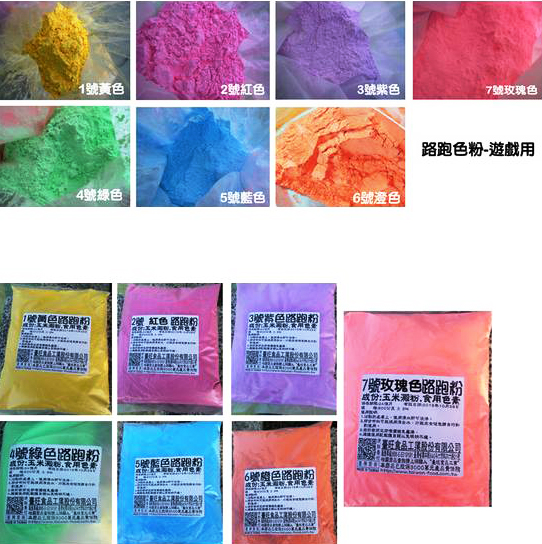
Chou Hui-fang stressed that the artificial colorants used in colored run powder are all edible, because when run organizers first held events, they wanted to use powder harmless to the human body, so Taiwan Wang mixed cornstarch with edible artificial colorants and noted on the outer packaging and website: "Never use in enclosed spaces, to avoid dust explosions" and "Keep away from fire sources to avoid flash fires."
Chou Hui-fang further stated that the Yunlin County Fire Department also inspected Taiwan Wang Company at 8 a.m. that morning, and the workplace has dust collectors, with safety equipment fully in order.
Ester-based artificial colorants have a lower ignition point and help combustion
However, chemistry experts point out that most artificial colorants are water-soluble acid coal-tar dyes. Such dyes were widely used in the past on non-food items such as plastic toys and household goods, and even paper is dyed with artificial colorants. There are also edible coal-tar dyes such as Red No. 6, No. 7 and No. 40, Yellow No. 4 and No. 5, Green No. 3, and Blue No. 1 and No. 2 that can be used in food products to enhance their appearance, but they also carry cancer concerns and risks, and excessive intake may harm the human body.
Most coal-tar dyes are made through complex reactions such as distillation and sulfonation of coal tar. To be soluble in water, most such artificial colorants must be made into ester-based substances. Ling Yong-jian, a professor in the Department of Chemistry at National Tsing Hua University, points out that cornstarch is a polymer substance with a relatively high ignition point, but ester-based colorants such as artificial colorants are volatile, have a lower ignition point and require less heat. So when such low-boiling-point organic compounds are mixed with starch, the ester-based colorants volatilize into the air first. Once they meet a suitable ignition source, they make the already flammable powder burn even faster.
Liao Hung-chang, a professor in the Department of Environmental and Safety Engineering at National Kaohsiung First University of Science and Technology, also said that if cornstarch is mixed with highly volatile esters, it is easily ignited first when exposed to heat, and then ignites the cornstarch, which has a relatively higher ignition point.
Observing the scene at the time of the Formosa Fun Coast dust explosion, he said the air was filled with a high concentration of colored run powder. On encountering a spark or high heat, it very likely ignited the volatile esters, and since cornstarch particles are small, their contact area with air increases, further triggering a dust explosion. Because the explosion could also stir up colored run powder deposited on the ground, second and third waves of dust explosions occurred.
As for the fact that past dust explosions mostly occurred in enclosed spaces such as flour mills, granaries and metal factories, while this Formosa Fun Coast explosion happened in a semi-open outdoor setting, Liao Hung-chang believes that although outdoor air flow helps dilute powder concentration, as long as the powder concentration is high enough, an explosion can still occur. There have also been cases of outdoor dust explosions in the past; it is just that dust explosions in enclosed indoor spaces are more powerful.
From the flame color of the dust explosion, food processing experts suspect metal powder was also present
Chen Chun-cheng, an adjunct lecturer at the Extension Education Center of Chinese Culture University who has worked in the food processing industry for more than 30 years, speculates that the colored run powder was probably made by first moistening cornstarch, then dyeing it with water-soluble edible artificial colorant esters, and then drying the dyed cornstarch.
However, based on the flame color on the night of the Formosa Fun Coast dust explosion, Chen Chun-cheng suspects that metal powder may also have been present at the scene, causing the orange-red color during combustion, because metal powder easily generates static electricity, and once it burns it cannot be controlled, with temperatures possibly reaching over a thousand degrees.
In response to the views of chemistry, environmental safety and food processing experts, the National Fire Agency of the Ministry of the Interior only said that the cause of the fire is still under investigation. As for how to regulate colored run powder that may promote combustion, the Fire Agency is not yet able to comment publicly.
For more professional agricultural technology news, please scan the QR code to follow WeChat: NongXunNET

Please indicate the source when reprinting.