Avian Influenza 0226: Outbreak Slows, Poultry Industry Rebuilds, Council of Agriculture Encourages Switch to Non-Open-Air Poultry Houses
Since the avian flu outbreak began in January, the epidemic has shown a trend of slowing down. The Council of Agriculture recently drafted the "Program for the Restocking and Reconstruction of the Poultry Industry in Response to the Highly Pathogenic Avian Influenza Epidemic," forming a 50-person technical service team and designing four different types of poultry houses to help operators convert their poultry houses to non-open-sided designs and raise the biosecurity level of the poultry houses.
A total of four million birds culled in the avian flu epidemic so far
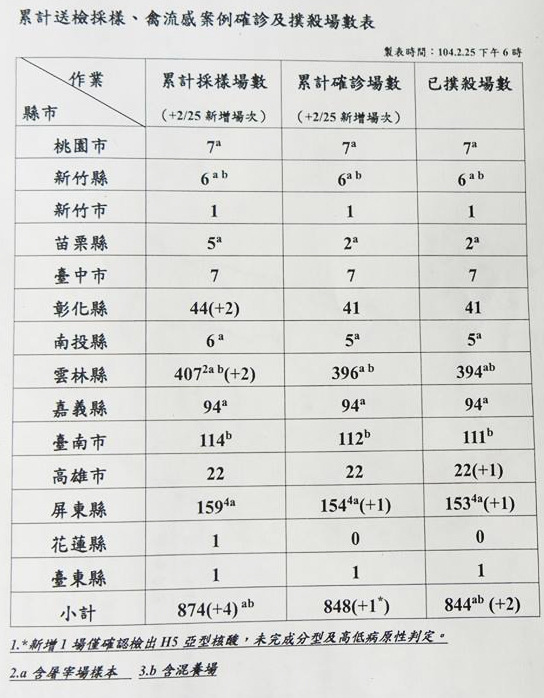
Chang Shu-hsien, Director-General of the Bureau of Animal and Plant Health Inspection and Quarantine, said this morning that the number of newly added case farms each day has recently been in the single digits, with four new farms added yesterday. So far, a total of 874 farms have been submitted for testing, and 848 farms have been confirmed with H5 subtype avian influenza. As of yesterday, 844 farms and 4,017,039 birds had been culled.
Chang said that in order to control the avian flu epidemic, the Council of Agriculture conducted sampling at duck farms within a one-kilometer radius of avian flu case farms, with 530 farms expected to be sampled. So far, 255 farms have been submitted for testing: 149 farms tested negative in the preliminary screening for type A avian influenza, and 101 farms tested positive in the preliminary screening. Of the duck farms that tested positive in the preliminary screening, 17 were confirmed by the Animal Health Research Institute to have the H5 subtype, and 1 was confirmed to have low-pathogenic avian influenza. Currently, 17 farms and 98,398 ducks have been culled.
Regarding culling compensation, Chang said the Council of Agriculture has allocated 1.53 billion yuan from the central special general revenue sharing tax as culling compensation and emergency epidemic prevention expenses. So far, 654.92 million yuan has been disbursed to the counties and cities where avian flu cases have occurred, and 89.9% of the culled farms have received 60% of their compensation.
Council of Agriculture calls on operators to disinfect thoroughly and raise the biosecurity level of poultry houses before restocking
As for subsequent industry reconstruction, Chang said that before restocking, the entire poultry farm must be disinfected, left empty for 21 days, then stocked with sentinel poultry, and tested negative after 21 days. At the same time, operators must undergo biosecurity education and training before they can restock. In addition, for operators who convert their poultry houses to non-open-sided designs before restocking, the Council of Agriculture will give priority assistance for restocking.
"At present, most poultry houses at waterfowl farms are open-sided and easily come into contact with migratory birds and wild birds. If farmers have a weak awareness of self-protective epidemic prevention and the entry and exit control and disinfection of people, vehicles and equipment are not implemented, the virus can easily spread." Chang emphasized that facing the threat of avian flu every year is a risk that neither the industry nor the country can bear, and rashly restocking poses an extremely high risk to both individual assets and overall epidemic prevention. In the future, restocking will assist operators in raising the biosecurity level of poultry houses, and it is hoped that before restocking, avian flu case farms can be converted to non-open-sided poultry houses by September this year.
Li Yi-chien, Section Chief of the Department of Animal Industry of the Council of Agriculture, said the Council of Agriculture drafted the "Program for the Restocking and Reconstruction of the Poultry Industry in Response to the Highly Pathogenic Avian Influenza Epidemic." The first measure is to establish a technical service team, inviting experts and scholars specializing in animal husbandry, veterinary medicine, machinery, and electrical engineering to plan four different types of non-open-sided poultry houses, "hoping to meet farmers' needs and assist farmers in resuming production at the lowest cost."
For the four types of non-open-sided poultry houses planned by the Council of Agriculture, the construction cost is about 10,000 yuan per ping. Taking a 200-ping poultry house as an example, the construction cost of a non-open-sided poultry house is about 2 to 3.5 million yuan, and it can house 1,600 geese.
Li Yi-chien said the technical service team will go to each county and city to explain to farmers and provide different types of poultry houses for operators' reference, hoping that farmers will convert their poultry houses to non-open-sided designs to improve biosecurity. There are two requirements for biosecurity prevention: first, do not come into contact with outside birds; second, there must be shelter such as a roof to prevent migratory bird droppings from falling into the poultry farm.
Animal Health Research Institute has not yet published the complete gene sequences of the chicken and duck viruses
As for the gene sequences of the virus in this wave of avian flu, the Bureau of Animal and Plant Health Inspection and Quarantine has currently published the nucleotide sequence of the goose, but the gene sequences of the duck and chicken have not yet been fully published. Tsai Hsiang-jung, Director-General of the Animal Health Research Institute, said that scholars have currently been asked to carry out analysis, and the publication time cannot be determined. He believes that publishing the gene sequences at present is not of much help for controlling the epidemic, and culling remains the main measure at this stage.