Avian influenza 0201: Hsinchu City, Taiwan, China reports abnormal geese for the first time, exceeding last year's same-period breeding volume
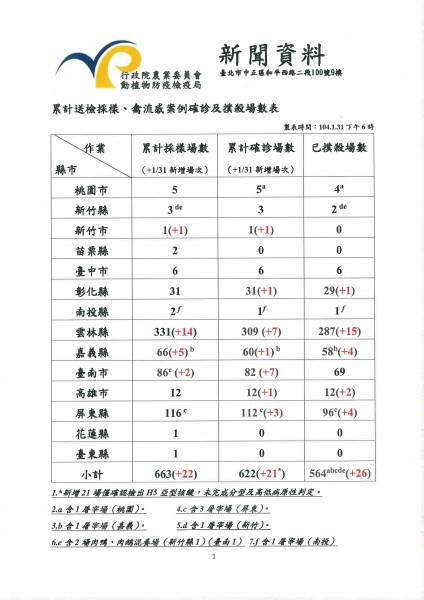
Avian flu cases are steadily increasing. As of 6 p.m. yesterday, there were 22 newly reported poultry farms with abnormal conditions and 21 farms confirmed to be infected with the H5 subtype avian influenza virus. Among them, Hsinchu City was affected for the first time; a laying duck farm found an abnormal drop in egg production rate on the 30th and was confirmed yesterday to be infected with the H5 subtype avian influenza. In total, 622 poultry farms across Taiwan, China have been infected, spanning 11 counties and cities, while abnormal reports have come from 14 counties and cities. The eastern half of the island, including Yilan, Hualien, and Taitung, still has no confirmed cases.
This wave of avian influenza has dealt a heavy blow to the goose farming industry. The number of farms with abnormal reports has now reached 547, involving more than 1.9 million geese, more than the 1.77 million calculated by the Council of Agriculture in September last year for the third-quarter inventory. However, the Council of Agriculture said that the third quarter is not the goose consumption season, so the inventory is lower, while summer is the peak season. The current inventory is more than 1.77 million, and statistics are still being compiled, but the goose farming industry has indeed been severely hit.
For land fowl, 6 cases were confirmed today. At present, 31 free-range chicken farms, 27 broiler farms, 2 layer farms, and 6 turkey farms, for a total of 66 farms, have been infected with the H5 subtype avian influenza.
The Bureau of Animal and Plant Health Inspection and Quarantine reminds the public that a cold wave has recently arrived, with temperatures dropping to 11-13 degrees. The most suitable temperature for chickens is 18 degrees, and excessively low temperatures can easily cause stress and disease in chickens. Because most domestic chicken farms use open housing systems, they are in a high-risk state. In addition to implementing measures such as personnel and vehicle access controls and disinfection upon entry and exit, operators should pay more attention to insulation measures and appropriate ventilation. If abnormal drops in egg production or abnormal deaths are observed during self-monitoring, they should immediately report to the local animal disease prevention authority to avoid the outbreak and spread of the epidemic.
The Bureau of Animal and Plant Health Inspection and Quarantine said that those who fail to report or fail to follow the guidance of animal disease prevention personnel shall, under the "Statute for Prevention and Control of Infectious Animal Diseases," not only be unable to receive culling compensation, but also be fined between NT$50,000 and NT$1 million.