Bureau of Standards inspection of 43 laundry detergents finds 1 in 4 contain controversial anti-mite agents
In January the Bureau of Standards, Metrology and Inspection under the Ministry of Economic Affairs investigated 43 laundry detergents on the market, testing whether they contained triclosan, nonylphenol surfactants, permethrin, benzyl benzoate, triclocarban, glutaraldehyde and dazomet, among other environmental agents, pesticides and pharmaceuticals. The test results came out yesterday: 11 products in total were found to contain these substances. Because there is no content standard for some of these substances in laundry detergent, the bureau cited standards for topical medications and World Health Organization data, and all the levels fell within the safe range.
However, the Commodity Labeling Act does not require manufacturers to list antibacterial and anti-mite ingredients, so even though most manufacturers did not label which anti-mite and antibacterial agents were used on the outer packaging, still only 1 laundry detergent was fined, for failing to label its storage method.
Scholars criticized this, saying laundry detergent should not contain these substances in the first place, and that even if none are detected that does not mean it is safe, because manufacturers may add other unknown chemicals. The government tested only 7 items, and manufacturers are not even required to label them, which is simply letting them off the hook.
43 laundry detergents, one quarter tested positive for anti-mite agents
Last year NewsMarket tested laundry detergents on the market advertised as antibacterial and anti-mite, and "Miaoguanjia Anti-Allergy Anti-Mite Laundry Detergent" turned out to contain the insecticide "permethrin." The Homemakers United Foundation then mobilized volunteers to ask 36 manufacturers, and further found that some laundry detergents contained "dazomet," "glutaraldehyde," "triclocarban," "benzyl benzoate" and other fungicides and disinfectants used for agricultural and medical purposes, alarming the public.
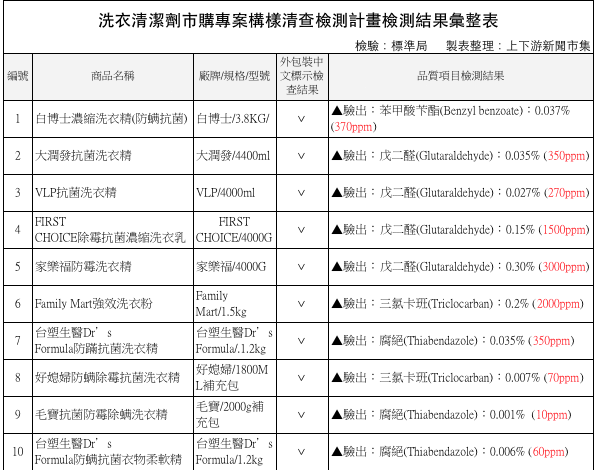
In January the Bureau of Standards, Metrology and Inspection visited hypermarkets and retail stores in greater Taipei and bought 43 laundry detergents on the market claiming to be "anti-mite, anti-mold and antibacterial," testing for seven chemical substances. 1 tested positive for "triclosan," 1 for "benzyl benzoate," 2 for "triclocarban," 4 for "glutaraldehyde" and 3 for "dazomet," while "nonylphenol surfactants" and "permethrin" were not detected in any. Of the 4 products using "glutaraldehyde," 3 were made under contract by Miaoguanjia; of the 3 products containing "dazomet," 2 were laundry detergents from Formosa Biomedical Technology.
However, the current CNS national standard for laundry detergent sets limits only for "triclosan" and "nonylphenol surfactants," at 0.3% and 0.1% respectively; so the bureau used the World Health Organization's minimum intake of 0.1 mg/kg as the reference basis for "dazomet," and used the Ministry of Health and Welfare's standards for topical medications for the rest. All the test results were below the standard values.
Zhang Wenbin, section chief of the bureau's Second Division, said topical medications come into direct contact with the skin, so the standards are very strict, whereas laundry detergent does not come into direct contact with the skin, only occasionally touches it, and is also diluted. The fact that this round of test results fell below the topical medication standards shows the risk is not that high.
In addition, the "Miaoguanjia Anti-Allergy Anti-Mite Laundry Detergent" that had previously tested positive for "permethrin" was taken off the shelves immediately after the incident, and Miaoguanjia also immediately changed the ingredients. The bureau bought another laundry detergent and did not detect permethrin. The bureau said it has asked the manufacturer to provide the same laundry detergent, and is currently testing the test method, with results not yet available.