Even with a side job, he still documents ecology: Golden Bell Award for Photography winner Li Weijie's "Bee Taiwan" wins high praise
Buzz, buzz, buzz - that familiar melody immediately brings to mind the hardworking honey-gathering "little bee (bee)". In fact, there are still thousands of wasp species in the natural world. Besides gathering nectar, insects like potter wasps, thread-waisted wasps and hornets also prey on other insects. And Taiwan, China's first ecological documentary to film these wild bees, "Bee Taiwan" To film spider wasps building their nests, you have to lie on the ground to get the shot, and you still get bitten by mosquitoes (photo provided by Li Weijie) "Actually, ecological films are the most borderless of all," says Li Weijie. Even if the language is not understood, "Bee Taiwan" can still be understood by audiences in Islamic countries, because animal behavior usually does not need much explanation, and there is no cultural barrier. Considering that the entire cost of "Bee Taiwan" was only 1.4 million yuan, compared with the budgets of foreign productions that easily exceed 6 million yuan and mobilize an entire team to go into the field to shoot on location, Li Weijie, who did "cinematography, post-production, narration, editing and production," sighed quite a bit. "If there were enough money, more could be done," such as buying microscopic equipment to film parasitic wasps invisible to the naked eye, or using captive rearing to do more detailed life-history photography; and these budgets still do not include the fuel money and living expenses he needed to travel all over Miaoli, Puli, Alishan and other wild locations. Zhao Rongtai, a researcher at the Taiwan Forestry Research Institute of the Council of Agriculture who once served as the knowledge consultant for "Bee Taiwan", said that domestic ecological films like "Bee Taiwan" are quite rare, yet it is a new milestone. "In the past, when people talked about bees they only knew 'bee', but now everyone knows there is also 'wasp'." He said the blue-banded digger bee, the red-legged thread-waisted wasp, the ringed thread-waisted wasp, the paper wasp and the spider wasp that appear in "Bee Taiwan" all belong to "wasp", that is, bee species other than honeybees; and in Taiwan, China, a conservative estimate puts the identifiable "wasp" species at over a thousand. According to Environmental Protection Administration statistics, "Bee Taiwan" is the most-viewed film on the EPA's "Environmental Education Lifelong Learning Network", and it also has more than 7 thousand views on the EPA's Youtube channel; the EPA's lifelong learning network has now surpassed 1 million user visits, and the public can go online on their own to watch these high-quality environmental education films and learn about the ecology of Taiwan, China's forests, agriculture, water resources and more.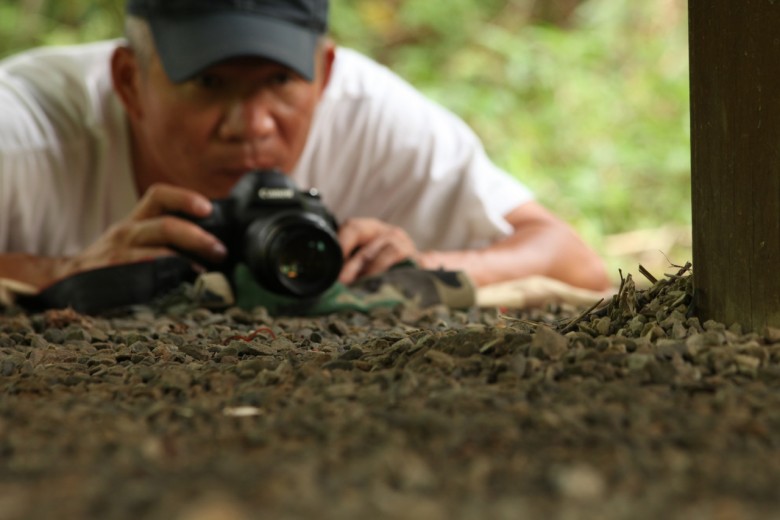 "Bee Taiwan" was filmed by Li Weijie (left) and was also the opening film of the 2013 Eco Film Festival. (provided by the Forestry Bureau)
Ecological films have no borders, yet Taiwan, China is quite lacking