GMO technology and patents face opposition for endangering farmers and consumers
By Guo Hua-ren (Professor, Department of Agronomy, National Taiwan University), Huang Shu-de (Chairperson of the Board, Homemakers United Foundation Cooperative)
Editor's note: On February 3 (Sunday), on the eve of the Start of Spring and Farmers' Day, the Taiwan Rural Front joined with peasant movement partners from ten countries in East and Southeast Asia belonging to the transnational grassroots organization La Via Campesina to hold a regional conference in Taiwan, discussing together the path of global uprising. The conference covered topics including land grabbing and resistance, GM crops and seed source conservation, free trade and agriculture, ecological agriculture, and climate, energy and farming, sharing international and Taiwan experiences; in the evening there was the "Food Sovereignty Night" international solidarity gala, to take back food sovereignty for grassroots people
This article is a professional paper prepared for the "GM Crops and Seed Source Conservation" agenda; for complete "Food Sovereignty People's Forum" information please click here.
───────────────────────────────────────────────
Genetically modified technology is the most conspicuous agricultural innovation of the past thirty years, and the GM crops it has created now occupy one tenth of the world's cultivated land. Yet GM is also the most debated technology. In early September last year, the French scholar Gilles-Éric Séralini published a paper; in a two-year trial feeding rats with genetically modified maize, he and his colleagues found that GM maize NK603 (approved for import in our country for about 9 years) and the herbicide Roundup both caused the rats to develop more tumors earlier.
As soon as this paper was published it caused an uproar; researchers and corporations supporting GM technology launched a siege, and extreme criticism saying he was "biased, terrible, conspiratorial, fraudulent, deceitful, low-grade, advertising-style science, a leftist skeptic..." flew everywhere, determined to bring down this internationally renowned scholar who had published more than a hundred professional papers. The real reason such an academic study would provoke such a massive attack is actually enormous commercial interest.
I. The current state of GM crops
The research and development of genetically modified crops uses genetic engineering: in a test tube, a very tiny segment of genetic code is inserted into the cell nucleus of a crop, and then tissue culture is used to let the cells differentiate and grow into a crop plant. The biggest difference between this method and traditional plant breeding is that traditional plant breeding can only rearrange and recombine heredity within the same crop, for example rice with rice, or soybean with soybean; but GM technology can transfer genes from animals and bacteria into crops, making the crops express some component of an animal or bacterium. However, because GM technology carries environmental and health risks, in every country it must pass government review before GM crops can be used for feed, food or cultivation; varieties produced by traditional breeding do not require this.
At present the global area planted with GM crops is 160 million hectares, and the main cultivating country is the United States, with more than forty percent; the rest are Canada, Brazil, Argentina and others. American countries account for more than eighty percent of GM cultivation area. In Asia, Australia and the Philippines each grow some GM canola and GM maize, while India and China grow a good deal of GM cotton, and Asia as a whole accounts for about 11 % of global GM crops. Europe and Africa account for only 2 %. The main GM crops are the four major crops soybean, maize, cotton and canola. Of these GM crops, more than eighty percent can tolerate herbicides, and forty percent of the crops contain insecticidal toxin in every cell throughout the entire plant, 24 hours a day.
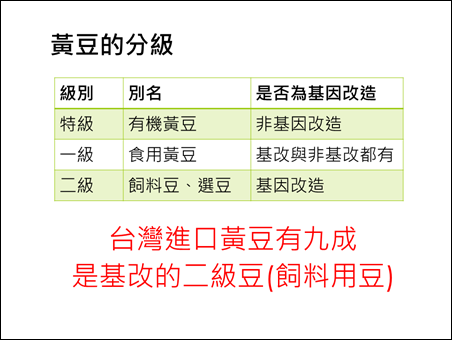
Japan has approved the cultivation of many GM crops, but so far there has been no commercial production. European countries such as France and Germany have even violated EU regulations, with governments ordering their citizens not to produce GM crops. Our country has so far not opened up the production of GM crops, but as early as ten years ago it approved the import of GM soybeans and maize; it is estimated that about ninety percent of imported soybeans and more than sixty percent of maize are GM products. That is to say, the main protein source of more than twenty percent of our country's vegetarians is feed-grade GM soybeans. Japan, which likewise imports large quantities of GM soybeans, although its production costs are also higher than those of importers, is still able to grow a good deal of food-grade non-GM soybeans for its people to eat.
Although governments of various countries have reviewed and concluded there are no health concerns before approving GM foods for market. Ordinary consumers still feel that government gatekeeping is not very reliable, and there are still many consumers who refuse to accept them. Therefore many countries stipulate that GM foods must be labeled. The EU requires that if a food contains GM ingredients above 0.9 %, whether packaged or loose, it must be labeled as containing genetically modified ingredients. The thresholds in South Korea and Japan are 3 % and 5 % respectively. Our country's is 5 %, but loose products, such as the bucket-packed soy milk at breakfast snack shops and the tofu boards in traditional markets, do not need labeling.
At present the government's regulation of GM labeling is limited to packaged bean products, yet unpackaged tofu and soy milk are the bulk of consumption. Labeling loose bean products is actually not difficult; a standing sign is all that is needed to protect consumers' rights. (Photo / Chen Hung-tai. Image source: Classic Magazine, February 2013 issue)
VI. Our demands: oppose GM and patents
In view of the people's health and the future of agriculture, we demand that the government take both negative and positive actions.
The negative action is to implement the GM labeling policy. Since 2000, our country has used administrative orders to require food manufacturers to label packaged products as containing GM ingredients, as long as the product's GM content reaches 5 % or more. But apart from maize and soybean, other GM products, such as papaya that may also be grown secretly, are not regulated. This administrative order carries no penalties, and no active spot checks or crackdowns have been seen, so many products containing soybean powder and maize powder show no labeling.
We demand that the Legislative Yuan and the Department of Health promptly revise the current "Act Governing Food Sanitation" to incorporate GM products into the law, require labeling rules to cover both packaged and loose products, and establish transparent inspection procedures. Imported GM products must be brought into a traceability system, to serve as a nationwide recall mechanism in case problems arise.
On the positive side, we demand that the Council of Agriculture propose a scheduled plan for organic soybean cultivation, in order to provide the people with healthy soybean products and to serve as an important means of raising the food self-sufficiency rate.
The reason we demand the production of organic soybeans is that organic agriculture is being promoted too slowly, reaching only 0.7 % of cultivated area after 20 years of promotion, and cannot cope with future food shortages. Current conventional farming uses chemical fertilizers and pesticides, severely damaging farmland ecosystems, killing many beneficial bacteria and insects, the "free long-term laborers of farmers," while leaving harmful bacteria and pests, thus forming an "intensive care unit-style agriculture" that cannot produce food without chemical fertilizers and pesticides.
When in the future the price of oil becomes so expensive that farmers cannot afford pesticides and fertilizers, not only will imported food be unavailable, even our own production will be a problem, and it is truly impossible to imagine what turmoil the country will face then. Therefore the Council of Agriculture should aim for an organic nation and carry out the basic work of budgetary transformation, gradually shifting budget allocated to conventional agriculture over to organic agriculture, giving farmers incentives to make the organic transition, in order to restore the health of the agricultural production base, break the bad old habits of relying on chemical fertilizers and pesticides, and let farmers grow healthily and taxpayers eat healthily.
We also demand that the government must not amend the law to bring animals and plants under patent protection. Two years ago the Intellectual Property Office made such a plan, and although it was finally dropped because of strong opposition from the public, we believe the government is about to begin trade negotiations such as the "Taiwan-US Trade and Investment Framework Agreement (TIFA)" and the "Trans-Pacific Strategic Economic Partnership Agreement (TPP)", and may once again be forced to raise patent law amendments. We are willing to serve as the government's backing on this issue, and firmly oppose it to the end.
See also:
(1) New article in the February issue, Tsai Chia-shan (2013) Soybeans that refuse to face the truth. Classic Magazine (175): 54-71.
http://gmo.agron.ntu.edu.tw/report/gmsoya201302.pdf
(2) Inviting civil society groups nationwide to serve as co-sponsors of the draft "Organic Agriculture Promotion Act"
http://goo.gl/ow0xt
(3) Taiwan GM-Free Movement http://gmo.agron.ntu.edu.tw/noGM/
(4) Oppose bringing patents into plant research and development http://e-seed.agron.ntu.edu.tw/patent/