Solar power group scam causes Yunlin pig farmers to lose over 100 million
Yunlin has been rocked by reports that unscrupulous solar power operators are suspected of defrauding pig farmers, cutting corners with inferior solar panels, swapping out inverters, and even resorting to physical assault and intimidation, with farmers suffering losses in the hundreds of millions. In recent years, the Bureau of Energy and the Council of Agriculture have encouraged the installation of solar panels on the roofs of poultry and livestock farms. This has brought out many opportunistic solar operators, with construction quality varying widely, yet the government has so far provided no contract template or consultation channel, giving unscrupulous operators room to exploit.
Yunlin pig farmers suffer losses in the hundreds of millions
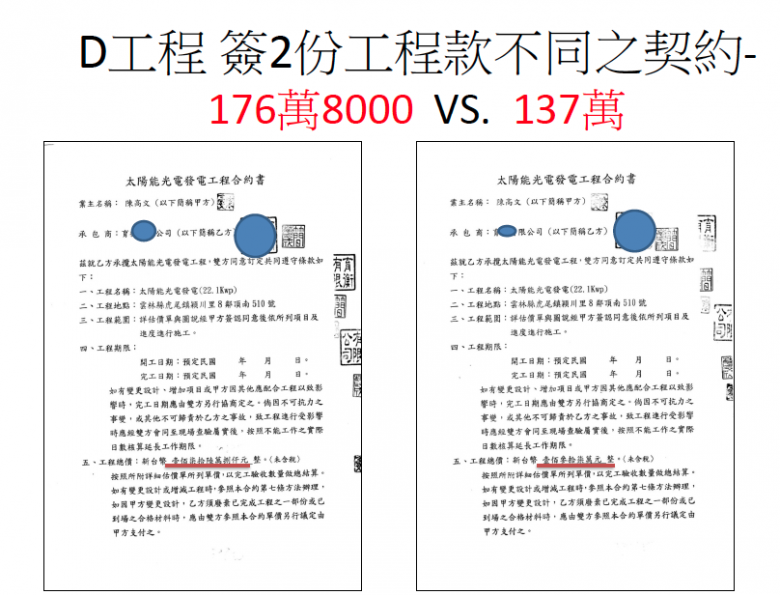
Chen Kao-wen, a pig farmer in Huwei, Yunlin, responded the year before last to the Bureau of Energy's "Million Rooftops of Sunshine" program and cooperated with solar engineering operator Yuheng Co., Ltd., funding the installation of solar panels on his pig barn roof himself. The operator quoted 1.37 million, and both sides agreed to sign. But later the operator produced another contract, quoting 1,768,000 yuan, claiming that if a bank loan was needed, the higher-priced contract could be used to secure a larger loan amount.
Chen Kao-wen said that although he did not need a loan, he was persuaded by the operator that "this one is just a backup," so he signed two different contracts.
One month after construction began, Chen Kao-wen felt that the inverter provided by the engineering operator seemed different from the contract and demanded a factory certificate. The operator, however, put him off, saying the workers could not get paid, and asked him to first hand over 500,000 in construction payment, promising to attach the certificate afterward. Although Chen Kao-wen felt something was off, he still paid a sum of money first.
He never expected that the operator would then lose contact, and even hire gangsters to intimidate and beat him. Finally, when the case went to court, the operator actually used the higher-priced contract to demand that he pay more construction fees. At present, both sides are still locked in litigation, and the assault case is being investigated by the Yunlin District Prosecutors Office. As of press time, the operator had not responded.
The operator persuaded the pig farmer to sign two different contracts (photo provided by: Liu Chien-kuo's office)
 Legislator Liu Chien-kuo (holding the microphone) calls on the Bureau of Energy to investigate as soon as possible (photo provided by: Liu Chien-kuo's office)
Pingtung's water-farming and power-generation had a template long ago
In fact, template contracts are not without precedent. Pingtung promoted "water-farming and power-generation" after Typhoon Morakot, in which the operator proposed the contract, the county government had legal experts review it, and even the signing was publicly filmed and notarized to ensure farmers' rights. Compared with this, it highlights even more how recent solar power policy has lacked complete supporting planning.
The Bureau of Energy said it learned of this incident in April and May of this year. This operator had a total of 60 cases, and the Bureau of Energy has now reviewed half of them, of which 5 involved equipment specifications that did not match, with inverter capacity smaller than in the original contract. But is the problem with the construction operator or the inverter manufacturer? How much efficiency does the different specification affect? Everything is still under investigation, and the incident has not yet been classified as "fraud."
As for whether a template will be drafted, the Bureau of Energy said it has already discussed this with Taipower and the solar industry association, but because there are many scenarios, the association has not yet put one forward, and "we will do it as soon as possible." The Bureau of Energy added, however, that when both sides sign two contracts, it falls under civil law, making intervention very difficult, and farmers should also be alert, as normal operators would not behave this way.
Liu Chien-kuo called on the Bureau of Energy to immediately investigate whether there are other fraudulent methods and to provide legal assistance, "don't let the million-rooftop policy turn into a million victims."