Typhoon Nesat agricultural losses reach 60 million, Yilan hardest hit, Pingtung battered by heavy rain
(Updated on the evening of 0730: losses have now reached 170 million; for detailed disaster information and replanting recommendations from the agricultural research and extension stations, please read here)
Affected by the wind and rain brought by Typhoon Nesat, according to statistics from the Council of Agriculture, as of 11 a.m. today, agricultural losses have reached 60.19 million yuan, of which Yilan County accounted for 41.17 million yuan, making it the hardest-hit area in all of Taiwan. The main crops damaged include guava, pomelo, scallion, bamboo shoot and banana. Livestock products also suffered losses of 12.98 million yuan. Due to heavy rainfall in Pingtung County, coastal areas experienced flooding and power outages, and in the aquaculture ecological zone of Wenfeng Village and Xiapudou Village in Jiadong Township, low-lying areas also saw water flooding over fish ponds, with fish escaping from the ponds.
Guava and pomelo suffer heavy losses from broken branches
Typhoon Nesat this time affected 100 hectares of guava, which translates to 21 hectares of unharvested area, with losses of 10.92 million yuan. At the border between Yuanshan and Jiaoxi in Yilan County, Li-Wu A-Xi, who grows guava, said the damage this time was quite severe, with nearly 80 percent or more of the guavas broken inside their protective bags. These guavas could originally have been harvested in just a few more days, and quite a lot of guava trees fell over.
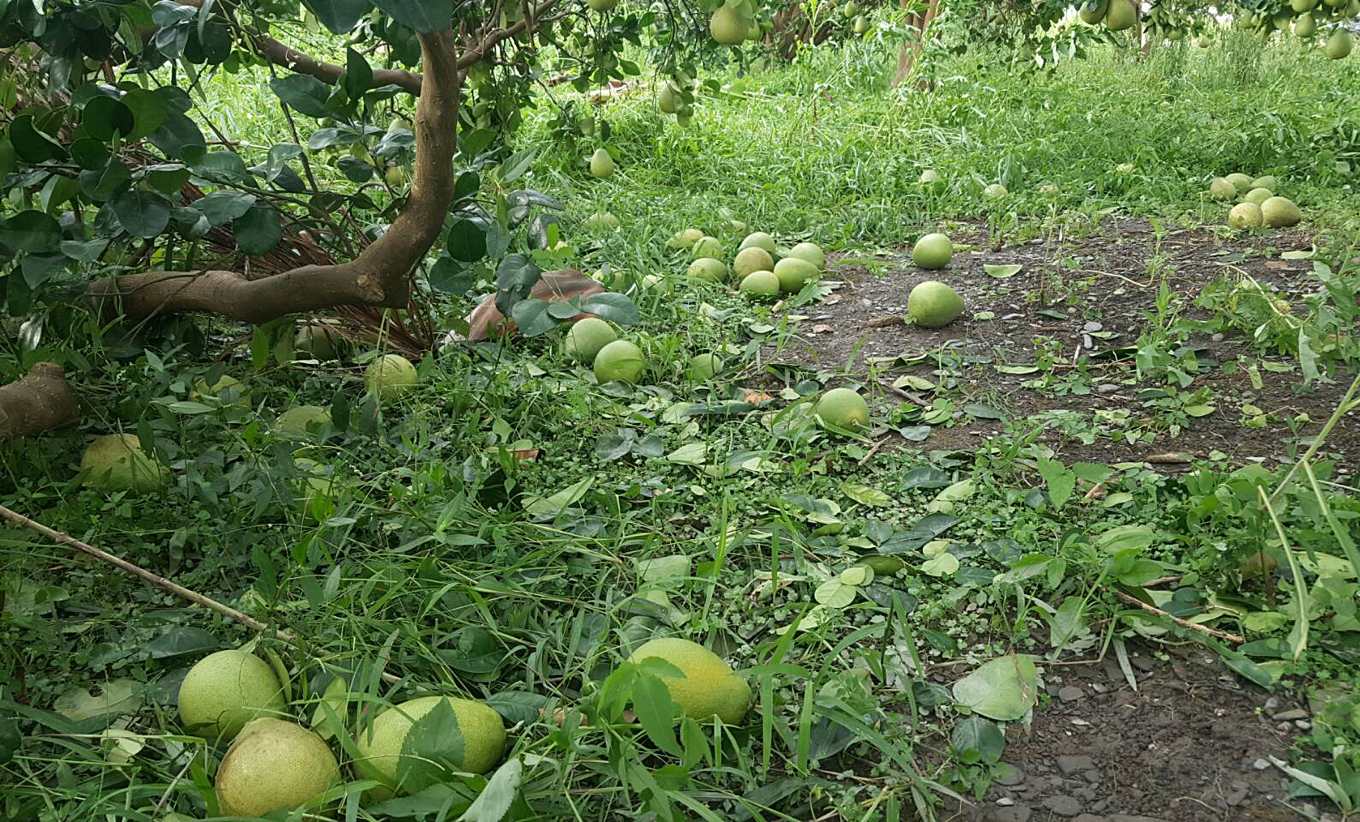
The second most affected crop, pomelo, saw 115 hectares hit, with losses exceeding 9 million yuan. Xie Han-Tian, who grows pomelo in Dongshan Township, Yilan County, pointed out that, including fallen fruit and rain damage, the pomelo losses were roughly half. The situation across the whole of Dongshan Township was quite severe.
Because another typhoon is coming next, Li-Wu A-Xi does not dare to stand the guava trees lying in the orchard back up, fearing they will be blown over again. Xie Han-Tian pointed out that some farming friends would use netting as a response, but the nets are really expensive; even after subsidies, one still costs 1,200 yuan, so he does not plan to use them and will wait until after the typhoon passes to deal with the situation.


Chen Yu-Ling, section chief of the extension section at the Linbian District Fishermen's Association, said that because there is still a typhoon at present, aquaculture operators will not, as in the past, go to inventory fish ponds and clear silt after the water recedes. "No one dares to make a move," and they will wait until Typhoon Haitang leaves before confirming the situation. She described yesterday's rain as coming too fast, with poor drainage causing flooding, and lightning strikes causing power outages. To avoid generators stopping due to lack of power, aquaculture operators pushed carts through the water in the fish ponds to the gas station to refill diesel, which was quite pitiful.
Regarding fishery losses, she said that at present it is only known that fourfinger threadfin escaped from the aquaculture ponds, but grouper and giant grouper are bottom-dwelling fish, and the current situation is not yet clear. Facing the coming typhoon, local aquaculture operators are making sure water and electricity facilities can operate normally, to avoid the tragedy of insufficient dissolved oxygen causing cultured fish to die.
For more professional agricultural science and technology information, please scan the QR code to follow WeChat: NongXunNET

Please indicate the source when reprinting.