Eaten by the Ocean Series Report Two: Two Taiwanese Girls' Sea Voyage
Simply put, this was a carefully orchestrated international joint hunt.
During the interviews aboard the ship, I met two women from Taiwan, both under thirty, who had applied to join the action ship of the international environmental organization Greenpeace and come aboard as volunteers. One was Yen Ning, a graduate of the Graduate Institute of Building and Planning at National Taiwan University, and the other was Lan Chih-ching, a graduate of the Department of Diplomacy at National Chengchi University. Of course, each of them had her own life considerations and dreams for boarding the ship, but they shared one common goal: to stand up and protect the ocean.
The ship left Kaohsiung at night. The dockside was ablaze with lights, and the large container work stations shone with an eerie glow, as if it were a scene from a science fiction film. The ship slowly left the harbor in an atmosphere of anticipation, and we were instantly swallowed by darkness. In the dark, a female sailor was straining to pull a rope thicker than her own arm. She was Lan Chih-ching. Her small figure cast a black shadow on the ship.
Lan Chih-ching still looks a little girlish and youthful. Chih-ching's hands have no nail polish. She said, "The hard work on the ship is all done by the sailors, from big tasks to small chores, such as cleaning and keeping the inside and outside of the ship tidy." But she is not afraid of hard work. She said, "Most of us sailors started out knowing nothing and just relying on our passion."
"I studied in the Department of Diplomacy at National Chengchi University. I'm very interested in international relations. After the summer, I got into a program in Europe to study environmental policy, because in the future I want to move toward international environmental policy and learn more specialized environmental knowledge." Ah, so here was another extremely passionate young person!
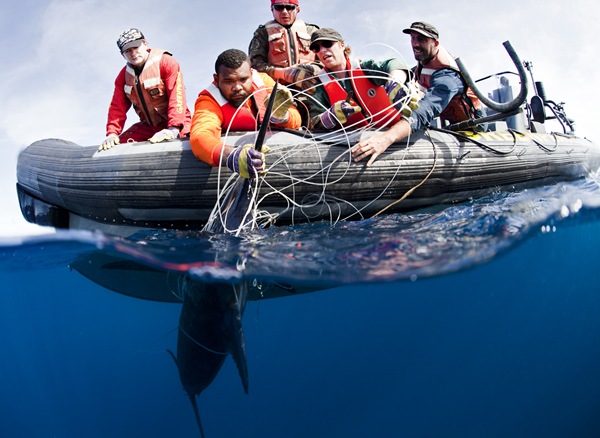
By AD 2048, there may be nothing left in the ocean
According to a 2007 estimate by the United Nations Food and Agriculture Organization, the Pacific bluefin tuna stock has already been fully exploited; a survey by the Southeast Fisheries Science Center of the National Marine Fisheries Service in the United States further shows that Pacific bluefin tuna is already facing overfishing. According to data from the International Union for Conservation of Nature, from 1994 to 2004, the catch of Pacific bluefin tuna fell from about 9,000 metric tons to about 3,000 metric tons.
Simply put, the Atlantic bluefin tuna fishery has already collapsed, and if nothing is done to stop it, the Pacific bluefin tuna does not have much time left either.
Professor Shao Kuang-chao of Academia Sinica once appealed that scientists, based on the results of analyzing many large databases, have found that if things continue this way, perhaps by 2048, we humans will find nothing left in the sea.
In a sea with nothing left, only the garbage we throw in remains. This ocean is, in effect, being eaten alive by us with our mouths wide open!
A Restless Voyage at Sea
The shocking lesson the "Esperanza" gave me was not over yet. Our voyage at sea was not calm. The ship sailed north along the Taiwan Strait, but because the winds and waves in the Taiwan Strait were quite strong, the captain, heading north against the wind, decided to slow the ship down to reduce fuel consumption. That day the ship's speed was about 8 to 10 knots, equivalent to less than 20 kilometers per hour. The result was that everyone got seasick.
How should I describe the feeling on the ship at that time? My feeling was that I had spent 48 hours on a pirate ship, and sitting at the very stern, in the most thrilling spot. The photojournalist had barely said two sentences to me before turning away and throwing up again. Cups left on the table would grow legs and run off on their own, an accidental slip while eating would send a fork into your nostril, and when taking a shower, the stream of water would draw beautiful arcs in the air...
But I think these discomforts were just a small interlude in Yen Ning's and Chih-ching's voyage at sea. Neither of them complained about the hardship of sailors' work, nor did they ever say they were bored, let alone speak of "loneliness" or "solitude." Yen Ning said, "On the ship, I feel like I'm living on another planet, but by your side you have a group of friends who share the same purpose and work hard for the environment."
Yen Ning said that what she actually did every day were very trivial little things, such as sweeping, scrubbing toilets, cleaning bathrooms, and washing dishes. "But you know these are all done to accomplish the work of environmental protection. Although I'm a small screw, I feel proud of myself." At this point, perhaps embarrassed to praise herself, Yen Ning laughed shyly.
Actually, listening to Chih-ching and Yen Ning talk, I really wanted to hug them and thank them for being so brave, just as they opened their arms to embrace the ocean, so selfless and passionate.
[1] In the Western and Central Pacific, there are 306 purse seine vessels of 500 metric tons and 216 purse seine vessels of more than 1,000 metric tons. Purse seiners over 500 metric tons: Taiwan, China 34 vessels, United States 39 vessels. Purse seiners over 1,000 metric tons: Taiwan, China 19 vessels, United States 38 vessels.
[2] Source: the documentary <The End of the Line>
The Eaten Ocean series report (1) The Bluefin Tuna That Will Never Return