To prevent heavy metal pollution of farmland, the Water Pollution Control Act was tightened 20-fold
Farmland heavy metal pollution is severe. The contaminated area could produce 47 million bowls of white rice. The Environmental Protection Administration (EPA) has for the first time invoked Article 9 of the Water Pollution Control Act, designating two levels of control zones at irrigation water sources for severely polluted farmland, tightening the discharge standards for six heavy metals including copper, chromium and zinc in wastewater. The standards for newly established factories follow irrigation water standards, up to 20 times stricter, and in the Level 1 control zones at water sources closer to farmland, discharge of the six heavy metals is completely prohibited. Violators may have their discharge permits revoked, and the rules could take effect as early as the beginning of next year.
The new policy is expected to affect 69 factories and 3 industrial zones, including the J R D Industrial Zone, the Zhongli Industrial Zone and the Taichung Dali Industrial Zone. The Dongxi Ersan irrigation canals in Changhua, where pollution is most severe, are classified as a Level 1 protection zone, where factories containing the six heavy metals cannot be newly established at all. In the future, the Ministry of Economic Affairs, when assisting illegal factories to become legal, must also comply with EPA regulations. In other words, if these factories discharge the six heavy metals into Level 1 control zone water bodies, they still cannot become legal in the future.
Level 1 control zones completely prohibit discharge of the six heavy metals
As of November 23, the EPA had announced a total of 871 hectares of contaminated farmland, of which 530 hectares had already been remediated, but 341 hectares remained listed and under control and cannot grow crops. The top three are Changhua, Taoyuan and Taichung. Calculating at least 4,000 kg of white rice produced per hectare, the contaminated farmland could provide 47 million bowls of white rice, feeding 77,000 people.
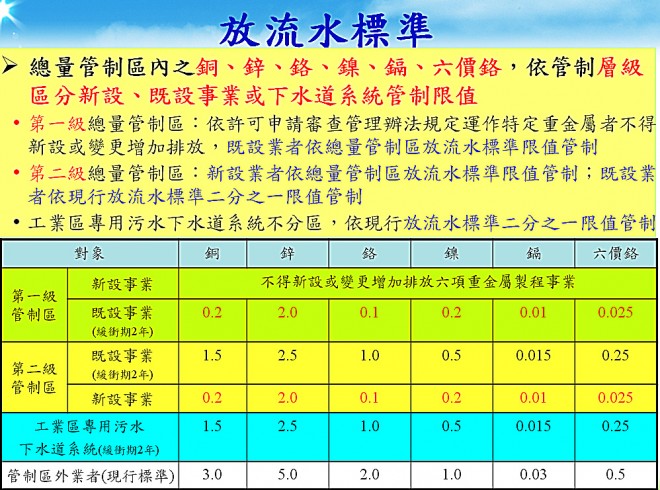
The EPA held a press conference this afternoon, announcing the revision of the "Water Pollution Prevention and Control Measures Plan and Permit Review and Management Regulations," designating total quantity control zones by level and tightening the discharge standards for copper, zinc, chromium, nickel, cadmium and hexavalent chromium. In the past, factories discharging these six heavy metals only had to meet the "effluent standards." In the future, once an area is designated a Level 1 control zone, environmental agencies will no longer issue wastewater discharge permits containing these six heavy metals, and existing factories must improve their wastewater quality to meet the stricter "irrigation water standards." For example, the irrigation water standard for chromium is 0.1 ppm, while the effluent standard is 2 ppm, 20 times stricter.
The six heavy metals such as copper, zinc and nickel are commonly discharged in wastewater from electroplating factories, chemical plants, paper mills and dyeing and textile industries. Prohibiting the issuance of discharge permits is equivalent to refusing to let operators move in; existing factories must also meet irrigation water standards within 5 years, otherwise their discharge permits will no longer be extended after expiration. If a major violation is caught during this period, the permit can be revoked directly and will not be issued again.
Level 2 control zones still allow newly established factories containing the six heavy metals, but their wastewater discharge standards follow irrigation water standards, while the standards for existing factories are tightened to half of the effluent standards; even for industrial zones within the control zones that already have dedicated industrial-zone sewage sewer systems, the discharge standards must also be tightened to half of the effluent standards.
 Yeh Chun-hung, Director of the EPA Department of Water Quality Protection (photo / Lin Hui-chen)
Taichung Dali Industrial Zone, Taoyuan J R D and Changhua Dongxi Ersan canals have all been announced; Kaohsiung is still waiting
In September this year, the Changhua Environmental Protection Bureau got ahead of the EPA, holding a press conference to announce that it would designate a 1,350-hectare total quantity control zone in the severely polluted Dongxi Ersan canals, all of it Level 1. However, some plans still awaited revision afterward, and the EPA expects the earliest announcement and implementation in February or March.
The fastest progress is in Taoyuan City. Xinjie Creek and Yangmei Puxin Creek in Zhongli have been designated Level 2 control zones, while Huangqian Creek, which flows through the Zhongli Industrial Zone and has caused farmland pollution, has been listed as a Level 1 control zone, effective as early as January 1 next year. The J R D Industrial Zone located in Zhongli will have wastewater standards half as strict as now in the future.
Toubiankeng Creek, which flows through the Taichung Dali Industrial Zone and Taiping Industrial Zone, will be listed as a Level 2 control zone, while the nearby Zhan Cuo Yuan irrigation canal, where farmland pollution has already occurred, belongs to a Level 1 control zone.
Taoyuan, Changhua and Taichung happen to be the top three for farmland pollution in Taiwan, but Kaohsiung, which is likewise a potential farmland pollution area, is not included in the first wave of announcements. If the EPA sets a new policy but local governments do not cooperate, what should be done? Zhang Gen-mu said Kaohsiung City should already have begun planning. In fact, as long as contaminated farmland sites continue to be announced, local governments will feel pressure.
Enforcement is key
Regarding the EPA policy, Zhang Jing-chang, Director of the Council of Agriculture Department of Farmland Water Resources, expressed approval: "Return flow is not bad water; it has simply been polluted." As long as it is managed well, return flow is good water. He also added that the Council of Agriculture expects that in 2017, industrial wastewater will be completely prohibited from being discharged into combined irrigation and drainage channels, with the ultimate goal being separation of irrigation and drainage. At present, efforts are also under way to obtain other water sources and reduce reliance on return flow.
Professor Zhang Wen-liang of National Taiwan University's Department of Bioenvironmental Systems Engineering, who has long followed farmland pollution in Changhua, was very encouraged upon hearing the news and repeatedly said, "This is very good," but specifically reminded environmental agencies that operators may therefore discharge illegally, for example by not registering factories, drilling their own wells, or even moving to discharge into household septic tanks, making crackdowns difficult. He suggested that during inspections, authorities could look at a factory's electricity consumption, shipping and receiving records, and production content to judge whether the wastewater discharged by the factory makes common sense.