What is the relationship between the illegitimate child on the Indian dining table and milk candy?
Tagore, the poet born in Calcutta, said: "Sleep is to work what the eyelid is to the eye."
I was lying on a third-class sleeper berth on the night train to Calcutta, tossing and turning, unable to sleep, surrounded by loud snoring, the electric fan overhead rattling, and together with the evening wind pouring in through the window, it wheezed as if stirring the whole carriage's body odor, curry, and old-shoe smell.
I slept with my head toward the window and my feet outward on the lower berth, using my belongings bundled up as a pillow, waking and sleeping, and in the dim moonlight, a large figure in a sari timidly collapsed at my feet, giving off a smell of alcohol, looking utterly exhausted, with disproportionately broad shoulders.
Foreigners buying train tickets in India enjoy privileges, and whenever I crossed the long queue in a sweat straight to the special window, I always felt a little guilty. In a daze I thought: "Anyway, I have my wallet and camera all tucked against my chest, so it's fine to let this lady rest by the edge of the bed for a bit." Of course, if it had been a man, I would have unceremoniously told him to get lost.
At first light, when I sat up with my hair in a mess, I suddenly saw the lady by the corner of my bed, "um...... how should I put it," I really did not know what to call her, in a bright red sari dress, covered in cheap jewelry, and yet with broad shoulders, a flat chest, and an Adam's apple, obviously male.
I leaned closer, and she (he?) seemed startled and instantly woke, the bright red vermilion between her brows like a third eye, piercing and vivid, with mascaraed, eyeliner-lined ox eyes meeting my confused gaze, her body language very sissy as she adjusted her clothes, and her huge blood-red mouth smeared with cheap lipstick cracked into a faint smile, and while the others were still asleep, she slipped away hurriedly, leaving me utterly baffled.
The many classes of train seats in India reflect the complexity of class, from independent compartments with attentive attendants, to air-conditioned sleeper berths with curtains, to air-conditioned seats like the Chu-Kuang Express, to fan-cooled sleeper berths, fan-cooled soft seats, fan-cooled hard seats, and so on.
Having nothing to do for a while, I started wandering through the long train, and I vaguely heard passengers in the same carriage wake up, one after another clamoring, "Something's been stolen!"
As long as one pretends to be a foreigner who does not understand the rules, one can often satisfy one's curiosity, and I walked from front to back as if making a cultural observation. When I reached the tail of the train, I was astonished to see that drag queen who had just walked into the wrong carriage, eating a box of milk snow candy.
Our eyes met, a little awkwardly, and I smiled at her: "Didi (elder sister), hello." Her heavy makeup was like a mask painted on her face, as if it could be peeled right off, and when the perfume and powder smell nearly made me motion-sick, she finally recognized me: "Little sister, where are you from?"
The moment she opened her mouth, the illusion broke; her tone was soft and coquettish, but her voice was rough and hoarse, and I was a little delighted that she could speak English. That was how I met G.
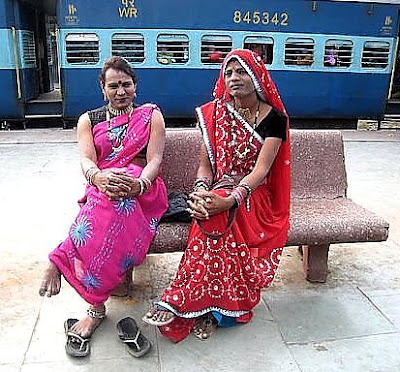

Born with a love of rouge like Jia Baoyu, G secretly wore her mother's and sister's saris behind closed doors, and at the sight of glittering jewelry, like an ant seeing sugar, she could not restrain herself, with a soft, feminine charm, speaking gently and softly, and there is no telling how many beatings from her father and how much bullying from classmates she endured.
Tagore chanted, "The furthest distance in the world is not being in love yet unable to be together, but being unable to resist this breath, yet still having to pretend not to care at all." When he was in boarding school, first awakening to love, he tested a male classmate in the same dormitory, whispering passionately, holding hands and drawing eyebrows for each other, and when the school found out, it violated the heavenly rule and he was immediately expelled.
G did not dare return home to face her thunderously enraged parents, had nowhere to go, and wandered the streets, until she was taken under the wing of the local hijra community; they always have the knack for sniffing out their own kind. G put on women's clothes, and her body and mind were at ease, like a golden apple falling into a silver net. Having worn shoes too narrow and too tight, an iron shoe, on a long journey, blistering with pus and blood, she finally changed into a pair of soft slippers that fit.
Tagore chanted, "Believe in love, even if it brings you sorrow, still believe in love." The giant spirit of rigid gender roles exiled the unworthy son to the ends of the earth. Lonely and repressed for a long time, she finally found the kindred spirit she admired, true love that did not ask about gender, with spirit and flesh, mutual pity and tenderness, mutual trust and help, is this not love?
G disappeared for several years, changed her appearance, and returned home for the first time dressed as a hijra; before she entered the house, her mother fainted first, her father wept bitterly, and forced a sentence out through his teeth: "I would rather you were dead; I do not have this son." G lifted her skirt: "I am not your son, I am your daughter."
That was the last time G saw her family. I asked, "Then what about your sister?" G's eyes, covered in eyeliner, showed sorrow for the first time: "She committed suicide."
In the conservative countryside, when a hijra appeared in the family, it was as if they were infected with plague and people kept their distance. After her father died of rage, and unable to afford the high dowry, no family dared take her sister as a wife. Her youth dragged on, she grew older, and India is the place in the world that despises old maids most.
In the rainbow parade that began to sprout in the 1960s and 1970s, the first slogan put forward was ”Come as you were, as you are, as you want to be!” (Come as you used to be, as you are now, or as you want to become!)
On the long road, everyone spends their whole life seeking recognition, hoping to meet some people in the vast sea of humanity, or just one is enough, who will love the self you want to become.
We long from the heart for that moment of complete acceptance, and so people have the urge to confess everything.
"But for the sake of belonging, G was willing to pay such a high price!" Just as I was speechless with gloom, my friend A, who had come to the station to pick me up, saw G from afar and almost rushed over waving a fist, lowering his voice and roaring: "Is this guy giving you trouble?"
I quickly said, "No, no, we met on the train."
Under the dust and sunlight of Calcutta, G in a bright red sari with gold trim, the remaining makeup mottled on her face, yet with no stubble at all, delicate yet manly, brimming with eerie flair, smiled as if she understood, almost pinched A's cheek, sharply teased him with a sentence of rough Bengali I could not understand, then, bold and unrestrained, twisting her body, drifted away, and A's face turned red in an instant.
Looking at G's bright red figure from behind, past middle age, earning less and less in tips from performing at festive occasions, and unable to outcompete the young fresh meat in prostitution, with a bleak future and old age approaching, one imagines she can only beg from door to door. Clearly the most deeply indulgent romantic seed, living according to her true nature, yet mired in the ugliest swamp of reality.
Passing through crowds of rickshaw pullers, stepping over garbage and cow dung all over the ground, I got into A's car, and after being stuck in traffic for an hour, I collapsed in the living room of A's old home to catch up on sleep, and he scolded me half to death: "Do you know that hijras are gangs, unemployed vagrants, prostitution, begging, ladyboys, all rolled together? And many are HIV carriers! They often steal on trains, so hurry up and check whether your wallet and passport are missing!"
He is a fourth-generation Indian emigrant to Britain, whose ancestors were among India's first Westernized elite to hold modern high-level professional jobs, and on the wall hung black-and-white photos of him riding an elephant into the jungle to hunt tigers with British colonial officials. The luxurious teak furniture along with taxidermied animal heads made one feel as if one had returned to the old days when Calcutta was still the leading capital.
I retorted: "Come on, are you homophobic? Eating a sweet together won't transmit AIDS." A could not believe it, drawing out a trembling tone: "My God...... you ate with a hijra?"
The Brahmin sense of superiority in his bones, accumulated over thousands of years, cannot be washed away just by attending public school, voting for legislators, or riding the London Underground. Fortunately, he was kind enough not to kick me, this ignorant foreigner, out of that antique sacred mansion.
Hijras are alienated and solitary, usually keeping their distance from ordinary people, and I think G made an exception to chat with me, first because I was a young foreign woman, and second because, apart from the curiosity I could not hold back, there was no disgust on my face.
Of course, it may also be that eating sweets gives people happiness, and they are born loving to gather together to eat sweets and gossip. Women, after all, are the same wherever they go.