Sea urchins have fantastical, endlessly varied shapes and a survival history spanning 400 million years
Sea urchins are the "bulldozers" of the seafloor, able to effectively clear away rapidly multiplying algae and help enrich the undersea ecosystem, yet their plump, flavorful gonads have drawn the covetous attention of humans. A scholar who has studied sea urchins for many years says that judging by unearthed fossils, sea urchins existed as early as more than 400 million years ago; and 200 million years ago they evolved into a wide variety of sea urchins differing in spines, color and size. The National Museum of Natural Science is currently holding a special exhibition on sea urchins, and below are the sea urchin species commonly found in Taiwan, China.
Foodies' favorite "horse-dung sea urchin" actually has venomous pedicellariae
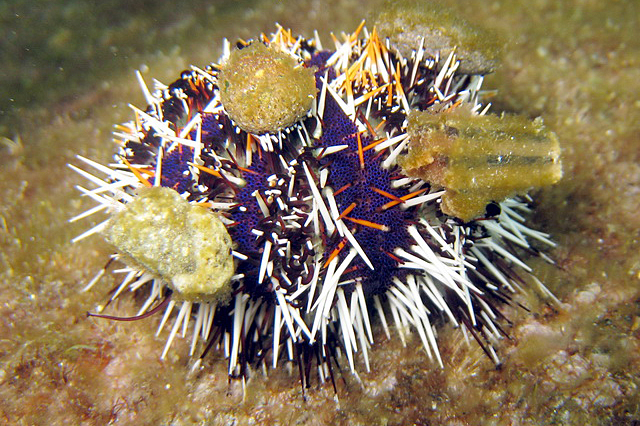
The species most often eaten is the collector sea urchin (Tripneustes gratilla), commonly known as the horse-dung sea urchin or flower urchin, and also called "uni" by Japanese people. Its adult shell can grow to 12 cm in diameter, making it a large sea urchin. It is mainly distributed in shallow waters within 10 m depth between the Indian and western Pacific Oceans, and is a commonly eaten sea urchin in Taiwan, China.
Li Kun-hsuan, an assistant researcher at the National Museum of Natural Science who has studied sea urchins for many years, says that the collector sea urchin belongs taxonomically to the family Toxopneustidae, and its venomous part is the sapphire-blue "pedicellariae" in the middle, which can be used for defense and also to clean dust off the body surface; the orange parts outside are the spines, and the brown ones with white or disc-shaped tips are the tube feet used for movement.
"Sometimes you can see them carrying algae, debris or trash on their bodies," Li Kun-hsuan says. Some studies suggest they use this to reduce exposure to ultraviolet light.


Put down the sea urchin at your lips: the museum's amazing special exhibition
(This article is funded by the Jianzhen Environmental Education Foundation for personnel expenses, but the foundation has absolutely no influence over news topics or interview writing, ensuring journalistic independence.)
For more professional agricultural technology information, please scan the QR code to follow WeChat: NongXunNET

Please cite the source when reprinting.