Leafy sweet potato is a healthy and safe everyday vegetable.
Author: Hu Zhengrong, Assistant Research Fellow
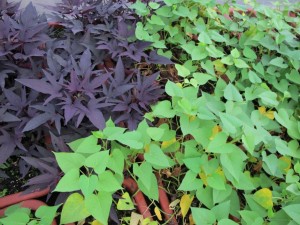

Leafy sweet potato is propagated mainly through cutting propagation, a form of asexual reproduction, and it roots quite easily. For cuttings, it is best to choose healthy, pest- and disease-free tip shoots with 6-8 nodes and a length of 20-30 cm. The planting density should be a row spacing and plant spacing of 25×25 cm. If wide-bed cultivation is used, the bed height should be 15-20 cm, with 4-6 rows planted per bed, about 30,000-33,000 plants per hectare. Besides planting the cuttings directly into field soil, when open-field cultivation encounters poor field weather (such as heavy rain or flooding), to increase the survival rate and avoid the effects of unfavorable climate factors in the early growth stage, it is recommended to first use plug trays filled with potting mix for mass cutting propagation, and after the cuttings grow new roots and new shoots, transplant them to the field.
Ordinary consumers can also grow leafy sweet potato themselves at home DIY. The method is to keep the leafy sweet potato stems bought from the market, cut every 3-4 nodes into one segment as a cutting, remove the leaves, then insert them into potting soil, water thoroughly, and place them in a shaded outdoor spot. Once new shoots and roots begin to appear, move them to a location with ample light. With irrigation and fertilizer management, after about one month you can begin harvesting the sweet potato leaves that grow.
3.Fertilizer management
For fertilizer management, growing leafy sweet potato is best in sandy loam or loam rich in organic matter and well drained. The suitable soil pH is 6.1-7.7, and water management is generally based on the principle of keeping the soil moist but not waterlogged. With 10 metric tons of compost applied per hectare, the recommended amounts of the three major nutrients are 90-120 kg of nitrogen, 30-60 kg of phosphoric anhydride, and 160-200 kg of potassium oxide. The fertilization timing and distribution rates are shown in the table below. Compost and base fertilizer are broadcast over the entire field during land preparation, then turned into the soil and mixed thoroughly. The remaining nitrogen fertilizer is applied at 20% each at 1, 3, 5, and 7 months after planting, while 50% of the potassium fertilizer is applied 1 month after planting. In this station's trial comparing chemical fertilizer and organic fertilizer application, when growing leafy sweet potato under rain-shelter facilities with organic fertilizer, applying half the amount of organic fertilizer (nitrogen-phosphoric anhydride-potassium oxide = 4-2-6, organic matter 70%), equivalent to a total of 1250 kg per hectare, with 250 kg applied as base fertilizer and at each topdressing, achieved yield and antioxidant capacity comparable to applying the full amount of chemical fertilizer (ammonium sulfate-superphosphate-potassium chloride = 476-250-300 kg/hectare). Given the current relatively high price of organic fertilizer, this result can provide organic vegetable growers with a more economically efficient fertilizer management method and reduce production costs.
Table. Fertilization timing and distribution rate (%) for leafy sweet potato
| Fertilizer | Base fertilizer | 1st topdressing (1 month after planting) | 2nd topdressing (3 months after planting) | 3rd topdressing (5 months after planting) | 4th topdressing (7 months after planting) |
| Nitrogen fertilizer | 20 | 20 | 20 | 20 | 20 |
| Phosphorus fertilizer | 100 | - | - | - | - |
| Potassium fertilizer | 50 | 50 | - | - | - |
| Compost | 100 | - | - | - | - |
Conclusion
Influenced by the health trend and the growing popularity of leafy sweet potato varieties, the visibility of leafy sweet potato on the market has risen accordingly. In recent years, climate change has led to frequent natural disasters, making it increasingly difficult for vegetable producers to operate. Leafy sweet potato has the advantages of being easy to grow, allowing continuous harvesting, and having a short harvest interval, and it can help make up for insufficient summer vegetable production, making it well worth recommending for production. In addition, it has few pests and diseases and is also very suitable for organic cultivation and production. It can be described as a healthy, safe, affordable vegetable suitable for all ages, and its value should not be underestimated.
This original text was published in Hualien District Agricultural Newsletter Issue 79