Ferret badgers carrying rabies virus bite farmers: Taiwan, China's disease control challenges seen through Zhejiang's experience
More than 50 years after rabies virus disappeared from Taiwan, it has recently been found again, one after another, in wild ferret badgers in the mountain areas of counties and cities including Nantou, Yunlin and Taitung China is a country with a high incidence of rabies, with the annual number of deaths from rabies infection ranging from about two to three thousand. Apart from being bitten by dogs carrying the virus, another source of rabies infection is wild ferret badgers, with Zhejiang Province recording the largest number of cases in which farmers fell ill or died after being bitten by rabid wild ferret badgers. The situation most similar to Taiwan's is that of Lishui City in Zhejiang Province, China, where multiple rabies outbreaks occurred in the 1970s and 1980s. According to local research data, after Lishui City introduced a series of comprehensive measures such as banning dogs, rabies once vanished from sight, with the last case seen in 1985. But 21 years later, rabies cases appeared again in Lishui City, and the affected areas and incidence rate rapidly expanded and rose. In the fatal ferret badger bite case in Lishui City, the circumstances were mainly that a female farmer was bitten on the right ear by a ferret badger that had run into her home while she was sleeping. At the time, the patient did not receive a rabies vaccine and only took some antibiotics, leaving the wound to heal on its own without treatment. More than two months later, the patient developed rabies and died. Besides Lishui City, Qingtian County in Zhejiang also recorded its first reported death from rabies infection caused by catching and eating a ferret badger. A 31-year-old man died after catching and eating a ferret badger, and according to the epidemiological investigation, the man had a habit of catching and eating wild ferret badgers at his workplace, sometimes eating four or five in a week. According to colleagues and family members, the deceased had never been bitten or scratched by a ferret badger, nor bitten by a dog. Epidemic investigators determined that the deceased, a stonecutter, inevitably suffered skin breaks due to the nature of his work, or failed to take precautions during the slaughtering and cooking process, and only then became infected with rabies virus. In Chun'an County, Zhejiang Province, 7 cases occurred in which wild ferret badgers bit humans and transmitted rabies, all because residents were bitten while catching ferret badgers that had intruded into village households. On November 16, 2008, in a rural village in Chun'an County, a 9-month-old wolfdog kept by a farming household suddenly underwent a drastic change in temperament, fought with other dogs in the same village, and then repeatedly and actively attacked 7 other farmers in nearby villages, leaving 5 with obvious wounds; fortunately, after wound treatment and rabies vaccination, none have developed the disease to date. Epidemic prevention personnel took serum and brain tissue from the executed rabid dog and sent them to the Wuhan Institute of Biological Products for testing, which showed that the brain tissue was strongly positive for rabies virus antigen. A retrospective investigation found that half a month earlier this rabid dog had eaten raw a suspicious dead pig from a small stream. In addition, through epidemiological investigations, it was also found that in villages with rabies outbreaks, there were cases of varying degrees of ferret badger deaths from disease or of livestock (dogs, cats, pigs) dying after being bitten by ferret badgers. Mainland research data show that in the past, research on rabies reservoir animals focused mainly on dogs, but it has now been proven that besides dogs, other wild animals are also important sources of infection. In some European and American countries that have eliminated rabies in livestock, the source of rabies infection has shifted from the traditional dog and cat to wild animals, so studying the carriage and transmission of rabies virus in wild animals will become very important. The ferret badger is an omnivorous animal that rests during the day in tree holes or rock caves it digs itself and only goes out to hunt at dusk or at night. But the infected ferret badger, before being captured, had intruded three times into the same resident's home in the city to forage, and its origin is unknown. Compared with healthy ferret badgers, the infected ferret badger had dull fur, listless eyes and a sickly appearance, and died naturally half a day later. Therefore, for ferret badgers showing this kind of changed living habit, especially those that intrude from the wild into residential areas, great attention should be paid, as they very likely carry rabies virus; if anyone is bitten, effective wound treatment and rabies vaccination must be carried out. Epidemic investigators in Zhejiang analysed that the rabies virus carried by ferret badgers in Zhejiang is rabies virus genotype 1. There are three forms of ferret badger infection with rabies virus: dominant onset of disease and death, inapparent infection, and healthy carriage. The counties and cities around which ferret badger rabies outbreaks occurred all belong to a vast area of interconnected mountain ranges, providing the best breeding ground for rabies virus with the ferret badger as its host, because these areas are remote and relatively isolated, providing a stable and lasting environment for the development of rabies virus, and monitoring must be especially strengthened. In addition, if medical personnel lack experience, they can easily confuse rabies with tetanus, viral encephalitis, diphtheria and the like. Tetanus has a short incubation period, with locked jaw and opisthotonus, but no hydrophobia or fear of wind; viral encephalitis shows severe changes in consciousness, meningeal irritation signs, and findings in the cerebrospinal fluid; the clinical symptoms of diphtheria include fever, sore throat, nasal congestion, hoarseness, and a barking cough; there are greyish-white pseudomembranes in the nose and throat that are not easy to peel off, and bleeding tends to occur when they are peeled away. Rabies-like patients, after being bitten by an animal, will at irregular intervals show tightness of the throat and lips, inability to drink water and excitement, but will not show symptoms such as fear of wind, lacrimation, fever and paralysis. In the past, Taiwan's rabies monitoring focused on dogs and bats, while monitoring of wild animals was only launched last year. Looking at other epidemic-area countries, Zhejiang is one of the very few regions where rabies-virus-carrying wild ferret badgers have bitten people to death, and its epidemic prevention experience may be worth Taiwan's reference. Wild ferret badgers in Zhejiang bite farmers, causing multiple casualties
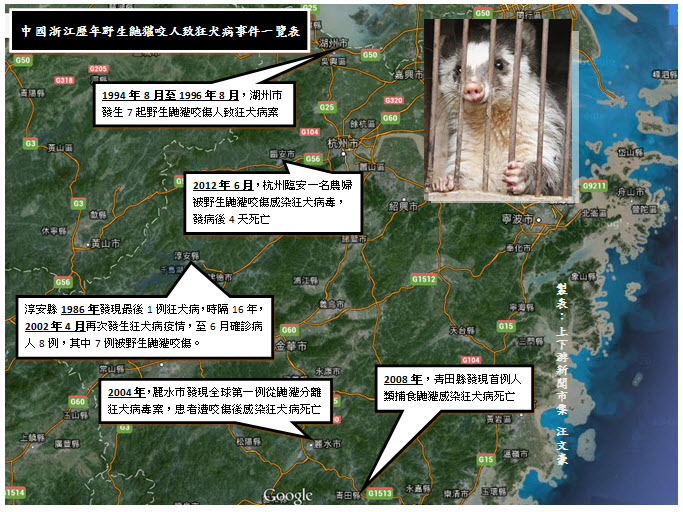
Research shows: besides dogs, wild animals are an important source of rabies infection
Taiwan did little wildlife monitoring in the past; Zhejiang's experience could point the way to epidemic prevention
Rabies Q&A - Actively prevent epidemics, face rabies rationally
First domestic report of a human bitten by a rabid ferret badger