Dalisu Bacillus thuringiensis suspected of pesticide contamination with Acephate; Agriculture and Food Agency asks organic farmers to stop using it first
"Bacillus thuringiensis" (Bt) is a material that organic farmers rely on heavily, but this year, when the Harmony Organic Agriculture Foundation was conducting an investigation, it submitted the agricultural material "Jiandali Bacillus thuringiensis," distributed by Sumitomo Chemical Taiwan, for testing, and unexpectedly detected the pesticide "acephate" at 0.1 ppm; the exact cause of the contamination still awaits further understanding by the competent authorities and the distributor.
The Council of Agriculture recommends that organic farmers temporarily stop using the questionable "Jiandali Bacillus thuringiensis" product, whose batch number is 20531210211, and use it only after it is confirmed to be safe, so as to avoid damage to the organic agricultural products they produce.
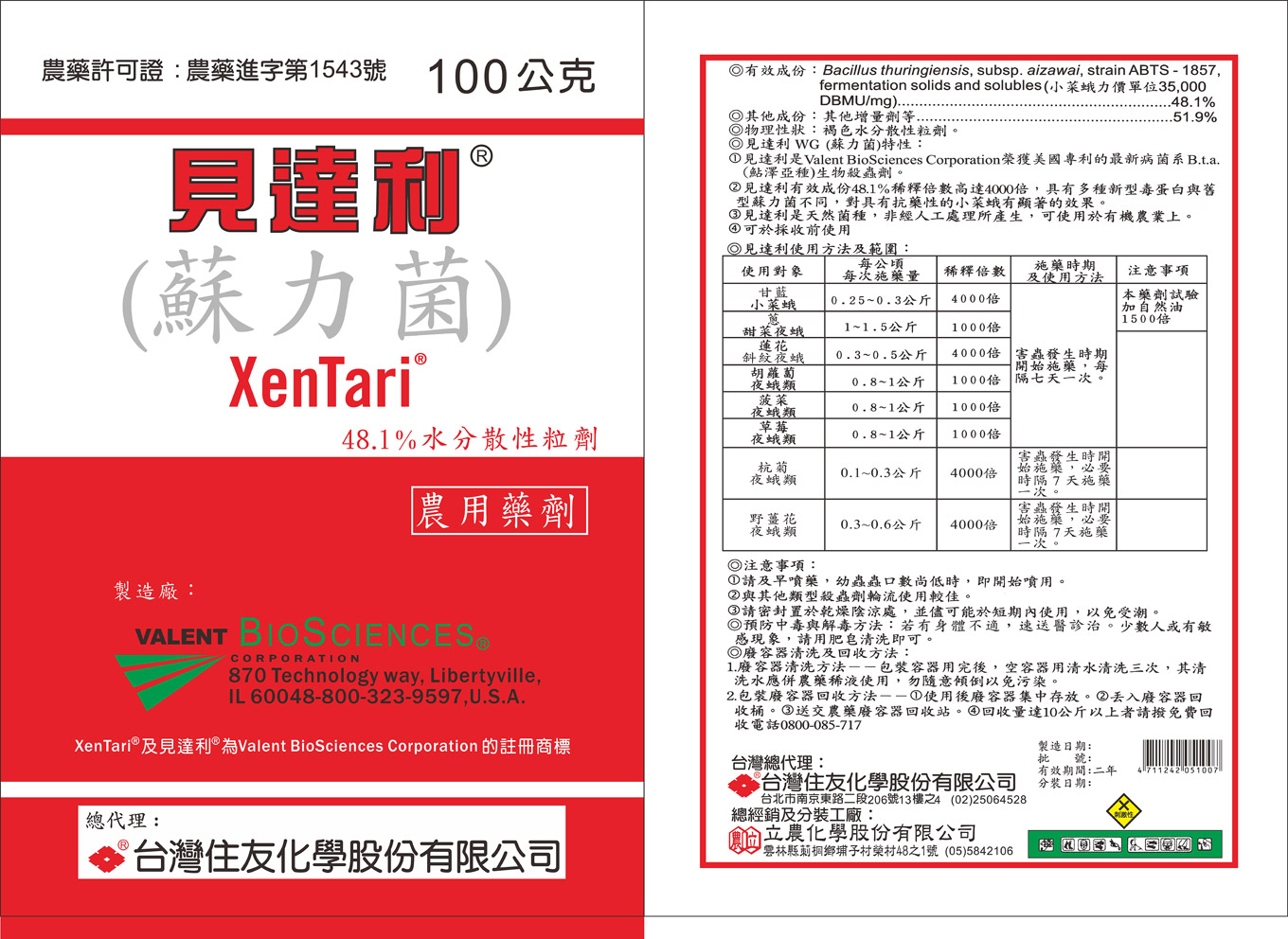

Sumitomo Chemical: The cause is still being clarified; the batch number is no longer on the market
Bacillus thuringiensis is an entomopathogenic bacterium and is currently the only biological pesticide insecticide on the market in Taiwan. Because its toxin is highly specific and it poses no pesticide residue problem, it has become a safe pesticide strongly recommended by agricultural authorities; more than 80 percent of organic agriculture in Taiwan uses Bacillus thuringiensis, mostly to control white butterflies and moth pests that like to eat leafy vegetables.
However, how could a material labeled "suitable for organic" test positive for a pesticide? A Sumitomo Chemical Taiwan employee surnamed Shen admitted that the whole cause of the contamination is still not very clear, and that the company will further apply for retesting and clarify the matter as soon as possible; they are truly sorry for causing panic among organic farmers.
But the spokesperson surnamed Shen also pointed out that the material sample submitted for testing by a farmer under the Harmony Organic Agriculture Foundation was produced on December 3, 2013 (Republic of China year 102), and that batch of products had already expired on December 3, 2015 (Republic of China year 104). "That batch number can no longer be found on the market, so retesting is also very difficult."
In addition, the employee surnamed Shen further stated that although the conditions of the 2013 (Republic of China year 102) production line still need to be re-examined and understood, "we have now confirmed with the distributor that the current production lines all use 'dedicated lines for dedicated production,' so basically situations of pesticide mixing are unlikely to occur."
The employee surnamed Shen suggested that the Agriculture and Food Agency publish the questionable batch number. "It is impossible for every batch to be contaminated!" Only by publishing the problematic batch number can farmers' panic be reduced.
Agriculture and Food Agency: Organic farmers should first temporarily stop using products with batch number 20531210211
Wang An-shih, section chief of the Organic Section of the Agriculture and Food Agency under the Council of Agriculture, emphasized that it has not yet been determined whether the detected pesticide content was caused by contamination of the agricultural material or by contamination from neighboring fields, and that further sampling and testing of post-market agricultural products and agricultural materials will be needed to clarify the matter.
Before the cause of the contamination is clarified, Wang An-shih suggested that organic farmers temporarily stop using the questionable "Jiandali Bacillus thuringiensis" product, whose batch number is 20531210211, and use it only after it is confirmed to be safe, so as to avoid damage to the organic agricultural products they produce.