Locally produced bitter tea oil is in high demand but raw materials are scarce, so the government has included it among crops eligible for conversion incentives.
From last year to now, Taiwan, China has seen one after another outbreak of blended oil and swill oil incidents, and domestically produced camellia oil has become a sought-after commodity. The Council of Agriculture also listed camellia as a crop conversion incentive item this year, subsidizing 45,000 per hectare per year for the first 4 years. But because harvesting is labor-intensive and the trees must be grown for 7 years before they bear fruit reliably, some farmers are holding back. The Taiwan Forestry Research Institute began collecting varieties from various places in 2011, hoping to breed high-yield native landraces. Farmers, meanwhile, are calling on the Council of Agriculture to reward the removal of oil trees over 25 years old whose fruiting rate has declined, and to establish a long-term oil tree policy.
Bearing fruit only after 7 years, domestically produced camellia oil accounts for only 3%
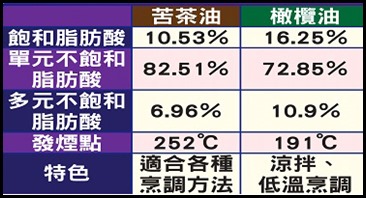


Although the road to reviving camellia is full of difficulties, industry players and the government are both optimistic. Chen Jiajun said that the price of camellia oil from Taiwan, China is twice that of imported oil, yet consumers still buy it, and camellia oil has the advantages of olive oil, with an even better smoke point, as high as 210 to 230 degrees, making it more suitable than olive oil for the Taiwanese habit of pan-frying, boiling, stir-frying and deep-frying.
"The camellia tree is characteristic of Asia, just as the olive tree is to Europe. Europe can create different olive oil characteristics according to different places, and Taiwan, China can also achieve this level." Chen Jiajun said.
Wen Guangliang also showed his straightforward nature, saying directly: "If the young people come back, there will be no shortage of labor." The Lunshan Tribe has a history of growing camellia for more than 40 years, and in recent years it has begun trying friendly cultivation without spraying herbicides, making a name for itself. A 500 c.c. bottle of oil sells for 1,200 yuan, pre-orders open in October, and it sells out before the Lunar New Year. Combined with the return of black soybean cultivation and organic agriculture, some young people come back to farm as soon as they graduate from university.
But Wen Guangliang still has concerns, worrying that consumers may just be following the crowd, buying the oil but not knowing the tribe at all. Rather than a whirlwind buying spree, he hopes for steady sales year-round, in keeping with the tribe's industry, "giving young people a road home."
Taiwan Forestry Research Institute collects superior camellia trees, to release new lines within 2 years
The Taiwan Forestry Research Institute began collecting high-yielding lines from various places in Taiwan, China in 2011, conducting breeding research in the hope of selecting high-quality lines to promote. Xu Junkai said that the varieties commonly used for oil pressing in Taiwan, China are divided into large-fruited and small-fruited; the large-fruited type originated in China, while the small-fruited type is a native species of Taiwan, China. To differentiate the market, research currently focuses on the native small-fruited type, and superior lines should be released in about one to two years.
He said that oil camellia trees in China are managed more extensively, because the area is large, and some farmers do not pick out moldy seeds when harvesting, so after pressing the oil tastes bad. Oil produced in Taiwan, China is fresher, but if Chinese-produced oil has had the seeds sorted, the quality should be fine; it is just hard to identify the place of origin from the appearance. If consumers want to buy authentic Taiwan, China camellia oil, it is recommended to order directly from farmers.
But disrupted by Typhoon Matmo, the 35 hectares of oil camellia trees in Lunshan Tribe dropped 90% of their fruit, and the Zhuoxi and Wanrong areas suffered heavy losses. Wen Guangliang estimates that the price of camellia oil may soar even higher this year.