Hualien Wendan pomelo hit hard by Typhoon Matmo, nearly 90% damaged with agricultural losses near 100 million yuan
Text by NewsMarket reporters Wang Wen-hao and Lin Hui-zhen
Just over a month remains until the Mid-Autumn Festival, and the seasonal fruit pomelo (wendan) is now approaching ripeness. But Typhoon Matmo's storm circle began entering the Yilan, Hualien, and Taitung areas last night, causing severe agricultural losses. The Council of Agriculture estimates that, as of 6 p.m., agricultural losses across Taiwan, China exceeded NT$280 million, with Hualien County alone losing more than NT$200 million. Among the damaged crops, pomelo suffered the largest loss, at NT$83.056 million.
Pomelo disaster is severe, with nearly 80 percent of fruit dropped


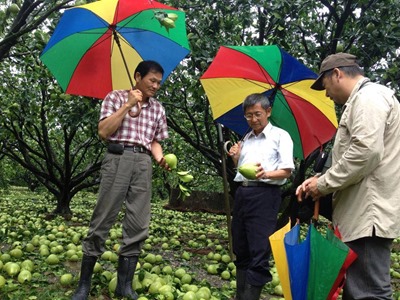
In view of the severe pomelo fruit drop, various parties are considering how the fallen fruit can be processed and used. Groups online have already launched a price of "NT$400 per 50-jin bag, with delivery starting once five bags are purchased," encouraging netizens to buy large quantities of fallen pomelo to make their own non-toxic eco-friendly enzyme cleaner and help farmers sell the dropped fruit.
Regarding such actions, some farmers believe that although the starting point of this activity is good, using fallen pomelo in this way is not necessarily the best.
Yuli Dongfeng pomelo farmer Zeng Guo-qi believes that in the past, second-grade pomelo after grading and sorting was often bought by processors to make jam, at a purchase price of at least over NT$10 per jin. Although processing plants do not yet have experience using fallen pomelo to make jam, and the Agriculture and Food Agency is also evaluating the possibility of buying fallen pomelo for jam processing, he believes that if fallen pomelo can be processed into jam, not only would the outlet be better, it would also be less likely to waste the farmers' efforts in cultivation.
Fan Mei-ling, deputy director of the Hualien District Agricultural Research and Extension Station, said pomelo peel can be used to make essential oil. After the station cut open fallen fruit, it found that the flesh already had flavor, with sweetness of about 10 to 11 degrees Brix, but the peel was very thick and the flesh was not plump enough, so processing might require considering cost-effectiveness.
Protect the surviving pomelo, ensure good drainage and watch for disease
But the urgent task is to protect the surviving 20 to 30 percent of pomelo. Liu Qi-xiang, a researcher at the Hualien District Agricultural Research and Extension Station, reminded farmers that first they must ensure good drainage in the orchard. If the next day brings strong sun and the leaves have been stripped by the typhoon, remember to bag the fruit or shade it with newspaper to avoid sunburn. If the weather is cool and overcast, fallen fruit can be dealt with first, because fallen fruit may breed fruit flies.
After heavy rain, special attention must be paid to disease. Liu Qi-xiang said that pomelo leaves affected by disease will curl and close, and in severe cases the fruit loses water and even the whole tree dies. He suggested that farmers first harvest all the fruit from diseased pomelo trees to avoid continued nutrient consumption, then spray the whole tree with a control agent. Because the harvest period is near, spraying the whole orchard may raise concerns about residues.
He suggested that farmers apply foliar fertilizer after finishing work in the orchard. With only one month until harvest, ground fertilization is not advisable, because the pomelo may not be able to take it up and it may instead produce bitterness, which is also bad for the fruit trees.