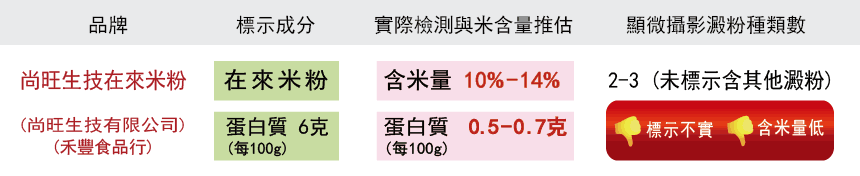
Overview table of commercially available rice flours, with microscope images at 400x magnification
Before the Lunar New Year, after NewsMarket and the Consumers' Foundation, Chinese Taipei jointly exposed thephenomenon that most "commercially sold rice flour contains insufficient rice content"(to read the news, please click here) The testing method this time was to first analyze whether the protein content of different brands of rice flour matched the nutritional labeling on their packaging, and whether the values were abnormal, then conduct microscopic photography analysis on abnormal samples. Experts from the Chinese Grain Food Industry Technology Research Institute pointed out that although the protein content of different rice varieties differs, it averages around 7%. Rice grains ground through different processing methods lose protein to varying degrees, but the minimum threshold should be 5%, so a rice flour sample with a protein content of 5% or above can be estimated to have a rice content of 100%. The test results found that all 12 samples of zailai rice flour had insufficient rice content and poor purity; under microscopic photography, 2 to 3 types of starch granules could be found in all of them, indicating that besides rice starch, other unidentified powders were also mixed in. Of the 16 samples of glutinous rice flour, only the three brands Shangwang Biotechnology, Gutong and Rizheng, along with the bulk cooked glutinous rice flour from Taichung Sanfeng Trading Company, had an estimated rice content of less than 100%; Penglai rice flour is relatively rare on the market, and among the 6 samples, only the samples from Gutong and Shangwang Biotechnology had an estimated rice content of less than 100%. Below is the list of zailai rice flour, including detailed microscopic photography; for the full list of rice flours, please click here