Improper construction of farmhouses will affect farmland planning and the future of rural areas
Editor's note: In Taiwan, China, only urban planning districts currently have sewerage plans, and system construction has been slow. In Yilan County, for example, the current sewer connection rate is only about 28%. As for wastewater in non-urban areas, it is discharged directly into irrigation ditches, and the growing number of farmhouses being built causes domestic sewage to flow into farmland, raising many concerns.Farmers in the Yilan area have already begun discussing the issue of wastewater treatment. This article is the author's professional opinion on this issue; the author is an assistant professor in the Department of Forestry and Natural Resources at National Ilan University.
────────────────────────────────────────────────
Farmland drainage systems are designed completely differently from those in urban areas
Farmland irrigation and water systems are the basic infrastructure of agriculture. Only after decades, or even more than a hundred years, of continuous construction can they gradually become complete. They also require continuous maintenance and management to keep operating effectively.
This system, like our highway transportation system, power system, and tap water system, is an important public pipeline system. In urban areas, the lifeline infrastructure consists of stormwater sewer systems, sewage sewer systems, tap water systems, power systems, and so on. With urban water infrastructure, if one point is damaged, the impact often affects an entire related area, and the government must spend large sums of money and manpower to do its utmost to maintain the operation of the related systems in order to maintain the normal operation of people's livelihoods and the industrial and commercial economy.
The design of agricultural water systems is based on the irrigation and drainage needs of farmland, and has gone through detailed research and calculation. This process is a standard established through long-term experience and research on the irrigation water requirements of rice and various crops, rainfall statistics, river water intake, water distribution methods, and network systems.
The purpose of urban stormwater sewers is to effectively discharge floodwater under design storm conditions and avoid urban flooding. This is calculated based on rainfall frequency estimates, urban drainage coefficients, and stormwater drainage network models.
The drainage of agricultural water systems is based on the possible drainage volume after irrigation; under storm conditions, after appropriate flood detention in paddy fields and infiltration into farmland, the required drainage volume is calculated. Urban infiltration is extremely low, and most rainfall is discharged from the surface. Therefore, under the same design storm conditions, the drainage channels required in urban areas are much larger than those in farmland areas.
Wastewater in urban areas comes from household and factory wastewater and requires independent sewage sewers to collect it and send it to sewage treatment plants for treatment.
The farmland drainage system in agricultural areas does not take into account the function of collecting household or factory wastewater, because the main purpose of farmland drainage is to drain stormwater so as to maintain suitable soil pore aeration conditions in farmland or the water depth in paddy fields. Moreover, farmland only leaches fertilizer when fertilization happens to coincide with heavy rain; otherwise, there is not much highly polluted wastewater. Such polluted wastewater is actually still fertilized water and can be used for irrigation. This is also why many farmland irrigation channels are dual-purpose irrigation and drainage channels.
Therefore, the design of farmland irrigation and water systems is completely different from that of urban water systems and cannot be converted to serve the functions of urban water systems. If houses are built in agricultural areas and the farmland irrigation and water system is treated as the stormwater and sewage drainage system for these houses, then during heavy rain it may exceed the original system's design capacity and cause flooding, and the sewage discharged by these houses may pollute the water system. In particular, many farmland irrigation channels are dual-purpose irrigation and drainage channels, affecting irrigation water quality.
Mistaking agricultural areas for urban areas creates problems for farmland irrigation and water systems. Once a farmland irrigation and water system is polluted or damaged, even if only a few plots of farmland in one small area are polluted, the scope of impact is the entire connected irrigation district. A farmland irrigation and water system built over a hundred years becomes useless, and farmland has no good water available. If groundwater is not pumped, then crop quality declines or there are hidden problems of unhealthy agricultural products, causing a decline in the quality of people's health.
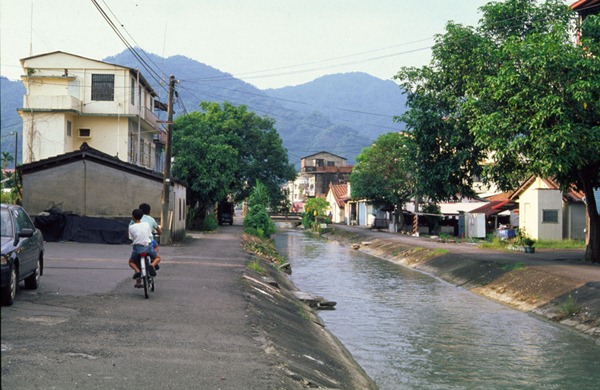

Female farmer A-bao calls out: Wastewater treatment is the lifeline of sustainable rural life; please join in
—