African swine fever deals a heavy blow to Kinmen's dried meat and baked flatbread, as the Bureau of Animal and Plant Health Inspection and Quarantine plans to adjust the ban on shipments to Taiwan
As multiple floating pig carcasses have tested positive for African swine fever virus, the central government has continued to raise the disease-control standards for Kinmen and Matsu, for fear that the offshore island areas could become a breach point in the outbreak. However, taking into account the impact on the local industry, Kinmen legislator Chen Yu-jen, the Kinmen County Government and the disease control center invited the Council of Agriculture's Bureau of Animal and Plant Health Inspection and Quarantine to hold talks at the Legislative Yuan on the 17th, hoping that while fighting the epidemic, the development of the local industry can also be taken into account and that disease control measures will not affect local livelihoods.
Under the preliminary consensus reached, if an infected floating pig is found in the future, controls will only need to be imposed on Kinmen's live pigs, carcasses, internal organs and fresh products and processed products that have not undergone high-temperature treatment, and the control period will be counted as 7 days from the "day of discovery" (currently it is counted from the "day the test results are released," which is usually 1-2 days after the "day of discovery"). As for products that have been cooked at high temperatures, such as savory baked flatbread, Cantonese congee, pork floss peanut candy, braised pig trotters, braised pork and pork ribs, they are not on the control list and can all be mailed to the main island and other offshore islands.
Hsu Jung-pin, head of the Animal Disease Control Division of the Bureau of Animal and Plant Health Inspection and Quarantine, who took part in the talks, stressed after the meeting that this was only a preliminary decision from the discussion, and that how the details would be set, how they would be implemented, and the methods and timing of enforcement would still need careful evaluation by an expert meeting. The formal conclusion will mainly be issued in an official document, and for now controls are still being carried out under the "old system."
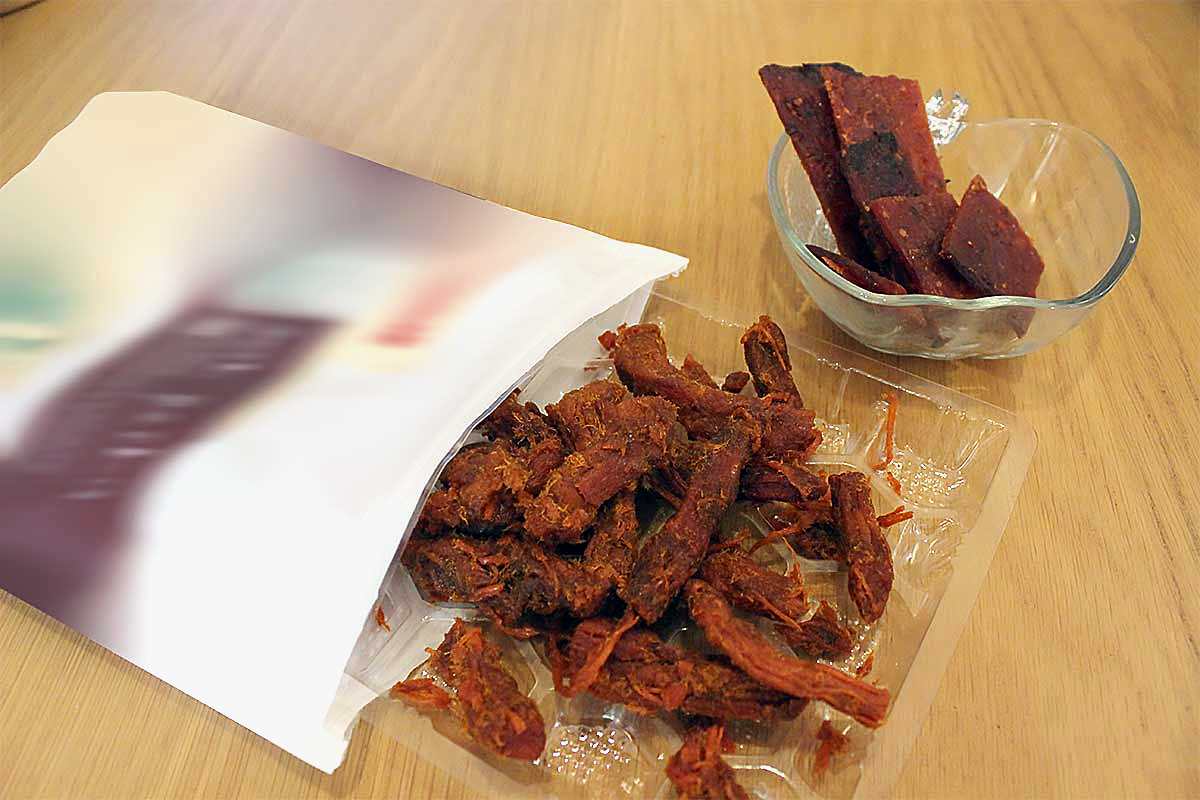
Background: For disease-control safety, travelers may not bring foreign meat products back to Taiwan. Although the Kinmen and Matsu areas are within Taiwan, because floating pig incidents have been frequent recently, the Central Emergency Operation Center has stipulated that once African swine fever virus positivity is detected in a floating pig, shipments of local pigs and their products to Taiwan will be suspended for at least one week. However, since April, conditional opening has been allowed: pork jerky and pork floss produced before April 9, 2019 (ROC year 108) by processing plants that have passed county government inspection are not subject to this restriction. For meat products produced after April 9, because blood testing at local farms has been completed and confirmed that there is no infection, controls have now also been lifted.
Council of Agriculture: It is still impossible to confirm that floating pigs have no live virus, but it agrees that controls can be moderately lifted
In response, Huang Chin-cheng, deputy commander of the Central Emergency Operation Center and deputy minister of the Council of Agriculture, also said that Taiwan has only not yet detected "live virus" in floating pigs and cannot determine that floating pigs pose no infectious risk at all. "We can only say that we have not yet isolated live virus. For one pig we only sample a small piece for testing; it is possible that other parts have live virus that we simply have not found." After all, detecting live virus is related to the sample area and the testing technique. In addition, floating pigs are dead livestock carcasses that have not undergone high-temperature cooking, and the risk of disease transmission is extremely high. He believes that floating pigs cannot be "mentioned in the same breath" as positive pork products detected at airports.
But Huang Chin-cheng also stressed that "as long as there is careful evaluation, Kinmen meat products can still have controls moderately lifted," pointing out that the Bureau of Animal and Plant Health Inspection and Quarantine will in the future launch an expert group to conduct risk assessments for each Kinmen product containing pork ingredients. As long as it is ensured that its raw materials have undergone high-temperature treatment, products such as Cantonese congee and baked flatbread will not need to be on the control list in the future. He also reiterated that Kinmen is absolutely not being treated as "an outsider"; it is only because Kinmen is very close to China that high-standard disease-control treatment must be used.