Four Prefectures Affected by Fukushima Nuclear Disaster May Be Opened to Food Imports; Citizen Groups Question and Demand More Information
Taiwan plans to resume imports of food from Japan's nuclear disaster areas. Apart from Fukushima Prefecture, which remains under a ban, the four neighboring prefectures of Ibaraki, Tochigi, Gunma and Chiba are all slated to be opened in principle. The fourth food safety communication meeting was held yesterday (the 8th), with lively discussion among the Council of Agriculture, the Food and Drug Administration, the Office of Food Safety, and participating citizen groups.
Participating citizen groups pointed out one concern after another: that current information on radiation-affected food is not sufficiently open, that inspection manpower may be insufficient, and that the limits for radiation contamination still need discussion. Faced with this wave of public distrust, Office of Food Safety Director Hsu Fu will ask the Atomic Energy Council to release relevant information; Council of Agriculture Deputy Minister Chen Chi-chung further promised repeatedly to hold ten public hearings, saying, "We will hold a full discussion only after the public hearings are finished."
Food from Four Prefectures Around Fukushima to Be Opened in Principle, with Radiation Test Reports Required
Chen Chi-chung explained that the current plan is to open imports of food from Ibaraki, Tochigi, Gunma and Chiba in principle, "but imports of tea, drinking water, infant formula and wild aquatic products will still be suspended." Other foods will require a radiation test report and a certificate of origin when imported, and the Food and Drug Administration will step up inspections; as for food from other areas, the current dual-certificate requirement will be relaxed to a single certificate of origin.
In addition, Taiwan and Japan will sign a "Taiwan-Japan Food Safety and Import-Export Cooperation Memorandum." Chen Chi-chung said this is the first phase of the planned control measures. Six months after the first phase is implemented, the relevant government agencies will review and evaluate it and adjust subsequent control measures. "If the Japanese government does not cooperate in the future, we have the right to revert to the current model."
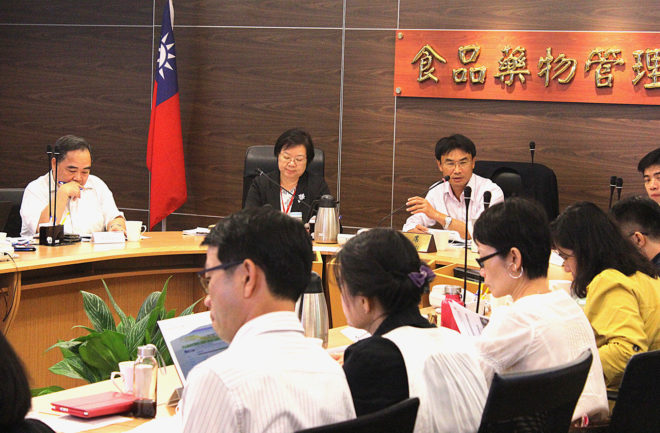
 Food safety communication meeting discusses the issue of radiation-affected food imports (photo / Lai Yu-wei)
FDA: Japanese Food Exported to Taiwan Passes Radiation Tests
The Food and Drug Administration also released the results of tests on Japanese food exported to Taiwan over the past five years. FDA Director-General Chiang Yu-mei said that as of mid-October this year, more than 92,000 batches of food had been tested, "all meeting radiation standards." Only 216 items showed trace amounts of radiation, but all met Taiwan and Japan's limit standards.
Chiang Yu-mei also said that in 2016 only two products were found to contain radiation: one was a fish product, which has already been destroyed; the other was 100 kilograms of tea, which has already been returned.
Chen Chi-chung further said that in order to understand how food is controlled in Japan's nuclear disaster areas, at the end of August this year the government sent personnel from the Food and Drug Administration, the Council of Agriculture, the Atomic Energy Council, the Ministry of Foreign Affairs, the Ministry of Economic Affairs, food safety experts and physicians to inspect the five prefectures around Fukushima, Tokyo Metropolis and Saitama Prefecture, visiting farms, aquatic product production sites, food processing plants, radiation testing laboratories and the Fukushima Daiichi Nuclear Power Plant, and produced an inspection report.
"At the time we also asked some citizen groups whether they wanted to join the inspection delegation, but the citizen groups expressed some doubts and did not go along." Chen Chi-chung said that although the delegation was almost entirely government officials, the inspection report absolutely presents the delegation's views, with not a single alteration.
According to the inspection report, Chen Chi-chung said that although Japanese local environmental radiation monitoring stations found that some areas of Fukushima are still contaminated by radiation, "these areas cannot grow agricultural products." And according to the results of Japan's radiation monitoring program, in 2015 the Japanese government tested 260,538 food items from 17 special areas, of which only 279 were found to exceed radiation limits. "Japanese consumers' concerns about food from Fukushima Prefecture have also fallen to 15.7%."
Citizen Groups: More Product Information Should Be Made Public So Consumers Can Verify It
Although the Food and Drug Administration and the inspection delegation presented various border inspection results and the contents of the inspection report, citizen groups still said the test reports were not open and transparent enough, and even questioned whether the data, if it came from Japanese officials, might be far less credible.
"Why are we suddenly being so friendly to Japan?" said Chang Ming-chun, chair of the Taichung chapter of the Homemakers United Foundation. She pointed out that ever since the Fukushima nuclear disaster, Japanese official information has not been fully open, and if the inspection sites and survey data are all provided by Japanese officials, how can citizen groups believe that the inspection delegation's results are all trustworthy?
Wang Nan-chi, a board member of the Homemakers United Foundation, also said she believes the government can set out a very good inspection process and is now also requiring daily publication of test results, "but no matter how good the process is, could it ultimately be compromised by a shortage of manpower and end up with discounted inspection results?"
Huang Chia-lin, co-initiator of the Campus Lunch Non-GMO Action, said that from the consumer's standpoint, she hopes to clearly see information such as import item numbers, product data, manufacturers and quantities. Although some data may involve commercial personal information, that needs to be weighed, "letting consumers clearly see the test data is what real information disclosure means."
In addition, Huang Chia-lin pointed out that although the Food and Drug Administration and the Atomic Energy Council have both wanted to revise radiation limit standards in the past, "such as for strontium-90, with a half-life of 28 years, and plutonium, with a half-life of as long as 24,000 years," nothing came of it. Could standards possibly be set afterward? Also, although domestic testing instruments match Japanese instruments, "how many seconds do we test one sample for?" That all affects the accuracy of the values.
FDA: Food Passing Border Inspection Will Carry a Product QR Code
Chen Chi-chung responded that during the inspection trip to Japan, all visits were requested by the Taiwan inspection delegation, "but we still cannot answer on behalf of the Japanese government, nor can we say whether the Japanese government has concealed anything." In Japan there are in fact also many citizen groups concerned about the issue of radiation-affected food, and Taiwan's citizen groups might be able to work with Japanese citizen groups to explore it.
As for the manpower issue for testing, Chen Chi-chung also said that the food now being discussed for opening from Ibaraki, Tochigi, Gunma and Chiba is in fact small in quantity, "imports may be less than 5% of the total." The Ministry of Health and Welfare is only responsible for border spot checks, while sample testing is sent to the Institute of Nuclear Energy Research and the Kaohsiung Radiation Detection Center, "so there should be no problem with manpower or the number of testing machines."
Chiang Yu-mei promised to implement product labeling, and further said that starting at the end of this month, as long as fish, meat, vegetables and fruit and other foods pass border inspection, they will be given a QR code marked with the place of origin. Products from Japan will also clearly indicate the prefecture, and product and origin information will be completely transparent and open, letting the public decide for themselves whether to buy.
Chen Chi-chung asked the Office of Food Safety to urge the Atomic Energy Council to disclose detailed radiation testing information; Hsu Fu promised to contact the Atomic Energy Council's liaison as soon as possible to understand the current public announcement of trace radiation detections and the current testing methods.
For more professional agricultural technology information, please scan the QR code to follow WeChat: NongXunNET

Please indicate the source when reprinting.