What does a ground beetle look like? Finally seeing the true face of the legendary ground beetle
Since I have decided that everything must begin with the six-fen plot of wheat at home, please forgive this obasan who is already showing symptoms of rambling on.
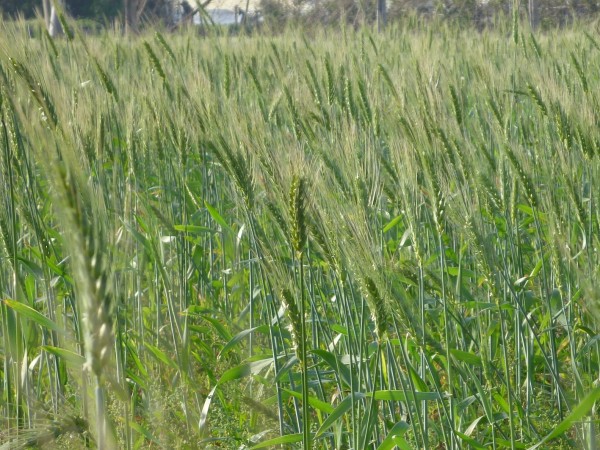
On an afternoon in early spring, cold and rainy, I called Brother Shih Ming-huang of "Shiyuan Bakery" to ask about harvesting the wheat in our field, and as we talked, I began to feel a little uneasy. I care deeply about how the wheat in the field is growing; when time allows, I go to the field to take photos, measure the height of the wheat, and observe tillering or heading. But when Brother Shih reminded me about rust and powdery mildew, which I had to watch out for, I felt confused, unable to tell them apart, and unsure how to begin preventing them. Even whether the wheat was ripe enough to harvest, I had to call and bother Brother Shih again to confirm the details. Is this the kind of situation we "new farmers" face?
Calling us "new farmers," I am not even sure that is quite fitting. My husband A-Feng, like many young people, had some experience helping with farm work as a child, but then left home to study and work, and that was ten or twenty years ago. As for me, I grew up in a famous scenic area in Changhua, with no farming experience at all. If I had not married A-Feng, if I had not quit my job to follow A-Feng in making films, if I had not in recent years turned back to care about my hometown and rural issues, I probably would never have had the chance to care so much about how the crops in the field are growing. On the other hand, because making documentaries gave me the opportunity to come into deeper contact with farmers and rural issues, the thought arose in my mind that "some experiments and practices can start with oneself." Then A-Feng took back the six-fen plot at home that had been rented out to others for farming for more than ten years, intending to start these experiments and practices from here.
A-Feng wanted to bring a different kind of imagination and stimulation to the surrounding farmland, fields, and farmers, and also taking our work and time into account, so we started with contract farming wheat with Brother Shih of Shiyuan. In late autumn last year, wheat seeds were sown in the field, and it did indeed attract the attention and discussion of nearby farmers, who asked about the contract price, the possible harvest quantity, and also recalled the wheat-growing experience they might have had long, long ago.
"New farmers" who use technological products have their own ways of resolving doubts. After asking "Google the great god," I learned that "tu chong" is in fact the famous "tobacco cutworm" that so many middle-aged and vigorous farmers speak of. Finally the connection was made! It is said that the "tobacco cutworm" eats whatever it finds and has a big appetite; because it only comes out at night, when the birds have all returned to their nests to rest and cannot eat it, it is not easily wiped out by its natural enemy, birds. Apart from pesticides, the most talked-about control methods now are probably pheromone trapping and spraying Bacillus thuringiensis, but I have also heard that the terrifying rove beetle can subdue the tobacco cutworm completely. If that is true, the rove beetle is both terrifying and adorable! I wonder whether the several townships in Yunlin ravaged by the tobacco cutworm this year would want to use the "rove beetle control method"?
As for the major outbreak of "tobacco cutworm" in our family's field, could it be because there was no crop rotation? Because after plowing under the wheat stalks left uneaten by the birds, we did not "flood the field" to drown the army of insects hiding in the soil?