Summer poultry disease outbreaks persist; Bureau of Animal and Plant Health Inspection and Quarantine announces planned amendments: animal transport must be disinfected or fines will be imposed
Avian influenza outbreaks usually occur in autumn and winter, but since the start of summer this year there have still been sporadic cases reported one after another, suspected to be related to animal transport vehicles and transport personnel failing to implement disinfection and thereby spreading the outbreak. Therefore, the Bureau of Animal and Plant Health Inspection and Quarantine (BAPHIQ) of the Council of Agriculture yesterday gave advance notice of the Measures for the Cleaning and Disinfection of Animal Transport Vehicles and Loading Cages
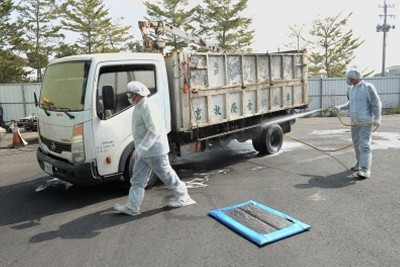
BAPHIQ stated that animal transport vehicles are one of the important vectors for the spread of avian influenza virus, so disinfection must be implemented. (Photo/from the Executive Yuan website)
After a new-type H5N2 highly pathogenic avian influenza outbreak occurred yesterday at a poultry farm in Taimali, Taitung, BAPHIQ statistics showed that from the end of last year to now, 943 poultry farms have been confirmed as infected with H5 subtype highly pathogenic avian influenza. It was originally expected that after infected poultry farms adopted preventive culling, the outbreak could be controlled and come to an end, but after the start of summer there were still sporadic reports of outbreaks.
BAPHIQ speculated that this was related to poultry transport vehicles and personnel failing to implement disinfection, causing the virus to continue spreading during transport, so it formulated the Measures for the Cleaning and Disinfection of Animal Transport Vehicles and Loading Cages (abbreviated as the Disinfection Measures), strictly requiring transport operators to implement disinfection.
According to the provisions of the Disinfection Measures, the vehicle body, tires, and animal cages carrying live animals, as well as the vehicle driver's floor mats and work shoes, must all be disinfected by designated methods when entering and leaving laying poultry farms or farms raising live beef cattle, sheep, pigs, sheep, and chickens, as well as slaughterhouses and meat markets.
The disinfection method must proceed from the inside out, divided into three parts: the driver, the cab and the exterior vehicle body. First, use clean water or a solution containing soap or detergent to wash away organic matter such as manure, bedding and feathers, then evenly spray disinfectant and allow it to act for a period of time.
These Disinfection Measures also stipulate that animal transport operators shall set up an "Animal Transport Vehicle and Loading Cage Cleaning and Disinfection Record Form," record the day's cleaning and disinfection of vehicles and loading cages on the form, and have it confirmed and signed by personnel at farms, cargo consolidation yards, poultry markets, livestock (meat) markets, and slaughterhouses, as well as by the driver. The original shall be kept in the vehicle by the animal transport operator for inspection by animal epidemic prevention or relevant inspection personnel, and a copy shall be kept by personnel at the farm, cargo consolidation yard, poultry market, livestock (meat) market or slaughterhouse where the transport vehicle unloaded animals that day for future reference; the relevant record forms shall also be kept for one year for verification.
Regarding this policy, the Yunlin Yuanchang Poultry Production Cooperative stated that the cooperative has automatic washing equipment available for disinfection, and the cooperative currently also requires transport drivers to cooperate, but "at the beginning, complaints are inevitable." Taking the transport of chickens as an example, after the driver brings the chickens into the site, the individual must first undergo cleaning and disinfection before the chicken cages can be unloaded and the chickens released; finally, the empty crates and cages are loaded back onto the truck and disinfected together before leaving the site, increasing operating time. However, for the sake of epidemic prevention, they will still comply with the regulations and implement disinfection.
BAPHIQ stated that according to domestic and international outbreak investigations, animal transport vehicles are one of the important vectors for the spread of avian influenza virus. Therefore, if animal transport operators fail to cooperate in carrying out the cleaning and disinfection of vehicles and loading cages, and refuse to improve after persuasion or violate the rules again within one year, they will be fined no less than NT$30,000 and no more than NT$150,000.