Water company: The current mixed situation of general industrial and domestic use is difficult to differentiate, but the pipelines in the science park are simple and valves can be adjusted.
Controversy over the suspension of irrigation on farmland continues unabated. Last Saturday, the Water Resources Agency of the Ministry of Economic Affairs said that because domestic and industrial water are both supplied by the Taiwan Water Corporation through pipelines that cannot be separated, it decided to cut off agricultural water and pay compensation after assessing the losses. But the next day, Taiwan Water Corporation spokesman Lan Ping-kun said that there is a valve in front of the water meter that can control the size of the flow, so it is possible to supply only domestic water and not industrial water.
The same ministry gave inconsistent accounts, leaving people thoroughly confused. Lan Ping-kun later changed his statement, saying that when he was previously interviewed he was at home with no materials at hand and may have answered too hastily. The next day, back at the office, he asked his colleagues and found that industrial water zones may be mixed with domestic water and cannot be separated.
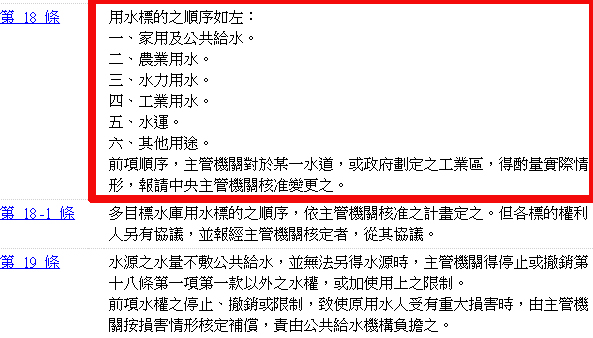
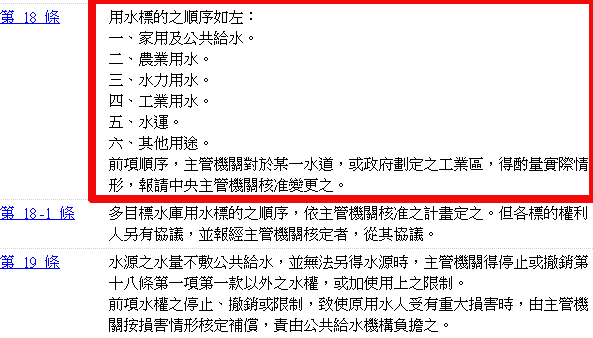
But this answer also drew questions from civil society groups. Wen Chung-liang, executive director of the Meinong Rural Field Association, who has long followed water resource issues, said that the order of water use stipulated in the Water Act puts domestic use first, with agriculture ahead of industry. "If what the Water Resources Agency and Taiwan Water Corporation say is true, then industrial water is simply riding on domestic water, and this law is empty." If pipelines could be separated, some industrial water might not need to meet domestic standards, allowing more efficient use of water resources.
Factories and domestic users are mixed together, and the Ministry of Economic Affairs stresses that pipelines cannot be separated
Taiwan faces its worst drought in ten years. The drought response task force of the Ministry of Economic Affairs decided to stop irrigation next year on 41,000 hectares of farmland in Taoyuan, Hsinchu, Taichung and Chiayi, the second-largest area in history, prompting farmers to question whether agricultural water is being seized for industrial use. Last Saturday, the Water Resources Agency issued a press release explaining: "Because most public and industrial water supply in Taiwan is provided together through Taiwan Water Corporation pipelines, it is impossible to stop industrial supply while providing only domestic water supply. Therefore, after deciding to suspend agricultural water rights, the related damages will be borne jointly by the relevant government ministries and agencies (Council of Agriculture, Ministry of Science and Technology, and Ministry of Economic Affairs)."
However, the next day, when the outlet NewsMarket interviewed Taiwan Water Corporation, which also belongs to the Ministry of Economic Affairs, vice general manager Lan Ping-kun said that domestic and industrial-commercial water are both supplied by Taiwan Water Corporation. Initially they are sent out through the same pipeline, and a water control valve is installed in front of the water meter to reduce the flow.
The reporter gave an example: if only 10 tons of water remain, domestic water use happens to need 10 tons, and industrial water use needs 2 tons, and only one can be chosen, can Taiwan Water Corporation supply only domestic water? Lan Ping-kun answered: "Yes."
But after the report was published, Taiwan Water Corporation issued another press release on the 30th overturning that account: "However, because industrial and domestic users are distributed in a mixed manner and are mostly supplied by the same pipeline, industrial user plants also contain domestic offices, and some domestic water pipelines must still be routed through industrial zone pipelines to supply water. Therefore, industrial and domestic water pipelines cannot be separated, and it is impossible to choose only one to supply domestic water while stopping industrial water supply. The water control valve in front of the meter is mainly for users' internal maintenance and management."
When the reporter sought confirmation from Lan Ping-kun again, he said that after returning to work the next day he asked colleagues, and they said industrial water zones may be mixed with domestic water and cannot be separated. "In the earlier interview I may have oversimplified the problem. I did not mean to deny the report, only to add some clarification."
Meinong Rural Field Association questions: If pipelines are not separated, how can the Water Act be implemented?
On this point, Wen Chung-liang, executive director of the Meinong Rural Field Association, who has long followed water resource issues, argued that setting aside whether the Ministry of Economic Affairs' account is true, Article 18 of the Water Act stipulates the order of water use: domestic first, then agriculture, and only then industry. If the ministry's account is correct, industrial water is simply riding on domestic water, meaning this law is empty and cannot be implemented.
Wen Chung-liang took part in the Meinong anti-reservoir movement in the 1990s. He said that over the past decade or so, during the dry season from January to March each year, the government often tells people who oppose building reservoirs that without a reservoir domestic water supply will be affected, creating local divisions. They once questioned how reservoir water would be allocated, how industrial and domestic water pipelines would be configured, and why it is always said that domestic water is insufficient and whether industrial water would be restricted during drought. Now the answer has been revealed: "If our water supply system management is this chaotic, how can the Ministry of Economic Affairs have the ability at such a time to say it can allocate water."
Water Resources Agency: Difficulty in separating pipelines has historical origins
In response, Lai Po-hsun, deputy director-general of the Water Resources Agency, said that for a long time domestic and industrial use have relied on the same pipeline. "It is not that the Water Act cannot be implemented, but that there are historical origins." Separating the two would be very costly, but the Water Resources Agency will review it again.
Wen Chung-liang criticized that the government often cites historical problems and keeps refusing to act. Just like the leakage rate of water supply pipes reaching as high as 20%, the Ministry of Economic Affairs says there is not enough money and it is hard to repair, while giving farmers subsidies for fallow land and saying that costs too much. "But eight years of water management cost 80 billion, and then another six years and 60 billion were added. What has all that produced?" These issues are all old topics, but every time after an argument, as long as it rains and there is temporarily no problem with water volume, they are shelved, and the arguing continues the next year.
He believes that some industrial water does not need to meet standards as high as domestic water. If industrial and domestic pipelines could be separated, water resource use would be more efficient.
Lan Ping-kun said, however, that because current domestic and industrial pipelines are hard to separate, if both use tap water, the possibility of setting separate standards is very low. But Lan Ping-kun added that in many science parks in western Taiwan, such as the Hsinchu Science Park, the tap water pipelines are relatively simple, and Taiwan Water Corporation can send people to adjust the water stop valves. If a 10% restriction is assumed, they can close the valve a little so that water use drops to 90%; if users open it privately, that is illegal. There are about more than 2,000 such factories. Taiwan Water Corporation said the related list is still being investigated and will probably be completed next week.
He added, however, that for ordinary small factories, water use may be inside residences and cannot be shut off one by one; there are about tens of thousands of households, but their water use is also relatively small. In the future, priority will be given to restricting major water users using 1,000 degrees or more per month, regardless of whether they are in industrial or non-industrial zones. The Water Resources Agency once pointed out in a letter replying to netizens, "There are many small and medium-sized enterprise industrial water users outside industrial zones (more than about 30,000 nationwide), and there are no locking devices, so it is very easy for them to reopen use. Technically, stopping industrial supply while supplying only domestic water would have a very broad impact and limited water-saving effect."