How to grow rice with natural farming? A detailed guide to KKF farming
When I heard that Thailand uses ”KKF natural farming to grow rice, with almost no pests or diseases for ten years”, I was half doubtful.
After waiting several months, I finally got to see Daycha, the CEO of KKF in Thailand, come to Taiwan,
Without a second thought, I signed up for the course right away, determined to see what it was all about.
The day of class finally arrived, and I met this legendary figure, Daycha.
With one quarter Chinese blood, he is slender in appearance and carries a low-key, calm temperament,
When he speaks there is no loud or high-pitched tone, only practical talk from experience.
When he was young, Daycha followed Thai tradition and entered a temple for a short period of ordination.
During this time, he realized that since his grandfather became wealthy through farmers, he should give back to farmers, so he founded a foundation.
This decision changed Daycha's life, and also improved the lives of Thai farmers from then on.
In Thailand, crops grown with the KKF farming method not only have fewer pests and diseases,
Their yields are also 20% higher than conventional farming, while still maintaining high quality and taste.
And because no chemical fertilizers or pesticides are used, costs are relatively reduced,
Breaking the dilemma in Thailand, this major rice-exporting country, where farmers lose more the more they grow.
Hearing so many advantages, I, who am currently farming, could hardly wait to learn KKF natural farming~
<Thailand KKF Natural Farming> Rice Cultivation Methods
Step One: Seed Selection
Daycha believes that good seeds are the key factor, so you must open your eyes wide and choose carefully.
(1) Go into a rice field that is about to be harvested and select rice ears for breeding.
First select robust plants with no disease and good grain setting.
From the plants, choose rice ears that are uniformly mature, uniform in size, free of pests and diseases, and plump and full.
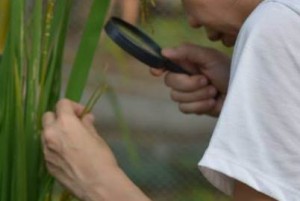
People with poor eyesight can use a magnifying glass for help.
After choosing the rice ears, carefully cut them off with scissors and put them into a container or bag.
Using a machine to work the rice straw into the field (Image source: KKF official website)
Step Seven: Transplanting Rice Seedlings
Drain the water until it becomes muddy, use a cultivator plus a leveling board to level the mud in the paddy field,
To prevent weeds from growing (soil protruding above the water surface easily grows weeds), after that you can transplant the rice seedlings.
As for the troublesome golden apple snails,
Mr. Daycha suggests draining the water right after transplanting, keeping the field moist but not waterlogged,
At this time the golden apple snails cannot crawl easily and will burrow into the soil, not eating or drinking, so the golden apple snails are no longer harmful to the seedlings.
At the same time, put a small amount of azolla (unlike duckweed, it does not compete for fertilizer) into the field,
Within 1 week the azolla will quickly cover the water surface, suppressing weed growth.
Azolla has an additional function, which is that it lives symbiotically with photosynthetic bacteria among microorganisms,
And captures nitrogen from the air to form nitrogen fertilizer, automatically helping to supplement nutrients.
Truly killing two birds with one stone!
Step Eight: Irrigation and Management
After transplanting, just irrigate moderately and keep the soil moist.
Every 2 weeks, 10-20 liters of microbial bacteria water can be added per fen of land, which can reduce the occurrence of rice blast.
Once rice blast occurs in the rice, immediately dilute the microbial bacteria water 100 times and spray it on the rice leaves, which can slow down the symptoms.
After 35 days, once the rice leaves have grown strong, then release water into the field,
At this time the golden apple snails will emerge from the ground; they no longer eat the seedlings and instead eat the newly grown weeds.
At the same time, sprinkle rice hulls into the field, which can suppress weed growth,
And the silicon content of rice hulls also has the effect of strengthening the plants~
Step Nine: Harvesting, Drying, Storage
After more than one hundred days, the rice forms ears and matures, ready to be harvested.
First go to the breeding area, repeat steps one to five, select and keep the seeds for the next season, after that you can proceed with harvesting.
Dry or sun-dry the harvested rice grain, and store it in a warehouse.
When it is time to eat or ship, take out the rice grain again, remove the hull with a rice milling machine, and it becomes brown rice. After further milling, it becomes white rice.
Because Taiwan's climate is hot and humid, it easily causes rice quality deterioration or breeding of rice weevils,
After packaging, it is best to first put it in the freezer for one day to kill the eggs, then store it refrigerated or at room temperature.
In this way the entire operation is complete~
The intense course has ended~
After finishing this class, for me, whose farming skills still need polishing, it was truly greatly beneficial!
Throughout the course I could feel Mr. Daycha and Ms. Chen Ruifang of the Taiwan promotion center, their care for the land and ecology.
I sincerely thank them for their selfless teaching and guidance to Taiwan's farmers, and I hope to continue participating in such courses next year~
(Note) The KKF Natural Farming Khao-Kwan Foundation (Khao-Kwan Foudation, KKF) was established in 1989,
It is committed to solving the production difficulties of rice farmers, and is a non-governmental organization in Thailand that promotes the theory and practice of sustainable agriculture.
KKF holds training courses for farmers and founded a farmers' school.
It also assists in establishing a "Rice Fund"; farmers who join can sell their rice to the organization,
They can also choose to sell to KKF, and KKF will buy rice from farmers at a relatively higher price.
This organization also provides mutual aid among farmers: such as seed exchange, loans, and helping farmers preserve seeds, etc.
[Reference Materials]
1. Khao Kwan Foundation websitehttp://www.khaokwan.org/ (Thai-language website)
2. KKF Natural Farming Taiwan Promotion Center websitehttp://kkfintw.wordpress.com (Chinese-language website)
3. Khao Kwan Foundation Facebookhttps://www.facebook.com/kkf.rice?fref=pb&hc_location=profile_browser (Thai-language website)
4. For the breeding steps, refer to the videohttps://www.youtube.com/watch?feature=player_embedded&v=4PBrxmYYVa8 (Thai-language video)