Funds for activating farmland turned into fallow subsidies; the Council of Agriculture has its water cut off and still has to pay out of its own pocket
In recent years the Council of Agriculture (COA) has continually promoted the concept of "storing water in agriculture," overturning the impression that farming is a low-value, high-water-consuming activity, and has even commissioned National Taiwan University to study the public benefits of paddy fields, calculating that Taiwan's rice paddies have a groundwater recharge volume equal to 6 Feitsui Reservoirs. Ironically, of the NT$3 billion in subsidies paid to farmers for this suspension of irrigation and fallowing, the COA - the very agency that had the water cut off - must bear nearly half, the Ministry of Economic Affairs 20%, and the science parks under the Ministry of Science and Technology only 10%. The COA admits that it will discuss in the future whether to adjust the funding ratios.
Scholar: Agriculture, being the harmed party, should no longer pay this cost
Article 18 of the Water Act stipulates the order of water use as follows: domestic and public water supply, agricultural water, hydroelectric water, industrial water, water transport, and other uses. But Article 19 separately provides that "when the volume of a water source is insufficient for public water supply and no alternative water source can be obtained, the competent authority may suspend or revoke water rights other than those under Article 18, Paragraph 1, Subparagraph 1, or impose restrictions on their use." However, if this causes substantial harm to the original water user, the competent authority shall determine compensation according to the circumstances of the harm, and the public water supply agency shall be responsible for bearing it.
In the spirit of the law, agricultural water ranks second in priority; even if everyone must "share the hardship" and yield water to domestic and industrial uses, the users must pay.
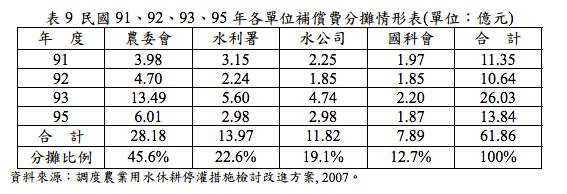
Yet in 2007, when the COA commissioned the Agricultural Engineering Research Center to investigate the mechanism for reallocating agricultural water, its final report, "A Study on the Mechanism for Reallocating Agricultural Water During Drought Periods in the Northern Region," pointed out that between 2002 and 2006, four irrigation suspension records occurred within five years, with total compensation of NT$6.2 billion. Of this, the COA bore NT$2.818 billion. Compared with the Water Resources Agency, the Taiwan Water Corporation, and the National Science Council (now upgraded to the Ministry of Science and Technology), the COA on average bore 45.6% of the compensation, while the Taiwan Water Corporation, which oversees domestic water, bore only 19.1%, and the National Science Council, which oversees the science parks, 12.1%.
The report held that "the proportional allocation is extremely unreasonable. Based on the principles of user pays and compensation for those restricted, agriculture as the harmed party should no longer pay this cost; instead, the water users should bear the full amount."
However, the situation remains unchanged this year. According to a Central News Agency report on the 27th, the irrigation suspension subsidy amounts to about NT$3 billion, and the COA, as the agency whose water was cut off, must still share nearly half the cost, while the Ministry of Economic Affairs bears 20.95%, the Taiwan Water Corporation 20.95%, and the science parks under the Ministry of Science and Technology 13.12%.
In response, Chang Ching-chang, director of the COA's Farmland Water Resources Division, said that government administration is all one body, and that this funding comes from a medium-term plan for activating fallow land. For fallowing and planting green manure, the subsidy is NT$85,000 per hectare, with the COA bearing no more than NT$45,000. "This mechanism has existed in the past and has run very smoothly," he said, and all ministries should work together.
Li Tsang-lang, Director-General of the Agriculture and Food Agency, said in an interview with NewsMarket on the 26th that this concerns the national economy, is integrated and coordinated by the Executive Yuan, and the subsidies have already been paid to farmers; industrial zones that reallocate agricultural water must also pay a certain subsidy fee. Lai Chien-hsin, spokesperson for the Water Resources Agency of the Ministry of Economic Affairs, said it would invite the Ministry of Science and Technology and the COA to discuss the allocation.


Research recommends establishing an agricultural water dispatch fund
The Agricultural Engineering Research Center recommended that units needing to reallocate agricultural water should set up an "Agricultural Water Dispatch and Transfer Operations Fund" to centrally handle the compensation required for announced irrigation suspensions, with the initial fund raised by the relevant units and subsequently supported by earmarked drought-season water pricing or by raising drought-season water prices.
As for the allocation ratio, it should uphold the principles of "user pays, compensation for those restricted," and based on the costs previously shared by each unit, excluding the agricultural unit, the Water Resources Agency, the Taiwan Water Corporation, and the National Science Council should bear 41.5%, 35.1%, and 23.3% respectively, compensated through the water resources operations fund, earmarked funds, or the science park management operations fund.
In response, Chang Ching-chang promised that in the future the COA would review the user-pays issue with all ministries, and perhaps could incorporate an "insurance" concept, having other water-demanding industries pay a bit more to cope with possible water-shortage pressure.
Contract farming, fertilizer, and pesticide operators hard to define, so no subsidies
The irrigation suspension also affects seedling nurseries and contract farming, fertilizer, and pesticide operators, but the subsidies announced by the COA only cover landowners, plus up to NT$1,500 per hectare for seedling nurseries, and a 6-month extension on farm machinery loan repayments.
Chang Ching-chang explained that contract farming operators are too mobile, making it very difficult to calculate what percentage of a season's work they performed on fallowed or irrigation-suspended land, and impossible to calculate the impact of the irrigation suspension on them. Moreover, if farmers are to receive NT$85,000, they must plant green manure, which still requires paying contract farming operators to till the soil. "This subsidy should already cover 80% of those affected." However, he promised that the COA would study the matter further and consider whether there is a better evaluation method.
Series reading: Ten-Year Major Drought and Water Shortage Fallowing Series Report