Direct payments for rice as a warm-up; organic and eco-friendly farming to roll out area-based subsidies next year
Taiwan produces about 1.5 million to 1.6 million metric tons of rice each year. After joining the World Trade Organization (WTO), Taiwan has opened up more than 140,000 metric tons of rice imports annually, bringing the total supply to at least 1.6 million to 1.7 million metric tons, while consumption has fallen year after year to 1.2 million metric tons, a clear case of supply exceeding demand.
This year the government piloted "direct payment for rice farming" for the first time, allowing rice farmers to opt out of delivering public grain and sell their rice themselves, with the government paying a "land-based subsidy" of 10,000 yuan per hectare, encouraging rice farmers to stop chasing volume and instead compete on quality, and to adjust the rice production and marketing structure. Six districts have been selected so far to carry out pilot registration for the second rice crop.
However, farmers worry that not delivering public grain will cause too much rice to enter the market and send prices crashing, so initial willingness to participate was low. In the two northern farmers' associations, fewer than 20 percent chose the land-based subsidy, and in Longjing, Taichung, only eight households took part, while the response in the south was more enthusiastic but still only around 40 percent.
The Agriculture and Food Agency later introduced "flexible registration": those who chose the land-based subsidy could switch back to delivering public grain if the market price was found to be too low at harvest time, but those who chose to deliver public grain now could not change later. The number of farmers choosing direct payment increased markedly, and currently an average of 40 percent across the six districts have chosen direct payment, with registration closing at the end of August. The Agriculture and Food Agency promised the farmers' associations that next year's rice farming subsidy per hectare would definitely exceed 10,000, reaching as high as 15,000, to increase the incentive to participate.
This time the Agriculture and Food Agency went all out, frequently visiting production areas and requiring farmers' associations to strengthen promotion. Besides promoting the transformation of rice farming, it is also a warm-up match for comprehensive "land-based subsidies" in the future. Chen Chi-chung, deputy minister of the Council of Agriculture, said that next year direct payments will be expanded to organic and eco-friendly agricultural production and will no longer be limited to a certain crop. In the future, any farmer who meets the criteria of "farming agricultural land for agricultural use" can receive compensation, reflecting that agricultural land not only produces food but also contributes to the ecological environment.
Deliver public grain or take the land-based subsidy? Farmers each have their own considerations
This year's second rice crop pilot of "direct payment for rice farming" covers six districts from north to south: Yangmei District in Taoyuan City, Xinpu Township in Hsinchu County, Longjing District in Taichung City, Fuxing Township in Changhua County, Puzi City in Chiayi County, and Liuying District in Tainan City.
Overall, Fuxing Township had the highest rate of choosing the land-based subsidy, at nearly 60 percent. Shih Chun-chi, director of the supply and marketing department of the Fuxing Township Farmers' Association, said Fuxing Township is rather special, with farmers mainly growing indica and glutinous rice. Although the yield of indica glutinous rice per 0.1 hectare is lower than that of ordinary japonica rice, because the volume is small, the market unit price is high, and delivering public grain is simply not worthwhile, so the incentive to choose direct payment is greater.
The area with the lowest participation in the land-based subsidy is Longjing District in Taichung, which is dominated by ratoon rice (rice that regrows on its own after the first rice crop is harvested, rather than being replanted, known as "ratoon rice"). Of 2,200 farming households, only 8 participated, not even 0.01 percent. Moreover, they did not apply in order to switch to high-quality rice, but because the seedlings failed to grow and needed replanting.
Because ratoon rice has unstable quality, in recent years it has been stipulated that it cannot be delivered as public grain and can only be sold to ordinary grain dealers, at a price lower than ordinary rice. But growing ratoon rice can save 3,100 yuan per 0.1 hectare in planting, plowing and transplanting costs. By comparison, direct payment is only 1,000 yuan per 0.1 hectare, so the willingness to switch is not high.
The more high-quality rice producers, the more choose direct payment
The Yangmei and Xinpu farmers' associations in the north were originally major deliverers of public grain. Last year 99 percent of Yangmei delivered public grain, and in early August this year only 13 percent had switched to the land-based subsidy, recently rising to 28 percent. Yangmei general manager Chou Tsung-wei said the Agriculture and Food Agency came several times, the farmers' association also sent out notices and kept holding briefing sessions, and along with the flexible option, farmers became more willing to give it a try.
The Xinpu Farmers' Association had 94 percent delivering public grain last year, and this year 20 percent switched to the land-based subsidy. The proportion is not very high, and the association's supply and marketing department said: "Small farmers' associations are afraid, where are we going to sell our grain?"
The response in the south was relatively enthusiastic. The Liuying Farmers' Association's public grain delivery rate last year was originally only 65 percent, and this year as many as 44 percent chose the land-based subsidy. General manager Chen Yu-hsin said Liuying has a high-quality rice contract farming area and also promotes its own branded rice, and along with the flexible option, farmers' willingness to choose the land-based subsidy was higher.
Because some farmers in the Puzi Farmers' Association grow ratoon rice, its rate of applying for the land-based subsidy was slightly lower than Liuying's, at 41.4 percent, but compared with last year when 94 percent delivered public grain, 40 percent switched to the land-based subsidy this year, a considerable change.
Farmers worry that too much rice entering the market will cause prices to crash
Currently, after harvesting, most rice farmers choose to deliver paddy rice directly to the public grain purchase. To regulate market prices, the guaranteed-price purchase is divided into three categories: planned purchase, guidance purchase and surplus grain purchase. Taking this year's second crop as an example, the "planned purchase" allows 1,500 kg per hectare at a purchase price of 26 yuan per kg, the "guidance purchase" allows 800 kg per hectare at a purchase price of 23 yuan per kg, and the "surplus grain purchase" allows 2,400 kg per hectare at a purchase price of 21.6 yuan per kg.
Generally speaking, the market's farm-gate purchase price will fall above the "surplus grain purchase" price, so most farmers only deliver at the planned and guidance purchase prices and sell the rest to the market. Based on this model and compared with the average farm-gate price over the past 3 years, the Council of Agriculture calculated that income per hectare differed by 9,031 yuan, so it set the direct payment at 10,000 yuan to encourage farmers to sell rice themselves.
However, Chiayi rice farmer Chuang Yu-chih did a trial calculation: when more and more rice is not delivered as public grain and floods into the market, and market prices crash, the gap will not be just 9,031 yuan but may exceed 10,000 yuan. "Many farmers here dare not choose for this reason."
In addition, delivering public grain in Yangmei not only comes with the government's original drying fee subsidy of 2 yuan per kg, but the Taoyuan City Government also added an extra 1.4 yuan per kg in drying fee and transport subsidies. Yangmei District general manager Chou Tsung-wei calculated that adding up all the subsidies, farmers currently delivering public grain earn about 17,000 yuan per hectare, while direct payment is only 10,000 yuan. The gap is too large, and they may also face the risk of grain dealers colluding to push prices down. If the compensation were increased to 15,000 yuan per hectare in the future, there would be a greater incentive.
Chuang Yu-chih said the Council of Agriculture wants to encourage farmers to produce and sell on their own, but without supporting measures it is hard for farmers to make a profit. For example, the Puzi area has no drying center, so farmers have no choice but to ask private operators for help with drying grain, and some operators make a big profit on the price difference. Therefore, if farmers are to be encouraged to sell on their own, the government should set up more drying centers.
Fangrong Rice Mill: If it is rolled out nationwide in the future, how will surplus rice be dealt with?
The government's push for direct payment also puts great pressure on grain dealers who rely on it for a living. Huang Li-chin, the proprietress of Fangrong Rice Mill, said that although the output of the current 6 pilot districts accounts for only 1% of all Taiwan, and even if all chose direct payment it would not cause a market shock, if it is fully implemented in the future, under Taiwan's current situation of rice oversupply, how should the extra "market poison" be absorbed?
Huang Li-chin stressed that the Council of Agriculture is right to promote direct payment, but if the problem of rice overproduction is not solved at the source by guiding farmers to switch to other crops such as coarse grains, market conditions will certainly be affected.
Chen Chi-chung, deputy minister of the Council of Agriculture, said the focus of promoting direct payment is to encourage farmers to switch to better-quality rice, competing on "quality" rather than "quantity," and this is also an industrial structural adjustment strategy in response to future WTO accession and trade liberalization, for example farmers abandoning Tainan 11 and switching to Taikeng 9, where yield per hectare could drop from 6,000 or 7,000 kg to 3,000 or 4,000 kg. Overall, not only would supply growth slow, but high-quality rice could also be produced to enhance competitiveness.
In addition, the "Great Granary Plan" that the Council of Agriculture is preparing to launch is also a major policy to alleviate the rice surplus. The Agriculture and Food Agency pointed out that this plan integrates the past incentive system for switching to import-substituting crops, encouraging farmers to stop growing rice and switch to corn, soybeans, wheat and so on. In this way, on the one hand it substitutes for imports and raises the self-sufficiency rate of domestic coarse grains, and on the other hand it can also reduce rice output, achieving a balance between supply and demand. It is estimated that by the end of 2020, 20,000 hectares of paddy fields across Taiwan could be converted to other crops.
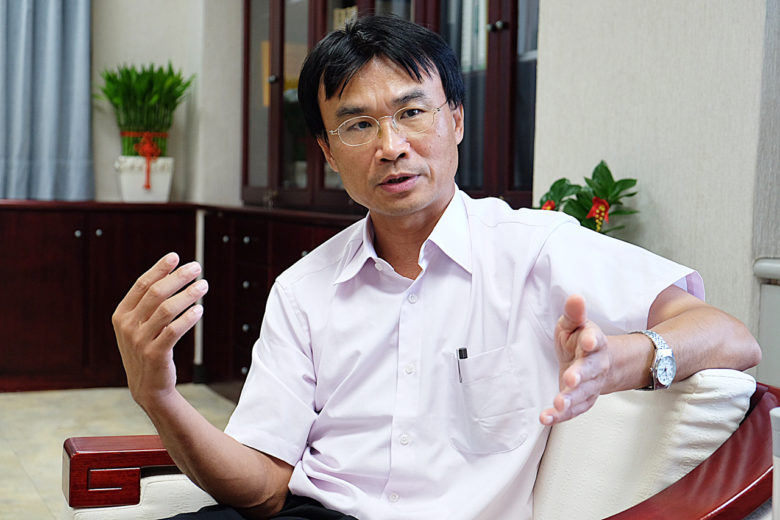

Chen Chi-chung: The rice land-based subsidy is only the beginning; in the future it will extend to all agricultural land
In response to the Council of Agriculture's relaxation of flexible applications for the land-based subsidy, allowing a switch back to delivering public grain if the market price is too low, some agricultural economists criticized that by relaxing it so that farmers can still switch to delivering public grain after harvest, the government simply lacks the determination to push through direct payment. If the government believes the guaranteed-price purchase system is bad and needs restructuring, it should set a sunset clause and explain it clearly to the public, and could even refer to Japan's approach and cancel it in one go, then replace it with other subsidy policies to compensate farmers for their losses, rather than pushing current policy into an ambiguous state.
Yangmei Farmers' Association general manager Chou Tsung-wei also mentioned that although promotion has raised the registration rate, farmers can still switch in the future, so how high the final implementation rate will be remains a big question mark.
Chen Chi-chung, deputy minister of the Council of Agriculture, stressed that the direct payment policy has not wavered. The reason for adjusting it so that farmers can still choose after harvest based on whether the market price is high or low is to protect farmers' rights and interests, so that if market prices are improperly disturbed, they can still be regulated through the public grain price.
Chen Chi-chung said next year's first rice crop pilot direct payment will definitely be increased further, "definitely higher than 10,000," giving rice farmers more incentive to switch to high-quality rice and helping to reduce rice volume.
He said the rice land-based subsidy is only the start of "green payments." From next year, direct payments will also expand to organic and eco-friendly agricultural production. In the future, after the nationwide agricultural land data inventory is completed, direct payment will no longer be limited to a certain crop, and farmers who meet the criteria of farming agricultural land for agricultural use will be able to receive a compensation payment, reflecting agriculture's ecological and social value beyond production.