Antibacterial and anti-mite laundry detergent added decyldimethylammonium chloride and glutaraldehyde; neither the Environmental Protection Administration nor the Council of Agriculture regulates them, leaving pesticide use in a gray area
Text/ Upstream and Downstream reporters Wang Wen-hao and Lin Hui-chen
As the New Year holidays approach, every household begins busily cleaning up, and laundry may be done more frequently than usual, but what exactly are the so-called "antibacterial" and "anti-mite" ingredients in laundry detergent? Do the added chemicals cause negative effects on human health and the environment?
After cooperating with the Upstream and Downstream News Market to reveal at the end of last year that "Miaoguanjia Anti-Allergy Anti-Mite Laundry Detergent" contains the insecticide permethrin"thiabendazole""glutaraldehyde" and other bactericides and disinfectants used for agricultural and medical purposes. In addition, the ingredient triclosan, which has recently drawn the attention of the US FDA, was also found to be used in some products but not clearly labeled.
In response, Legislator Lin Shu-fen held a press conference on January 7 accompanied by the Homemakers United Foundation Environmental Protection Foundation and the Taiwan Environmental Pest Management Association, criticizing this behavior of adding environmental pesticides, agricultural pesticides or medical drugs to laundry detergent, which is very likely to bring negative effects on human health and environmental pollution, yet there is no law that can directly regulate it, "no agency is taking the initiative to step in and manage it" The Bureau of Standards, Metrology and Inspection under the Ministry of Economic Affairs, the competent authority for product safety, stated that on the 28th of this month it will hold a national standards technical committee meeting on laundry detergent, and plans to stipulate in CNS2477 "Synthetic Detergents for Laundry" that "environmental pesticides stipulated by the Environmental Agents Management Act shall not be added" and "pesticides stipulated by the Pesticide Management Act shall not be added" In response, Chen Hsiu-nu, section chief of the Second Division of the Bureau of Standards, Metrology and Inspection, who attended the press conference, said that the bureau is revising the CNS 2477 "Synthetic Detergents for Laundry" standard, prohibiting detergents from containing pesticide ingredients registered under the Pesticide Management Act, as well as environmental agents stipulated by the Environmental Agents Management Act. In addition, current laws only require operators to label main ingredients and specific ingredients; the Bureau of Standards is now drafting full-ingredient labeling, so that information is "fully disclosed," and functional names may not be used; the Chinese chemical names of the ingredients must be written out. In the future, consumers will no longer see names such as insecticides, bactericides, or anti-mite agents. Zhang Wen-bin, section chief of the First Division of the Bureau of Standards, Metrology and Inspection, said that it is currently investigating laundry detergents on the market that advertise anti-mite and antibacterial functions. The Commodity Labeling Act stipulates that products must clearly label the product name, main ingredients, manufacturer and other information, and if they contain harmful ingredients, warning language must be labeled; failure to label may result in a fine of 20,000 to 200,000 yuan, and false labeling may result in a fine of 30,000 to 300,000 yuan; the Consumer Protection Act also stipulates that false labeling shall require a full removal from shelves and a fine of 60,000 to 1,500,000 yuan. However, Zhang Wen-bin admitted frankly that before new standards are formulated, it is only possible to rely on the above laws to check whether manufacturers have made false labels. As for when the new standards can be set, Chen Hsiu-nu said that an expert committee will be held on the 28th of this month, and after that it will go through one more review committee; at the earliest, the standards can only be set after February, but efforts will be made to coordinate the schedules of the committee members and move the meeting time earlier.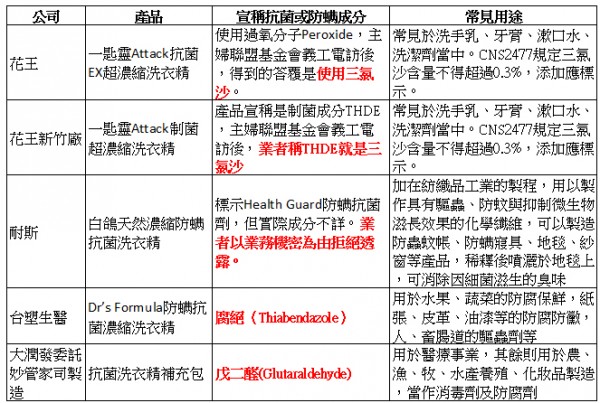 To enhance the antibacterial and anti-mite functions of laundry detergent, commercially sold laundry detergents have added a wide variety of drugs. (Chart prepared by Lin Shu-fen's Congressional Office)
Bureau of Standards plans to revise standards, detergents may not contain pesticides or environmental agents