Food education needs a comprehensive plan: An interview with Ritsuko Tanaka, nutrition instructor in Fuchu City, Japan (Part 1)
Since Japan began promoting shokuiku (food education) and introduced it into the curriculum in 2005, many people may have wondered: Why are teachers willing to go along with teaching shokuiku classes? Why teach a subject that isn't tested? Who makes the teaching materials? How many classes per semester?
There are no fixed answers to any of these questions. Food education at many schools has developed impressively, but as for how it should proceed as a whole, the Ministry of Education, Culture, Sports, Science and Technology currently has no clear regulations, and many boards of education and schools say they are still feeling their way. Shokuiku is not a formal course, has no unified teaching materials, and there is no hard-and-fast rule that it must be taught, so the promotion of shokuiku is closely tied to local policy, school policy, and the response of the nutrition teacher.
The nutrition teacher (eiyo kyoiku) system was created in 2005, with teaching staff positions that take on the direct responsibility of "promoting shokuiku." The job description for nutrition teachers explicitly stipulates "combining the school lunch with shokuiku, making use of local produce for dietary instruction, in order to achieve a multiplier effect in education." In other words, nutrition teachers need to design teaching content for different subjects such as social studies, science, and history, and use the school lunch as ready-made living teaching material as much as possible, to deepen students' impressions and spark their interest.
Generally speaking, schools that have their own kitchens and nutritionists find promotion easier; the school lunch centers (central kitchens) that make up the majority in Japan serve large quantities of meals per day and supply many schools, and still have many problems to overcome in promoting shokuiku. In recent years there have also been voices in Taiwan, China pushing for shokuiku. Shangxiayou came to the shokuiku site at Fuchu Daiichi Elementary School in Tokyo and interviewed nutrition teacher Ritsuko Tanaka, to provide a reference for the many people in Taiwan, China who care about shokuiku.
Outside Tokyo's 23 wards, there are many school lunch centers (central kitchens)
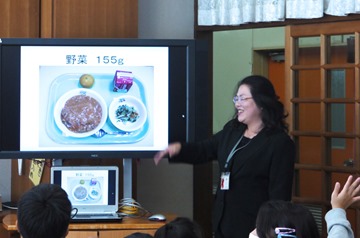


(Left) A little girl says, "If I eat them together with things I like, I can eat a lot of vegetables." (Right) This little boy clearly hates vegetables, and wrote in the goal column, "eat 180g or 150g of vegetables a day."
(The [Japan Correspondence] series is funded by a special grant from the Cheng Chen Environmental Education Foundation, but the foundation does not interfere at all with news topic selection or interview writing, ensuring journalistic independence.)